
This article is part of the Rory Smith on Football newsletter – a guide to help understand what is happening on the pitch, off the pitch, and why all of it matters.
Throughout the tournament, Rory will be travelling across America, delivering daily commentary on the biggest World Cup ever direct to subscribers. Never miss a newsletter, subscribe now here.
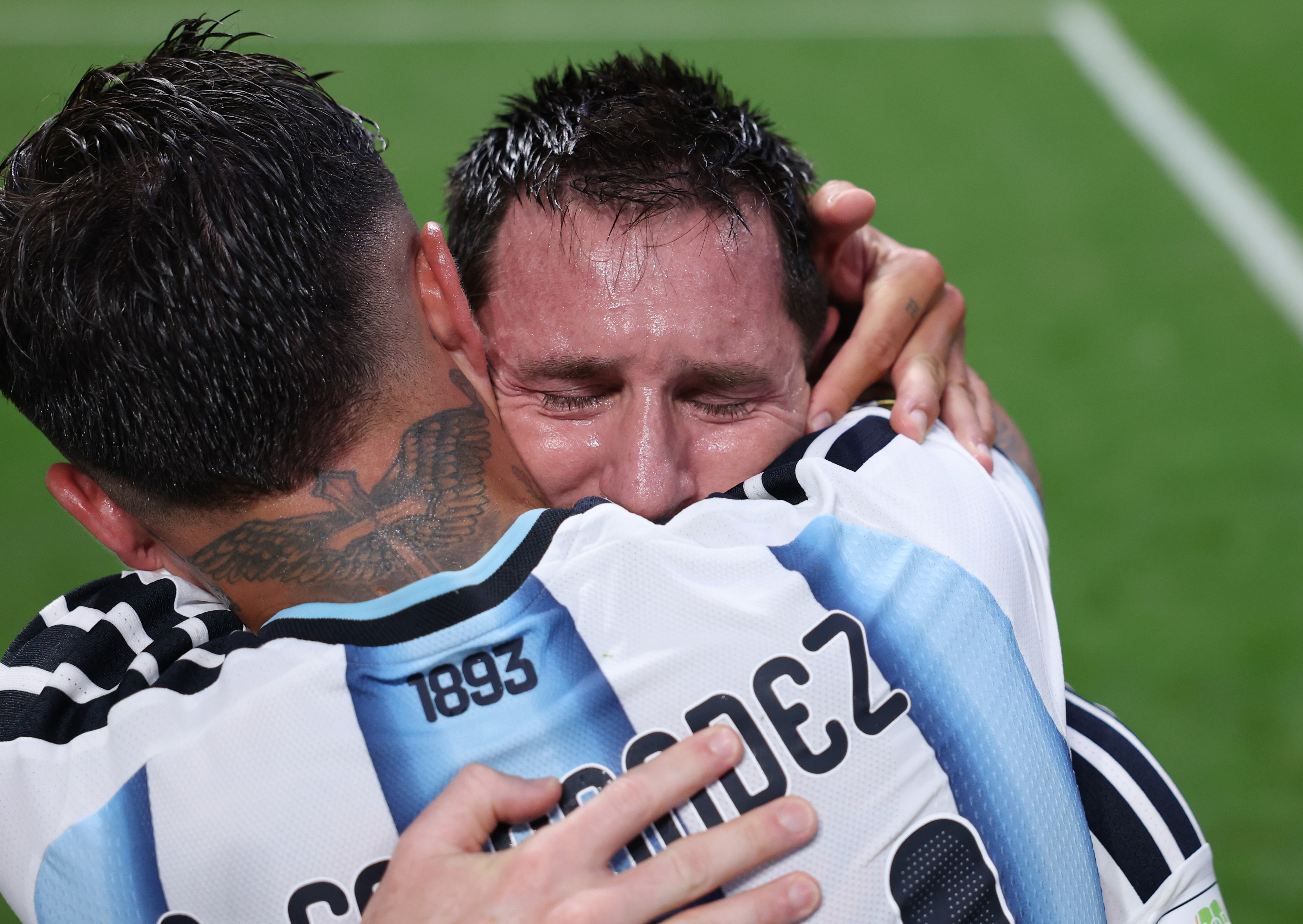
Lionel Messi looked around at what he had wrought, at his teammates celebrating with wild abandon, at his opponents strewn on the floor, at stands turned into an ocean of frothing blue-and-white, and he could not hold back any longer. The tears welled up and rushed out in great floods, the greatest player on the planet, the greatest player of all time, powerless to stop them.
Messi has never, in the course of his improbably long and his impossibly brilliant career, been especially expressive. He has always been hard to read. He plays with his brow furrowed in concentration. He smiles when he scores, and smiles when his team wins. He might even laugh. But he gives little away beyond that, a testament to a life lived in the most searching spotlight.
As he wandered around the pitch in Atlanta, though, the veneer that he has so assiduously maintained for so long creaked and groaned. Almost every member of the Argentina squad and most of their backroom staff attempted to comfort him, to dry his eyes, but to no avail. He clutched Nahuel Molina and Enzo Fernández and the others tight, and did not want to let go.
Quite what he was feeling, in that moment, only he would be able to describe with any accuracy. But at a guess, it would have been greater than joy at beating Egypt to secure a place in the World Cup quarter final, and greater than relief at avoiding what looked, at one point, like it might be one of the greatest shocks this tournament had ever seen.
Instead, it was likely closer to vertigo, that headspinning, nauseating sensation of having stared into the abyss and refused to fall. Messi had, for a few minutes, found himself at the end of the road, the end of his quest to retain the World Cup, the end of everything. Argentina were falling, falling, helpless and despairing. And then, all of a sudden, they were back on solid ground.
Quite how it happened, quite how the world champions averted disaster, is beyond explanation and beyond comprehension. There is no rhyme or reason here. When Mostafa Zico doubled Egypt’s lead in the 67th minute – completing a wonderful counter-attack, adding to a first half goal from Yasser Ibrahim – Argentina seemed to be finished.
Messi had missed a penalty. His teammates had missed a slew of chances. Mostafa Shobeir, Egypt’s goalkeeper, had decided to cosplay Lev Yashin for a day. It was only thanks to the sort of refereeing decision that Gianni Infantino and Donald Trump have made fans distrust almost entirely that Egypt’s lead was not insurmountable.
And then, out of nowhere, Argentina surged. Messi crossed for Cristian Romero to halve the lead. When Messi himself equalised, four minutes later, there was elation but absolutely no surprise. Some force, something that defies logic and defies reason, had taken hold. Enzo Fernández’s winner, deep into injury time, felt like a prophecy being fulfilled.
Newsletters
Choose the newsletters you want to receive
View more
For information about how The Observer protects your data, read our Privacy Policy
There are, doubtless, perfectly normal football reasons for why this happened. Egypt had tired; that was definitely relevant. Argentina had been able to bolster their resources from the substitutes bench; adding Lautaro Martínez, for one, gave Lionel Scaloni’s side a focal point that they had been missing. And, in Messi, of course, they have a player who is a sort of living embodiment of the concept of a difference-maker.
But none of that is enough; none of that adequately captures what it looked like and what it felt like inside the great air-conditioned dome of the Mercedes-Benz Stadium as Argentina, in the space of 13 minutes, turned the world on its head. It was, instead, a little like watching destiny unspool itself in real time.
Argentina are not, by any stretch of the imagination, the best team in this tournament. They lack the firepower of France, the cohesion of Spain, the tactical nuance of England, the reincarnated spirit of Fenrir, the dread wolf of Viking myth, who plays upfront for Norway. They are defensively vulnerable. They lack pace. They are, not to put too fine a point on it, now really quite old.
There are lots of reasons to believe that they will not retain the World Cup – including the fact that it is very difficult to do; it’s not a coincidence that nobody has managed it since Brazil in 1962 – and only two, really, to suggest they might. One, obviously, is the mere presence of Messi, a man who seems to have the capacity to bend events to his will.
And the other is the overwhelming sense of missionary purpose that seems to consume this team. They do not appear to be willing to countenance the idea that they might not win. Their principal tactic for this tournament, more than anything else, seems to be that they can lift the World Cup through sheer force of will. It is, as far as they are concerned, their manifest destiny.
There was a point, here, when it faltered. Argentina looked uncertain, for the first time, after Egypt scored their second. But as soon as they scored once, it came back in an irresistible torrent; from that point on, the outcome felt inevitable. They will not let Messi fail. Messi will not let Messi fail. Merely glimpsing it brought him to tears. He is not ready for it to end. Not yet. Not like this. Not when this is not how it is meant to be.
Photograph by Patrick Smith/FIFA via Getty Images