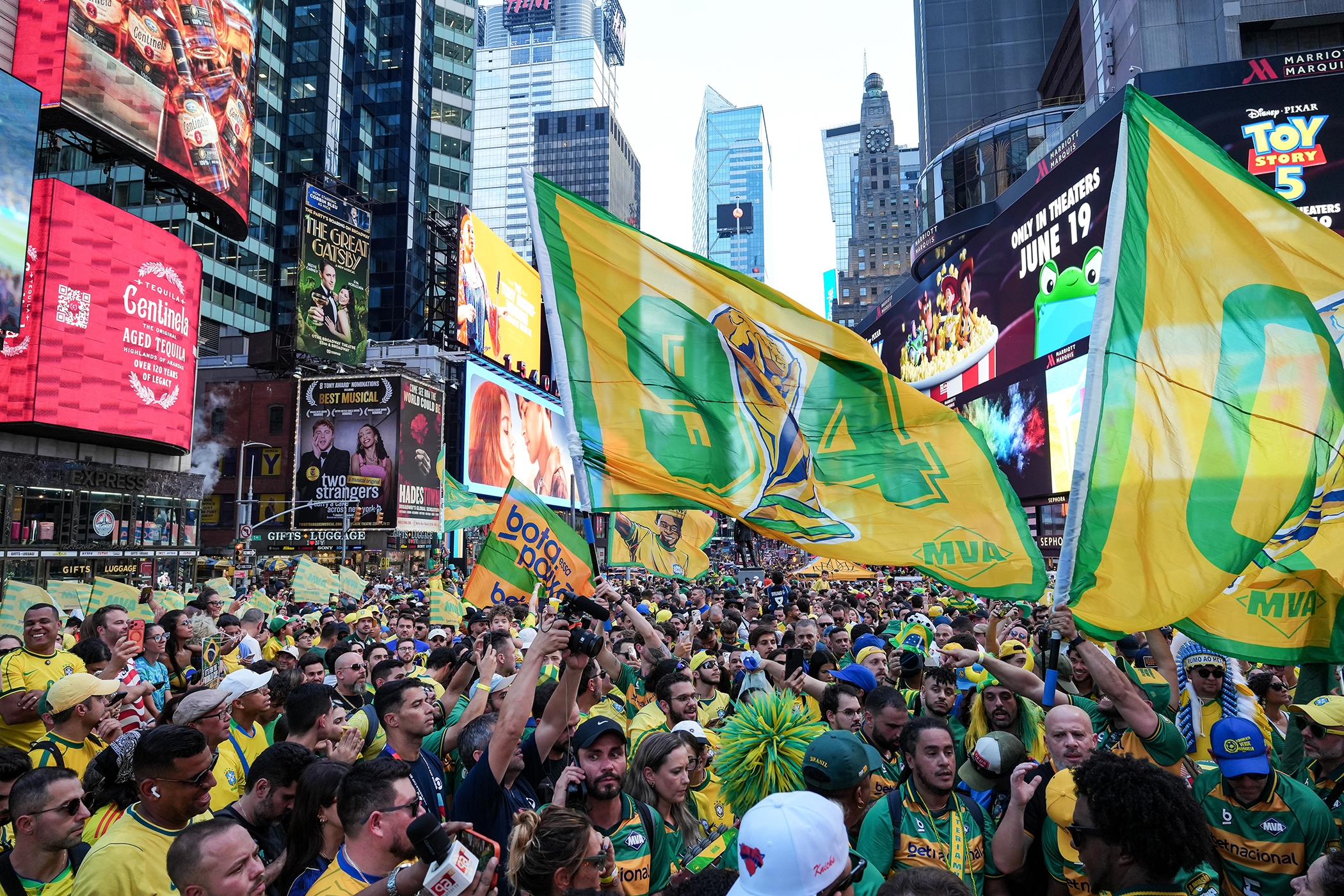

Brazil had not even played at the World Cup before their fans had seized Times Square. The day before their team met Morocco at the MetLife Stadium, they had swept into New York, a sea of yellow and green. A couple of days later, they shut down the Brooklyn Bridge. So many descended on Philadelphia’s Rocky Steps the following week that locals started calling it Braziladelphia.
This is, of course, what everyone expects of Brazil’s travelling support: drums and dancing, flags and flair. America’s complex mosaic of regional news channels invariably presented the flashmobs as naturally occurring outbreaks of Brazil’s innate party spirit. Words like “samba” and “carnival” were used with reckless abandon.
The thing about carnivals, though, is that a good one takes quite a lot of organising. The noise that bounced around Times Square and washed down from the Philadelphia Museum of Art was wholly authentic.
But it was not entirely spontaneous. It was, instead, the work of a group taking a very modern approach to ensuring that a Brazil game looks and sounds like it should. Their model is one that may well provide a blueprint for fans around the world as they seek to combat the common issues they all face: rising ticket prices, the cost of travel to major events, and the gradual sanitisation of the atmosphere that turns football from a game into a culture.
Among the tens of thousands of Brazil fans in the United States was a contingent from the Movimento Verde Amarelho (MVA), the Green and Yellow Movement, a group representing the Seleção’s most ardent fans. Some 500 or so of their 5,000 registered members have travelled to the World Cup, determined that Brazil are supported as they ought to be.
The MVA was established almost 20 years ago, a response to what a cadre of fans felt was a growing disconnect between the team and their supporters. “We decided to try to change it, by bringing people together to support the national side like people used to do with their clubs,” said Luiz Vasco, one of those founders.
“We had a lot of interest and support in 1994 and 2002, the years we won the World Cup. Then, with the lack of titles, we think people distanced themselves a bit. A lot of players also started playing abroad very early in their careers. It was hard for Brazilians to watch them play. The distance grew a little bit that way as well. The support and passion still exist, but generations that have never seen Brazil win the World Cup have a different relationship with the team.”
That, in itself, is not unique. Plenty of countries have organised fan movements who take it on themselves to corral and support at major tournaments. The Tartan Army left a far more lasting impression on this World Cup than the actual Scotland team; Dutch fans paid to have their Oranje Bus shipped to Galveston, Texas, so that it could lead their marches in Kansas City and Dallas.
What marks MVA out as different is how they have gone about it. The group has various revenue streams: they sell merchandise from their website; they have an associate programme which grants members various benefits in exchange for a fee; at both the 2014 and 2018 World Cups, as well as the 2024 Olympics, artists affiliated to the group transformed their chants into songs that proved to be viral hits.
The real innovation, though, may be the suite of corporate partnerships. MVA have agreements with a number of Brazilian companies – including Betnacional and Ifood – to help them meet the costs associated with transporting not just their fans, but their equipment, to ever-more expensive global mega-events.
Newsletters
Choose the newsletters you want to receive
View more
For information about how The Observer protects your data, read our Privacy Policy
“They know how important and valuable it is to be part of the numerous mobilisations we usually do, especially in such a positive environment,” Vasco said. “Our events during the World Cups in 2018 and 2022, as well as the Olympics, had thousands of people participating. And after that, we saw a big increase in our social media followers, both from Brazil and other parts of the world.
“That’s why [their corporate partners] want to be part of it. Sport is one of the main platforms where people from different audiences and cultures come together. It’s a great opportunity to be a part of that too.”
It would be easy to feel slightly dispirited at this, to see it as just another example of the commodified dystopia that football seems determined to create: the loyalty and the passion that the game inspires in fans has always been its most organic, and most powerful, trait; it turns out that is for sale, too.
But there is a more realistic interpretation. Both the men’s and women’s World Cup, as well as the Olympics, are increasingly out of reach for ordinary fans. The crowds in the United States over the last month have undoubtedly skewed middle-class; just as in club football, the people who come to absorb the atmosphere have squeezed out many of the people who are there to generate it.
MVA’s model offers a hint of how that might be reversed. In January, the MVA finalised a “historic” deal with the CBF, the governing body of Brazilian football, which gave its members access to “normal-priced” tickets for this tournament. Much of the federation allowance priced at $60 was directed towards the MVA.
Vasco, though, sees that as just the start. “Of course there are a lot of fans that still had to pay a lot of money for the tickets,” he said. “The amount of tickets we had through that agreement was great but it was still not enough for the amount of Brazilian fans that want to attend a World Cup game and don’t have enough money to do it.”
By working with companies, as well as the authorities, the MVA can do more than just export the frenzy of the torcida to foreign shores; they can make going to the World Cup just that little bit more realistic. “We have been fighting for these special tickets for a long time,” Vasco said. “The fans know we are working for them, that someone is thinking about them 100 percent of the time.”
Given the universality of the issue, it is something that fan groups elsewhere might like to consider; this World Cup has, after all, been defined as much by its “shoulder content” – all of that viral footage of bagpipes in Boston and Argentinians taking over Dallas – as it has the games. The corporatisation of the game is the source of the problem. It might also be the solution.
Photograph by Daniela Porcelli/Getty Images