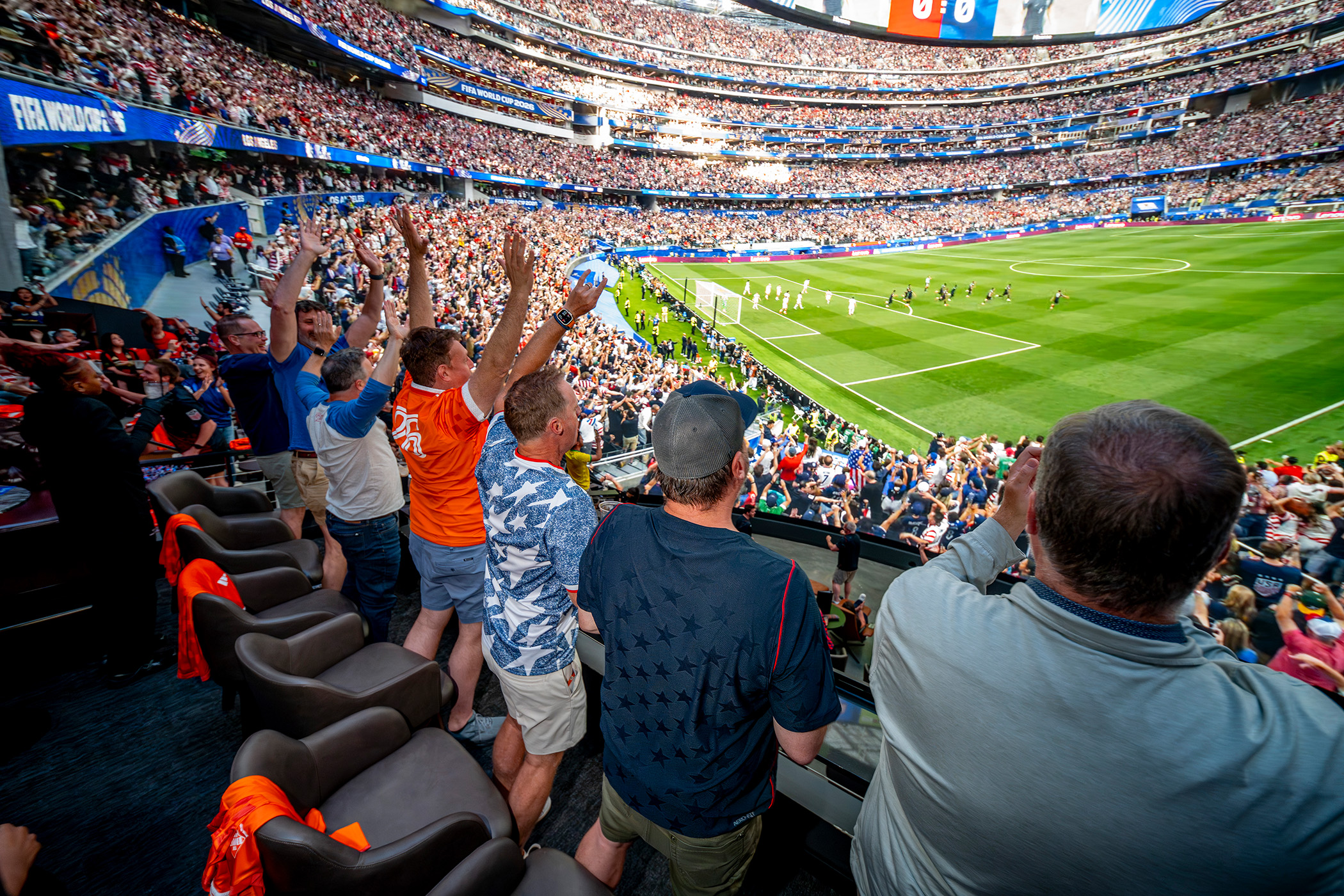




Gustavo Puerta, the Colombia midfielder, has the ball on the edge of Switzerland’s box. He glances up, takes a touch and curls a shot towards the top corner of Gregor Kobel’s goal. In Vancouver, the crowd rises from its seats in anticipation. Almost 3,000 miles away in Atlanta, as servers hurry around with shrimp tacos and smash burgers, the audience instinctively starts to do the same.
Watching beneath the vaulted dome at Cosm – an immersive theatre where football is cast onto the walls and ceiling of a digital cupola – the lines between all of those things start to blur: the stadium and the theatre, the back of the crowd and the front of the audience, the real and the simulation.
The effect is wildly technically impressive. At times, the optical illusion is so complete that it becomes genuinely difficult to distinguish between what is here and what is there. It is also deeply, disorientatingly uncanny, a manipulation of reality so convincing that it creates a sort of motion sickness, the eyes and the brain suddenly placed in violent, almost nauseous disagreement.
That does not appear to be a drawback. Cosm currently has three venues – in Los Angeles, Dallas and Atlanta – with two more slated to open in the next 18 months, in Detroit and Cleveland. The “shared reality” the company offers, the blend of the collective and the virtual, may well be the next frontier of how we consume sport.
In basic terms, Cosm can be thought of as what would happen if a planetarium and a sports bar had a baby. In more complex ones, it is a colossal, curved screen, projecting events in whatever lies beyond Ultra HD. Its transmissions are in 8K, which sounds like it should be double the 4K that broadcasters offer, but because of maths is actually much more: we are talking 15,000 LED modules and 33 million pixels, if you’re into that kind of thing.
It works, too. Cosm Atlanta sits directly opposite the Mercedes-Benz Stadium, where Argentina staged one of the great World Cup comebacks to beat Egypt on Tuesday. Watching Switzerland grind out a win against Colombia a few hours later beneath the giant screen was not, admittedly, quite as absorbing. But it was, at times, no less immersive.
“You can’t even really tell the difference between where the pitch – the real pitch – ends and where our fans begin,” Devin Poolman, Cosm’s chief product and technology officer, told The Observer earlier this year. “Part of the experience is that transporting element of feeling like you’re there in the stands, you’re with the people.”
The other is what Poolman defines as “proximity”. When a team attacks, Cosm switches to a feed from a camera placed directly behind the goal; the sensation is akin to watching a movie at an Imax, except that instead of some dinosaur or spaceship or superhero bearing down on you, it is Dan Ndoye. “You have that sense of being there, that sense of place,” Poolman said. “You have a proximity to the action that is completely unprecedented. It’s visceral.”
That is the theory. In practice, it works best as an advertisement for just how good the camera angles traditionally used for covering football happen to be. It is almost impossible to discern what is actually happening from a corner when you are placed behind the goal. It might offer a valuable insight into the perils of Kobel’s existence, but it is not an especially satisfying viewing experience.
The greater obstacle, though, is the uncanniness. The technical wizardry behind Cosm’s broadcasts is remarkable. “We do everything from soup to nuts,” Poolman said. That includes “the construction of the physical dome, the design of the LED modules, the software that drives every pixel on the display”. The commitment, too, is complete: long before their launch, Cosm bought out Evans & Sutherland, a company that was, it turns out, one of the world’s great digital planetarium builders.
Newsletters
Choose the newsletters you want to receive
View more
For information about how The Observer protects your data, read our Privacy Policy
Much of their effort, though, went into making the experience of watching a game as lifelike as possible; Cosm’s intention is that its audiences should forget that they are not actually at the stadium.
It is like watching a game live, in person, and it is also like watching a game at a bar, and so as a result it manages to be neither
It is like watching a game live, in person, and it is also like watching a game at a bar, and so as a result it manages to be neither
“We can blend what would otherwise look like small but visible seams between the [LED] modules,” he said. “We can make it look completely seamless. It looks as if your eyes are perceiving the real world because we have blended out all of the things that might throw you off otherwise.”
Perhaps that is the problem; perhaps Cosm’s display is, in its own way, too effective. It is so realistic that it creates a sensory tension: the eyes believe they are inside a stadium, but the brain knows, on some subconscious level, that the person at table 47 is waiting for their hot honey pepperoni flatbread. It is like watching a game live, in person, and it is also like watching a game at a bar, and so as a result it contrives to be neither.
Whether there is a solution to that – or if one is even necessary – is hard to say; it may just be a matter of personal taste. Or it might be to do with familiarity, with conditioning: maybe dissolving the membrane between the analogue and the digital is something that you get better at over time. (Or, like motion sickness, maybe there is an acupressure wristband that can help.)
Whether that is the case or not may have an impact that resonates beyond Cosm’s ongoing viability as a business; Poolman and his colleagues may, as it turns out, have happened upon a possible answer to a question that is of increasing concern not just to sport’s executive, money-making class, but to its architects, too.
As this World Cup has – possibly unfortunately – made clear, there is an apparently insatiable demand to experience live (elite) football in person. Fifa’s grasping and exploitative ticket-pricing strategy has, it would appear, basically worked; attendances have been far stronger than most anticipated on the eve of the tournament.
The same applies to the Premier League, where stadium occupancy regularly runs at more than 98 percent, and to the Champions League, too, where most games – certainly in the latter stages – are played to full houses. Tickets for NFL games are scarce and they are eye-wateringly expensive, even in the regular season.
There are, put simply, more people who want to attend major sporting events than will ever be able to do so, thanks to barriers of cost, geography and ultimately practicality, too: stadiums, no matter how large you make them, can only ever have a finite capacity. At the same time, our increasingly digital existence has placed a premium on collective, corporeal experiences, whether in sport or in any other form of culture.
Things like Cosm might, then, offer a way to meet some of that demand. Alex Thomas, a principal at HKS, the architects behind both SoFi Stadium in Los Angeles and the AT&T Stadium in Arlington, told The Observer last month that he believed secondary spaces would become more important in stadium design: places where fans can gather to experience games together even if they cannot be inside the ground.
His model for that was Henman Hill at Wimbledon, but it might just as easily have been the watch parties that have been staged across the planet over the course of the World Cup, whole stadiums given over to allow people to watch on vast screens. Like Cosm, these are places where the lines are blurred, between the real and the virtual, the digital and the analogue, places that exist willingly and happily in the uncanny valley between the two. We are watching on a screen, but we are watching it together; we are here, but reality is sufficiently porous that we can, even for a moment, believe that we are there.
Photograph by James Silla/Cosm