
This article is part of the Rory Smith on Football newsletter – a guide to help understand what is happening on the pitch, off the pitch, and why all of it matters.
Throughout the tournament, Rory will be travelling across America, delivering daily commentary on the biggest World Cup ever direct to subscribers. His colleague George Simms will report alongside him. Never miss a newsletter, subscribe now here.
In hindsight, the vibes were too good. Atlanta’s Mercedes-Benz Stadium shouldn’t work – from the inside it looks like someone constructed a flat-pack stadium inside a stripped-out shopping centre – but it is curiously majestic, a hodgepodge of the best bits of all the best American stadiums. Fans were having a Very Nice Time, swaying in the air conditioning to House of Pain and Rihanna, and hoping. Even the media centre was serving ice cream with assorted sauces and crumbled oreo. This was never going to last.
Enter England. We should know by now this isn’t often going to be fun or relaxing or even particularly entertaining. It’s going to hurt. They haven’t played 90 convincing major tournament minutes since Qatar. But perhaps the greatest cause for concern is that the draining, unruly saga that unfolded in Atlanta was everything functioning as Tuchel intended. Pre-match he said this was not the time “to expect glamorous performances,” called it “the moment to get the job done, to show individual quality.”
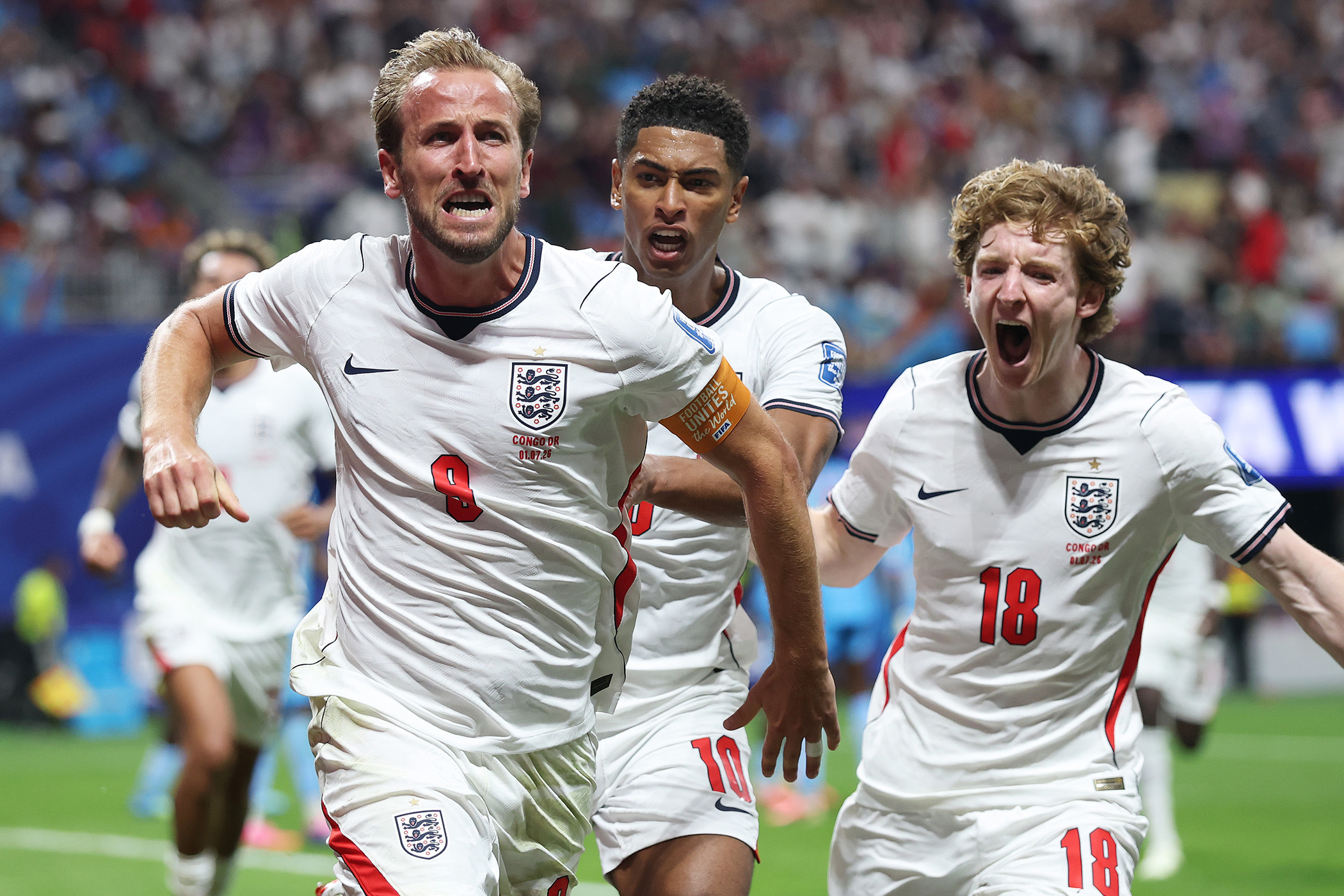
And so the individual quality arrived once more. This is now a team that has Bellingham days, Kane days and bad days. Harry Kane has always seemed an odd protagonist, as if Superman’s day job was middle manager at a regional accountancy firm. But here he was once again, leaping sixty feet in the air and firing laser beams at Chancel Mbemba from his eyeballs, carpe-ing the diem and throttling it into submission.
Kane is in divine form, his imperial phase at 32, these the latter days of the second-most prolific season for both club and country since coherent records began. These were his 71st and 72nd in 62 games, surpassing Lionel Messi in 2012-13 and Cristiano Ronaldo the year before (both 69 in 60). The arguments that he is not the greatest English footballer ever basically amount to how he makes you feel, to club biases and personal preferences, to grainy childhood memories. He has been the defining player of England’s greatest sustained period of success. No man born after 1940 to have won more than one cap has scored at a quicker rate for England than Kane. The winner on Wednesday was his 11th goal in a major tournament knockout game, having now scored more World Cup goals than all but five men: 13 in 15 games, scoring quicker than Messi and Ronaldo and Pele. He is England’s record scorer by 31, as many international goals as Jimmy Greaves and Michael Owen combined, more than twice as many as every player to have represented England this century bar Wayne Rooney. An underrated funny outcome is that Messi and Kylian Mbappe spend five weeks warring like ancient gods and Kane, a genius simultaneously accidental and forged by consummate force of will, wins the Golden Boot.
Of course, a decade ago Kane started against Iceland, and there was Big Iceland Energy here, glimpses of a timeline featuring riots and resignations and accusations of German spying. Yet the Kane-wave still felt somewhat inevitable. England didn’t manage a shot until the 30th minute, but finished with eight on target. Lionel Mpasi, whose day job is being Le Havre’s back-up keeper, had one of those transcendental halves that middling goalkeepers sometimes have, the perfect confluence of ability, opportunity and luck, but it never felt wholly sustainable. Sometimes this is about process and repetition and trust. Tuchel likened it to smashing a rock. Doing the same thing and expecting different results isn’t always insanity. England attempted 35 crosses from open play, their most in a World Cup match since 1966, but one created the first goal.
And Tuchel’s in-game alterations did work: Anthony Gordon creating both goals as a substitute, Nico O’Reilly effectively used as a second striker for most of the second half and occupying three defenders for Kane’s opener. There’s a necessary caveat that three of England’s best five players – Declan Rice, Bukayo Saka and Reece James – are either unfit or entirely crocked.
The facts underpinning all this is that building a sustainably coherent international football team is essentially impossible; the challenge is to be the least muddled, to have the fewest obvious weaknesses. You don’t have either the requisite time or control. Gareth Southgate was in charge for seven years and still only achieved it in glimpses. It takes time for viewers to readjust to this reality every two years after the comfortable patterns of the club game. This is how, after 18 months of planning, you end up with Djed Spence and Noni Madueke aeons apart down the right, looking like they spend most of their time digging each other out on social media, because they do. This is how Kane and Bellingham can so easily return to looking as though they are playing different games. The difference between national eras rising and falling is often one goal, occasionally two.
So now the World Cup Tuchel believes he is paid £5m a year for begins, the one he has brought Madueke and Spence and Ivan Toney all this way for, the one where England have to do more than pierce endless waves of bodies. Few English footballers ever have been good at leading and dominating, and playing Mexico in Mexico will help England manufacture the false belief they are underdogs, that they are facing some great industrial foe, not a team led by someone who’s just signed for Wolves.
Newsletters
Choose the newsletters you want to receive
View more
For information about how The Observer protects your data, read our Privacy Policy
But the vibes are back once more, Wonderwall already engineered into a snackable content factory, Kane forced to pretend he is as moved as he was the first time. As so often, this was a Kane day. What will Sunday be?
Photograph by Richard Pelham/Getty Images