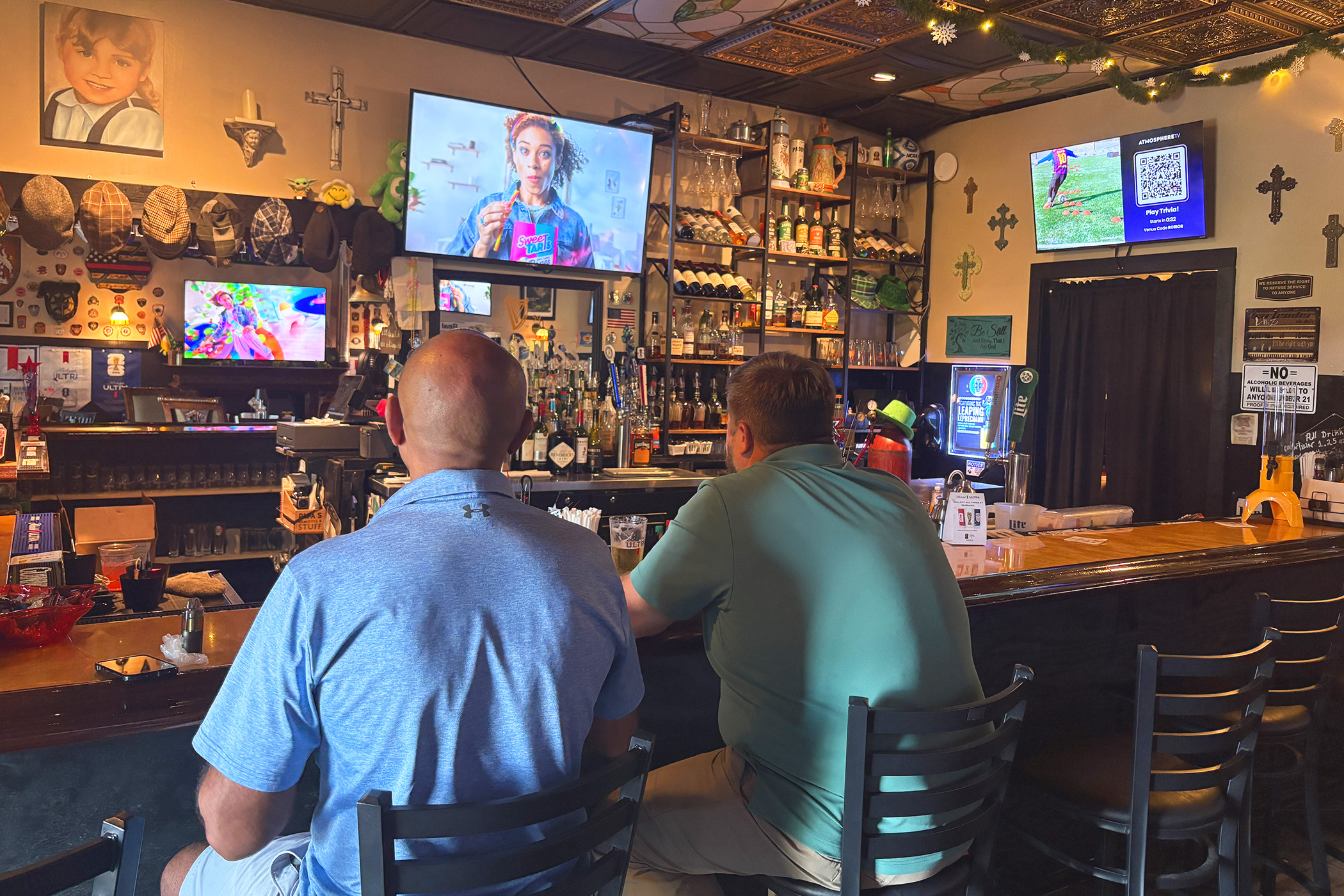

Wednesday night has been trivia night for as long as Oh Sherri has been open. The pub, tucked away in the corner of a strip mall along the road between the sleepy Alabama towns of Leeds and Moody, is reliably packed for the quiz. Eager teams of locals crowd round the tables that the owners, Joel Wallace and his wife Diana, made by hand.
Last week, though, they had a problem. Oh Sherri also serves as home base for the devoted and sizeable football community in this corner of Alabama. On Saturday and Sunday mornings, a few dozen descend to watch the Premier League; over the last few weeks, they have done a roaring trade for the World Cup, too.
And that meant a clash for the United States’s game against Bosnia-Herzegovina in the round of 32. “We’ve been jammed for all the US games,” Joel said. “Every table taken.” He knew, though, that cancelling trivia night would invoke fury. “That will stay inside,” he said. “But we’re going to put tents up with screens outside, so people can watch the game.”
To suggest that Oh Sherri is something of a surprise would be an understatement. Over the last few weeks, battalions of journalists have been dispatched across the United States to answer the question that has haunted Europeans, in particular, for generations: does the US like, or in fact not like, football yet?
These random and wholly unscientific samples have been characterised as more reliable than actual surveys, which have found that when Americans are asked to name their favourite sport, soccer now generally comes third. (This format is, admittedly, deeply unhelpful, because it neglects to mention that it is possible even for an American to like more than one sport equally.)
They have also been treated as somehow more telling than things like facts. About five times more people watched the opening USA game of the World Cup compared with ice hockey’s Stanley Cup finals. Nobody is wandering about asking passers-by if the US likes ice hockey.
Or basketball: more people watched that game than the NBA finals series that delivered the New York Knicks a first championship in half a century. Mauricio Pochettino’s team drew an audience of 22 million for their other group games. Around 9.6 million viewers, on average, watched each group phase game on either Fox Sports or Telemundo. It feels, deep down, like we know the answer.
But there is no point denying that some areas of this country have traditionally been not just resistant to soccer’s charms, but vehemently ideologically opposed. “I don’t remember it ever being seen as socialist or un-American,” said Sonny, sitting behind the counter of Don’s Pawn & Jewelry Store in Heflin, a neat one-street town just off the I-20, the highway connecting the sprawl of Atlanta with Birmingham. “But people did see it as maybe an Olympic sport.” This is, you sense, something of a euphemism.
Nowhere might that view have been expected to endure more than in Alabama in general, and this stretch of it in particular. The state as a whole is college football country in tooth and claw , its ardent loyalties split between the institutions of Auburn University – in its southeastern corner – and Alabama State, based in Tuscaloosa, further north and west.
Its other great claim to fame is Nascar, a sport that could be seen as acting as the antithesis to soccer in the American imagination. Half an hour outside Leeds, the grandstands of the Talladega Superspeedway are visible from the highway. There is a track for dirt racing next to it.
Newsletters
Choose the newsletters you want to receive
View more
For information about how The Observer protects your data, read our Privacy Policy
And it is avowedly, increasingly Republican, too, swinging that way in every presidential election for half a century, but appears to be growing even more entrenched in its preferences. The GOP’s candidate has taken the state by 20 points since 2004; in 2024, Donald Trump claimed it by a margin of 31 points.
In Cleburne County, centred on Heflin, 91% of the electorate went for Trump in that election. St Clair County, where Leeds partly sits, was more of a contest: just 81% voted Republican.
It does not take long to notice that this is Maga country. A tattered Confederate flag hangs, rather sadly, by the roadside, advertising something called Dixiefest; at Don’s Pawn & Jewelry – the fact it also sells guns does not apparently need to be made explicit – display cases feature not just ammunition boxes but Trump 2024 hats. There is a flag declaring “Jesus Loves You” and a sign reading: “In this place, we always salute our flag, support our troops, buy American, say ‘Merry Christmas’.”
The iconography is a little more subtle at Oh Sherri, where the Stars and Stripes flies outside along with the flags of Ireland, Scotland and Poland. Tucked away on the bar is a picture of the current president, as well as a custom dollar bill featuring his face. In the restaurant area, there is a small figurine, too, his hands outstretched and his middle fingers raised.
But it is just a glimpse; the defining aesthetic is not political. Instead, Wallace has decorated the pub he opened after the pandemic with the paraphernalia he has collected in his 30 years as a college soccer coach and lifelong soccer fan: framed Celtic shirts, images of David Beckham, scarves from Valencia and AC Milan and Real Madrid. “They’re all the stadiums I’ve been lucky enough to visit,” he said.
He is still occasionally ribbed, as he put it, by some of his regulars about his love for a “boring” sport; every so often, when a Premier League game clashes with a major college fixture, there will be some debate about which should take precedence on the pub’s largest screen. “But everyone knows it is Joel’s TV,” he said.
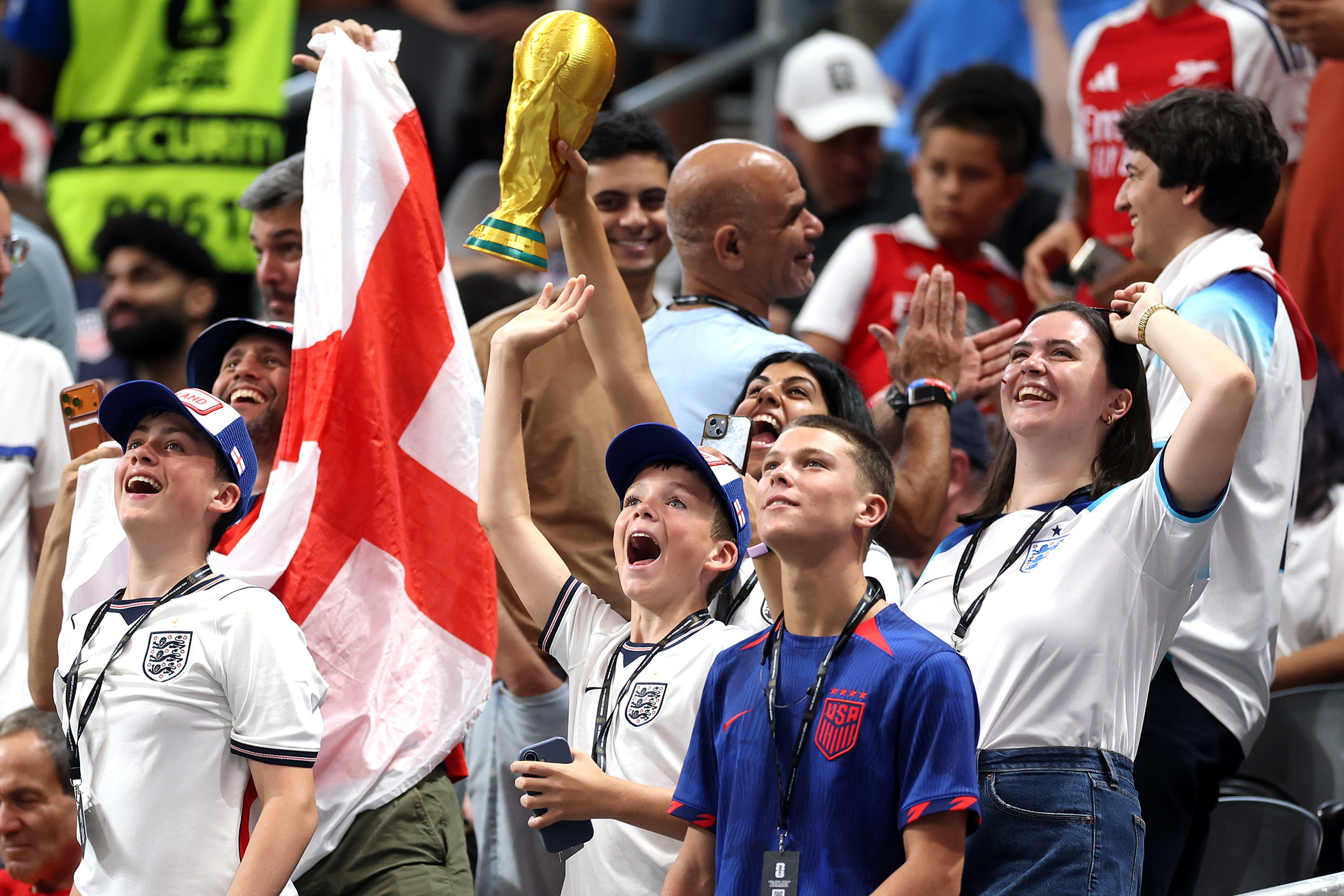
“If there was resistance to soccer, it’s gone,” said Casey, sharing a long lunch with his friend, Viran, at the pub. “Everyone’s kids play. As my daughters have played, I’ve gotten more understanding of it. I see the game better.” Together with some friends from Mississippi, he had bought tickets for England’s game with DR Congo in Atlanta on, as well as this week’s last-16 fixture.
That was Sonny’s view, too, more or less. “Oh, I’ve been watching it at home,” he said of the World Cup. “I’ve been enjoying it.” This is not a recent development; he has not picked up an interest because of Trump’s initial attempts to politicise the tournament or because the sport now seems to have the president’s approval.
“I’ve liked soccer for a long time,” Sonny said. “I keep up with how the team in Atlanta is doing. There’s a good meeting [of fans] around here. Definitely much more than you would probably think.” This is just a little pointed, too; he knows the stereotype of the place that he lives, what we expect.
This corner of Alabama, though, confounds that. Politics and personal interests are distinct. People are complicated. Places do not work as we assume they might. Speaking to Joel, Casey and Sonny is not especially necessary to prove that. There is a pub that proudly displays a Valencia scarf in the heart of Magaland. That says more than any one person, chosen at random, ever could.