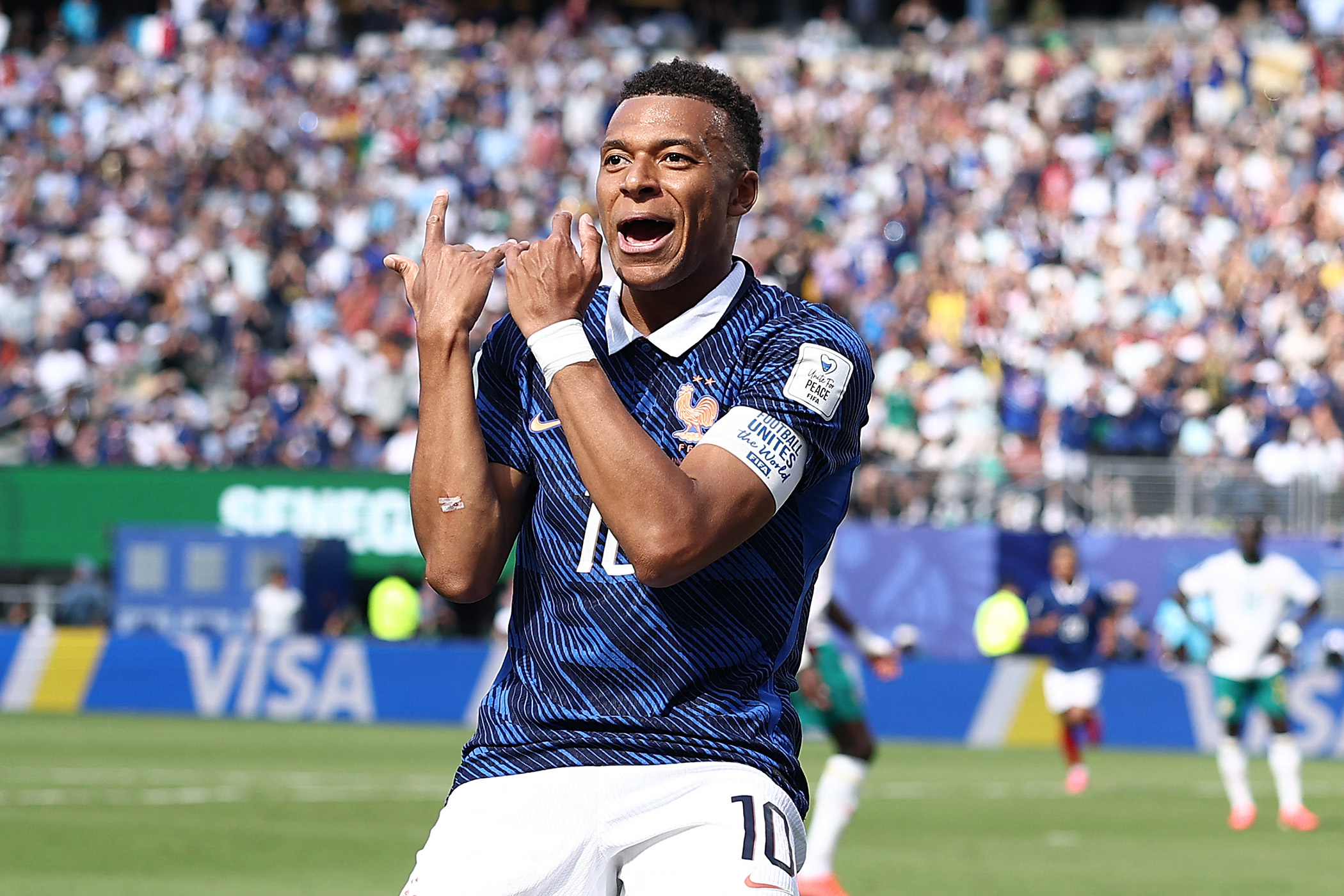

The night Kylian Mbappé won the World Cup was the same night he realised that was not enough. He was, at that point, 19. He had just become the second teenager to score in a World Cup final. The first was Pelé. He had accomplished the one thing, more than any other, that he had set out to achieve.
And yet, as he told France Football not long afterwards, he was “already thinking about the next one. The emotions, the thrills are so strong that you want to taste them again as soon as possible. I want to experience it again.” Most footballers, he said, would regard lifting the World Cup as their crowning glory. “Not me.”
Mbappé has always been assiduous in curating his own mythology. It is one of the very many ways in which the 27-year-old seems not so much old for his years as timeless. We have the opportunity to watch most players, even among his peers in the polished ranks of the world’s best, change and blossom and grow. Mbappé appears to have been fully formed at 17. He suddenly just was.
In the official telling of his history, the one that Mbappé and his family have carefully constructed and protected for the last decade, that can be explained by the sort of relentless, hyper-focused mindset that meant his reaction to winning the World Cup was to think about how good it would feel to win another one. This is, of course, an elite mentality. It is also ever so slightly sad.
Everyone knows the stories. Most of them are the sorts of stories that feature in the childhood of every single footballer anyone has ever heard of, and millions more children that they have not. The kid who always carried a football with them, and got told off for kicking it in the house, and who couldn’t concentrate at school because they were so busy thinking about football.
Later, once a player becomes successful, these details are retrospectively weighted with meaning, presented as though they are conclusive evidence as to why they made it through. The essence of these fables can, by and large, be boiled down to little more than “talented adult was also talented child”.
Admittedly, in Mbappé’s case, these stories are slightly more extreme. There is the one about him drawing a picture of himself on the cover of Time Magazine while still a teenager at Monaco, and the one about him learning Spanish as a child so that he would be able to understand what was going on at his Real Madrid unveiling.
And there are the ones collated in Julien Laurens’s biography of the forward, a surprising number of which focus on his relationship to the 1998 World Cup. Mbappé, the author writes, regarded being born in the same year as that triumph as “a sign of destiny”. As a three-year-old, he learned the words to La Marseillaise by watching the French players singing it with their hand on their heart. He watched Les Yeux dans les Bleus, a documentary exploring that triumph, on repeat as a teenager. He knew the names of the squad off by heart, right up to back-up goalkeeper Lionel Charbonnier.
Laurens’s book is one of two brought out in English on the eve of this World Cup. His is a traditional biography; the other, Philippe Auclair’s The Mbappé Project, is more conceptual, exploring how and why Mbappé has been able to remain so steadfastly unknowable, so deeply enigmatic, despite the white heat of his impossible fame.
“However remote we are from the stars we see flicker on the screen, I believe that we are closer to them than we are to Mbappé, who gets to act in the flesh in front of tens of thousands of fans but never sets foot in our shared reality, unless it is reality of a virtual kind, fragmented and conditioned to suit the purpose of others,” as Auclair puts it.
Newsletters
Choose the newsletters you want to receive
View more
For information about how The Observer protects your data, read our Privacy Policy
The timing of both books, though, is instructive. Mbappé is, by any definition, one of the most prominent players on the planet. He was the face of phase two of Paris Saint-Germain’s project for world domination, the phase just before it actually happened. He is the brightest of Real Madrid’s Galácticos. Both Laurens and Auclair assert that he is the best player in the world. That is obviously subjective. But it is not an outlandish position to hold.
And yet, with every passing season, his moment seems to pass him by. Mbappé has never won the Champions League. He has only ever played in one such final, the year it took place behind closed doors. He has never won the Ballon d’Or. It is easy to say with hindsight, but he remained at PSG too long. He has had roughly the same effect on Real Madrid as everyone anticipated.
His reputation has started to suffer. A statistic bubbled around towards the end of the club season suggesting that no player in any of Europe’s top five leagues had failed to sprint and track back and offer defensive cover more than Mbappé in his first year at Madrid. There have been suggestions of a rift with other players in the squad.
Through all that time, others have been coming to take his place. Ousmane Dembélé, his theoretical replacement at PSG, won the Ballon d’Or last year. Erling Haaland is regarded as the best striker in the world, Lamine Yamal the best player. Often, now, when we think of Mbappé at club level, it is in the context of being a problem.
The reason that not one but two books have been released now, though, is that Mbappé remains a defining World Cup figure. This is the point, every four years, where he reminds us what he can do. He might, in fact, be the quintessential World Cup player now, a strand that has died out in recent years as Europe has gobbled up all the talent it can find from the rest of the planet.
This tournament, though, seems unerringly to bring out the best in Mbappé; it is, quite possibly, now the only place where we reliably see what he could have been, what he was supposed to be. In many ways he has become the archetypal World Cup player, a star ascendant for one month every four years, his renown built on his exploits when the entire planet is watching.
Maybe that is because this is the competition he has craved, more than any other, since he was a child; that is, most likely, the version that Brand Mbappé has been crafted for you to think. Or maybe it is because he is so driven by the need to recapture the feeling he had back in 2018, because he craves another hit.
Or perhaps it is because the World Cup is where he is free of all the frustrations that have dogged him, wherever he has played, at club level; it is a tournament where all of his associations are positive. He has played in two and made two finals. It is here that his reputation has been forged; it is here that he seems most comfortable. It is here, more than anyone else, that Kylian Mbappé becomes himself.
Photograph by Charly Triballeau/AFP via Getty Images