Bryson DeChambeau was treated gently by the Birkdale crowd for his two-shot penalty for trampling grass on Friday – but Rory McIlroy was unforgiving, calling DeChambeau’s behaviour in disputing the punishment “performative” and accusing him of “holding the tournament hostage”.
It’s golf’s big crowds that are giving the authorities cause to worry. A growth in abusive shouting prompted the R&A to introduce a new code of conduct for this Open Championship. Instead it was discord in the clubhouse that had them reeling on the third day, with back-to-back Masters champion McIlroy channelling locker-room anger at DeChambeau for delaying the release of Saturday’s tee times while he was disputing a two-shot penalty for trying to clear long grass from the path of his backswing.
In a sport constrained by etiquette and protocol, McIlroy’s attack on DeChambeau was unusually fierce. “I was up in the players’ lounge watching it with a few other players, and as soon as he made the step into the ball, we all sort of looked at each other, and we were like: That didn’t seem right,” McIlroy said after his own Saturday round of 69.
“Then when I heard that he was called in by the rules officials, it was pretty obvious why. I think there’s no doubt that he improved the line of his backswing. Again, it’s like, whether it was careless or whether it was intentional, I don’t think it matters. Hopefully it was careless, but I think the two-shot penalty was justified for sure.
“[It was a] late night for everyone. I won’t pretend to be up here and defend Bryson. I’m not particularly fond of him. I think a lot of it’s performative. I think a lot of it’s for attention. To hold the tournament hostage like that, and to have all of us, players, volunteers, everyone waiting on him to depart, I didn’t feel like it was a great look.”
When DeChambeau stamped on the long grass on his second round, it bounced back up. Any gain was minimal. But to the R&A’s enforcers, that wasn’t the point. It was the intent they punished. On “moving day”, DeChambeau was cast as the bad guy to Tommy Fleetwood’s darling of the masses. Often nowadays American stars can expect help from on high, but Donald Trump didn’t bother to pick up his phone to get DeChambeau off the hook.
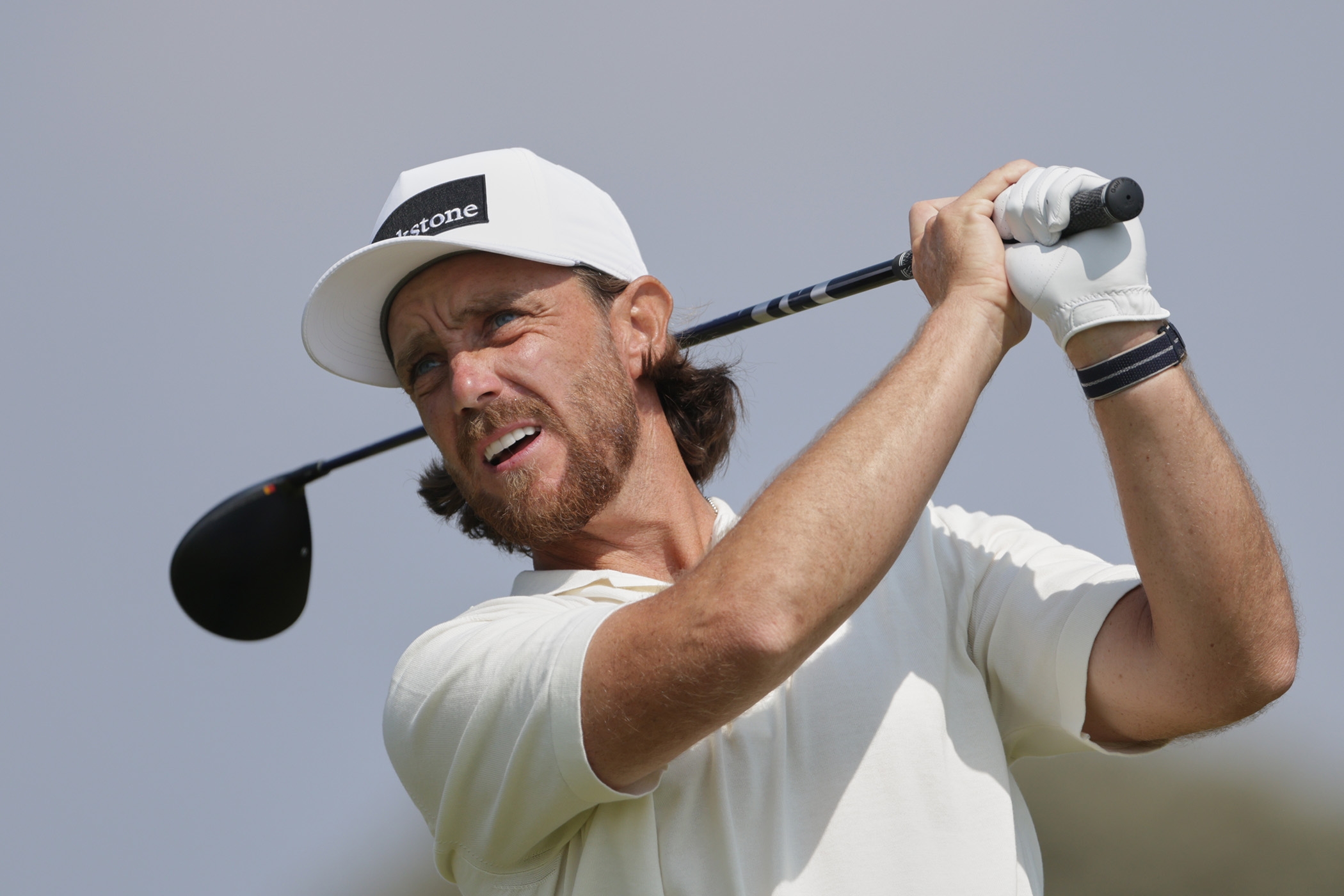
By the time that McIlroy had piled in on him, DeChambeau was on the front nine with his impressive playing partner, Sam Burns. The Birkdale crowd couldn’t match McIlroy’s indignation. Besides, they only had eyes for the “hometown kid”, whose hopes of winning his first major, on the perfect stage, remain intact but fragile after he missed a birdie opportunity at 14 and bogeyed 15 and 18.
As Fleetwood was about to tee off on the course he snuck into as a child, one of four marshalls patrolling the round turned to his colleagues and said: “This is going to be a rowdy one.”
Fifty-five minutes after guttural shouts of “Go on, Tommy lad”, the huge Birkdale gallery surprised officials braced for a hostile reception for DeChambeau with cries of: “Go on, Bryson lad.” A later cry of “Careful Bryson, watch where you’re standing”, didn’t qualify as cruelty.
The local fervour for Fleetwood you keep hearing about isn’t a media construct. The idea of a kid from up the road who once begged for autographs on his local course ending up as Open champion is almost too melodramatic to script.
Newsletters
Choose the newsletters you want to receive
View more
For information about how The Observer protects your data, read our Privacy Policy
It’s all there: the father sawing down a club for him when he was five, the illicit dart through the trees of Royal Birkdale so they could play the fifth hole. Local-idol syndrome has seldom been more pronounced. Fleetwood is as rooted and relatable to the golfing folk of Southport and this coast as the great footballers born on Merseyside are to the people of Liverpool a 40-minute train ride south.
This isn’t a celebrity returning to his hometown to pay polite homage to an old life escaped for a better one. Fleetwood’s coaches live near Birkdale and the Tommy Fleetwood Academy is part of Formby Hall, along the strip of clubs on the parched landscape stretching south towards Liverpool.
Whenever The Open comes anywhere near his old Southport home, Fleetwood is expected to fulfil his destiny and bring home the Claret Jug. The expectation first attached itself to him at Royal Liverpool in 2014, then again at Birkdale three years later, when the “Go on, Tommy lad” refrain was born; then for a third time back at Royal Liverpool in Hoylake in 2023. Runner-up, at Portrush in 2019, was his best Open finish. A first major win had still eluded him when he arrived this week to find an expected record crowd of 300,000 yelling him on.
Not a good week to be carrying English expectation. For 60 years, with the England men’s team, read 34 years in Open golf. The last English champion was Nick Faldo in 1992: a hiatus Justin Rose, who finished fourth here in 1998 as a 17-year-old amateur, describes as “a curse”. Tony Jacklin, the winner in 1969, calls it a “crazy thing” that “boggles the mind”. All of Faldo’s three wins were scored in Scotland.
There have been recent English winners of American majors: Justin Rose, Danny Willett, Matt Fitzpatrick and Aaron Rai. And Open champions from Scotland: Sandy Lyle and Paul Lawrie. And two from Northern Ireland: Darren Clarke and McIlroy. But English players continue to fall short in conditions that many of them grew up in, with links golf often to the fore. Links courses in this country bear no relation to the Arcadias of the PGA Tour across the Atlantic, yet four of the last five Open winners have been American.
Not everyone is a fan of looking at lists of champions through nationality’s prism. Equally, there’s not much wrong with hoping that a homegrown golfer might win the most prestigious prize that country has to offer. With Fleetwood, this yearning is sharply local as well as national.
His dad Pete finds the crush so off-putting that he prefers to watch his son from a “quiet place” nearby. But Tommy says it was the passion of the crowd that put him in contention, four shots off Lucas Herbert’s lead, heading into Saturday’s third round.
“They’ve been an absolute pleasure to play in front of for these two days,” he said. “I love that I played some good golf there and gave them something to cheer about. A hundred percent, they make a big difference to me. You can’t ask for any more than what they’re giving me.”
On a day when New Zealand’s Ryan Fox became the third player of the week to shoot a lowest-equalling all-time score of 62 in men’s majors, the words of Lucas Herbert, who fired one on Thursday, summarised neatly Fleetwood’s struggle to carry such vast local expectation. “I haven’t won a major yet,” Herbert said, “but I’m assuming what people feel winning a major championship is so euphoric because of the anxiety and the stress you have to deal with – and still be able to execute world-class golf shots.”
Fleetwood, who has top-five finishes in all four majors, bears it well. Merseyside Open Championships though intensify a question often asked of him: whether he has the killer instinct to graduate from contender to major champion. The crowd round the 18th green believe he has, even if his round petered out with a bogey, while the stands shook with support for him.
DeChambeau meanwhile didn’t look like such a cartoon villain when he left the practice ground and hugged, fist-bumped and posed for photos with youngsters, all dressed like schoolboy pros. By a gate that leads to the first tee stood a boy who was maybe 10 or 12, desperate for autographs, saying “Have a good day” to everyone who passed.
The boy had a mullet beneath his baseball cap, and was the spitting image of another who stood by the Birkdale clubhouse more than two decades ago, eager to fill his autograph book. Here, in 2026, was a mini-Tommy Fleetwood.
Photograph by Peter Morrison/AP