
Gianni Infantino really cannot help himself. Earlier this year, he took to the stage at the World Economic Forum in Davos, Switzerland. In his hands, he idly stroked the official ball of the 2026 World Cup. A little to his left, the World Cup trophy sat on a plinth, polished and perfect.
The Fifa president is in his element in these situations: in a room full of the sorts of Masters of the Universe he considers his peers. He was here, he said, to talk about football, but first he wanted to congratulate everyone. “Congratulations,” he said, “because you are participating in this year’s best meeting at the World Economic Forum.”
Given that Davos this year hosted dozens of world leaders, the cream of Silicon Valley’s technocracy and will.i.am from The Voice, that is quite a claim. But it is also how Infantino thinks. Whether it is a meeting in a conference room in Switzerland or the world’s ultimate mega-event, everything has to be the best, or the biggest, or the greatest.
In public, at least, the 56-year-old has largely reimagined the office he has held for the past decade – ever since he was elected as a milquetoast consensus candidate in the aftermath of Fifa’s belated encounter with the FBI in 2015 – as a sort of sales job. It might be imagined that the World Cup, at this stage, by definition speaks for itself. Infantino does not seem to agree.
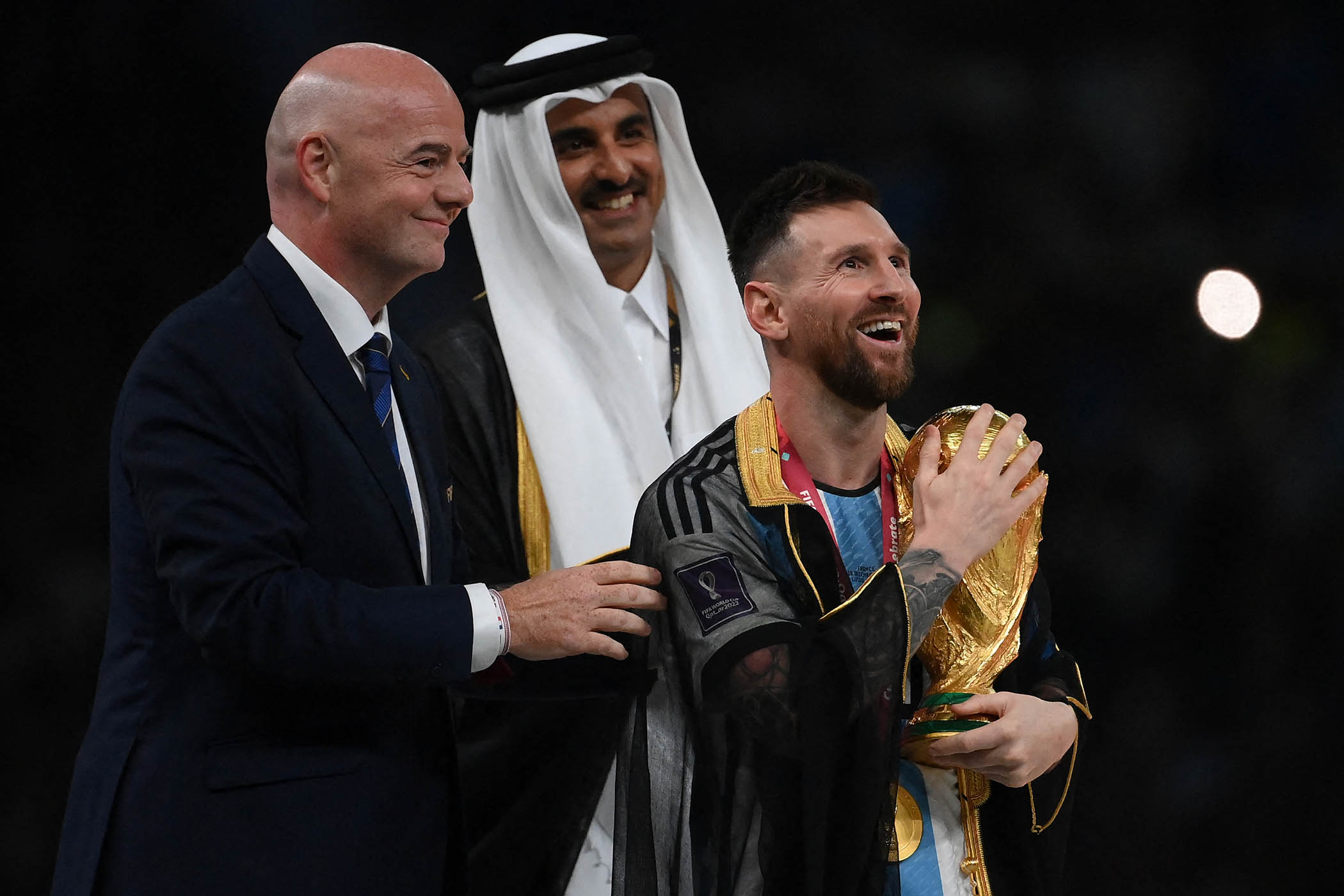
Instead, he has spent the three and a half years since the end of the Qatar World Cup – which he closed by declaring it the “best ever” – telling anyone and everyone exactly how amazing this next one is going to be.
His favourite line, for a while, was insisting that it would be the equivalent of “104 Super Bowls”. As he did at Davos, he insisted last week that it would be “the biggest, most inclusive and best” tournament of all time. (Infantino, like his close friend President Donald Trump, appears to regard “biggest” and “best” as synonyms.)
The effect of Infantino’s relentless carnival-barking started off at unbecoming, passed through gauche and cringe-inducing, and now oscillates between numbing and nauseating. It has served, somehow, to cheapen the majesty of the event Fifa is meant to protect. But the most galling thing of all is that, ultimately, Infantino will probably be proved right.
As a gauge of the power of the World Cup, it is hard to beat the fact that it has managed to survive everything that has been thrown at it over the last few years, not least from Infantino and Fifa – an organisation that now trails in his wake, learning about policy shifts from his Instagram account and passing its approval for his leadership by acclamation, like a well-paid Politburo – themselves.
As well as Infantino’s unabashed and undignified pitching, here was the expansion from 32 to 48 teams, a move designed not only to increase profitability but to keep as much of Infantino’s voting public as happy as possible, despite the fact that it turns the tournament into a bloated, slow-burning monster.
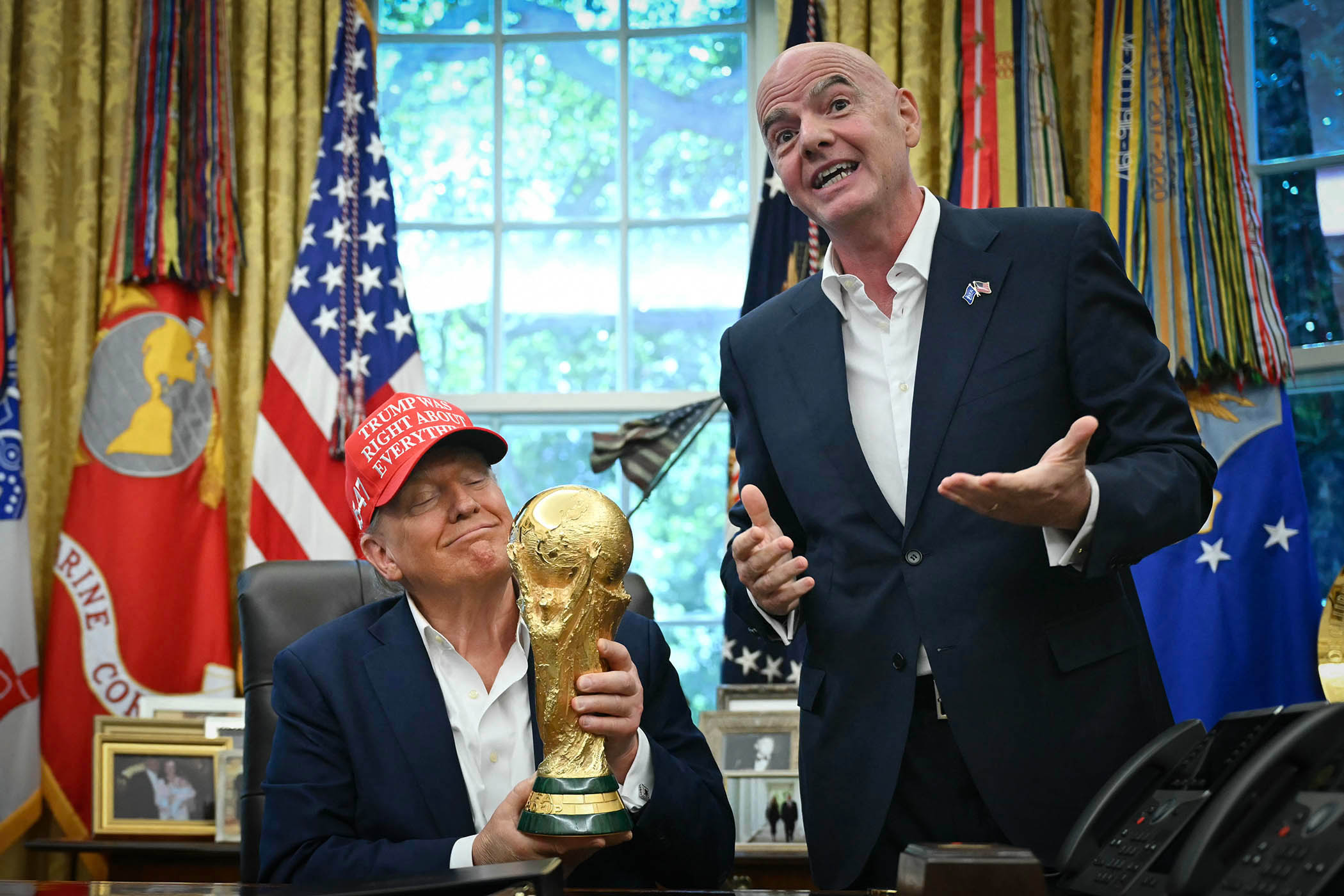
There has been his increasingly fraternal relationship with the Trump administration, one which has turned Infantino into a regular visitor to the West Wing and a frequent confidante of Jared Kushner. Fifa now has an office in Trump Tower in New York. In December, Fifa moved the draw for the World Cup to what was briefly the Trump and Kennedy Center in Washington DC.
Newsletters
Choose the newsletters you want to receive
View more
For information about how The Observer protects your data, read our Privacy Policy
On stage that day, Infantino presented Trump with the first – and quite possibly last – Fifa Peace Prize. Infantino defends his relationship with Trump as a strategic necessity, part of doing business with the World Cup’s principal host nation. At least one pressure group alleges it has breached the element of Fifa’s own code of ethics, which demands its staff remain “politically neutral”.
And yet, despite all the queasiness and the qualms, the World Cup itself still exerts an incomparable hold on the global imagination. That it is the most popular sporting competition in the world – well in advance of the summer Olympics, its only real rival – does not really need to be said; it is more useful, perhaps, to think of it as our last shared monocultural phenomenon.
That much is evident from the media feeding frenzy that surrounds it. In New York last week, the newsstands were dominated by football. The New Yorker and New York magazine have reported pieces on Infantino and Fifa. US star player Christian Pulisic is on the cover of Time. Others have profiles of David Beckham and Cristiano Ronaldo. GQ has made a deliberate shift to covering more sport.
It is not just the rotting husk of the legacy media that is determined to milk the World Cup for everything it is worth. In January, Fifa anointed TikTok as its “preferred” platform for the tournament. Netflix has paid Goalhanger, the production company founded by Gary Lineker, an eight-figure sum to produce a nightly show during the tournament, despite not being rights-holders.
It is going to be hard to believe it is the last global obsession if there is nobody there to watch it
It is going to be hard to believe it is the last global obsession if there is nobody there to watch it
All of those decisions have been driven by the same logic. Our shared culture has all but collapsed, undermined by filter bubbles and algorithmic delivery. At the same time, there is a vast swathe of research that indicates that we crave tangible, personal experience more than ever, a reaction to the increasing digitisation of our existences. The World Cup is the point at which those things meet. It fixates an audience like nothing else. Between June 11 and July 19, a considerable portion of the planet’s population will consume every single empty calorie of content that can be made for them. It offers a true, vanishingly rare, communal experience. No matter what they do to it, we just cannot get enough.
With, maybe, one exception. Fifa believes that the World Cup’s magic is such that people would pay almost any price to attend.
As well as instituting a dynamic pricing strategy – one that means seeing the final may cost $10,000 and even fairly ordinary group games are priced at several hundred – it launched its own resale platform, with the game’s governing body taking a 30% cut of every ticket that is sold on through the site.
Despite opprobrium, it has shown very little remorse for that decision. Infantino has made clear more than once that he (and by extension Fifa) regard this as fairly standard for watching sport in the US. The same, presumably, goes for the inflated prices for parking and train tickets and hotels that have turned this tournament into a particularly brazen form of alchemy: an attempt to turn love into gold.
The problem – one that Fifa does not seem capable of engaging with – is partly that this suggests Fifa does not understand what it is that makes a World Cup special: the sense of the planet descending as one, rather than an exclusive event, attended by only those with the means to afford it.
And, more pressingly, it risks diminishing both this tournament and the World Cup as a whole. Ticket sales for a number of games have been sluggish. Hotel associations in various host cities have said they have not seen the influx of visitors they were expecting. Last week, it emerged that whole batches of tickets had only just become available, through third-party resale sites, for some of the less attractive games in the group stage.
This is the consequence not just of greed, but of the entire model of Fifa under Infantino. He needs the World Cup to generate as much money as possible in order to satiate the federations that act as his powerbase. In attempting to do so, he may well have guaranteed that it is played out, at least in part, against a backdrop of all-but-empty stadiums. That would create a damning image: it is going to be hard to believe it is the last remaining global obsession if, at times, there is nobody there to watch it.
Photographs by Andrew Caballero-Reynolds and Franck Fife, AFP via Getty Images