
Mostafa Asal is the devil to some, a deity to others. A pioneer and a cheat, a transcendent talent squash needs and an irresponsible brute single-handedly degrading the sport’s standards and morality. Still only 24, the self-designated “Raging Bull” is the youngest man since 1988 to reach world No 1, steamrolling his past 21 matches without dropping a game, the reigning world champion unbeaten since October. He believes that the world is out to get him, conspiracy around every corner. His detractors believe the powers that be protect him to a fault.
And yet people unquestionably care about Asal in a way that squash is rarely cared about, a fact that the Egyptian is well aware of. He is the first to say that all publicity, particularly for the sport he loves, is good publicity. He has 2.2 million Instagram followers, more than 10 times the official Professional Squash Association (PSA) Tour account, a popularity largely fuelled by his association with Cairo football club Al Ahly SC, having played for their squash arm. By comparison, world No 2, Paul Coll, has just over 41,000 followers, No 3 Diego Elias 39,000. Rubber arms and liquid speed, Asal is the sport’s only remaining superstar.
Last April, an anonymous YouTube account called Quash Bad Squash uploaded a 12-minute video titled “Mostafa Asal Cheating Analysis”, focusing on the semi-final and final of the 2025 El Gouna International, which Asal won. Another clip, of match ball in the 2024 British Open final, appears to show Asal dragging his hand across opponent Ali Farag’s groin – Farag immediately stops and the ball flies past him; Asal’s wild celebrations only briefly paused by a referee’s video check that finds no fault. If it’s purposeful, it is one of the most egregious pieces of cheating in elite sport’s recent history.
Of course, it fits a pattern of behaviour which breaches squash’s traditional etiquette, often appearing to trip opponents with trailing legs and block their paths to the ball. At the 2022 US Open, Asal perforated an opponent’s eardrum with an aggressive shot. Between 2022 and 2023 he was banned three times for unsportsmanlike behaviour and dangerous play, totalling more than six months.
In 2021, then-world champion Tarek Momen posted: “The day I feel MY NAME IS PAIRED UP WITH ASAL in any context other than the draw, is the day I would retire immediately and ask to be stripped of any titles I’ve achieved.”
Marwan El Shorbagy was hospitalised after colliding with Asal at the 2023 Houston Open and said: “It is just so sad that we have someone who is 21 years old who is already bigger than the sport and more powerful than it.”
Elias also clarified that his recent knee injury, which ultimately required surgery, was suffered while playing Asal at the Egypt Open final last September – subject of its own 20-minute Quash Bad Squash analysis. “I’m sure I speak for others when I say we all want things to be highly competitive but within limits and the rules so others don’t get injured like me,” Elias said. His statement came because the PSA reported he was injured while training, not helping accusations of protecting the tour’s greatest asset.
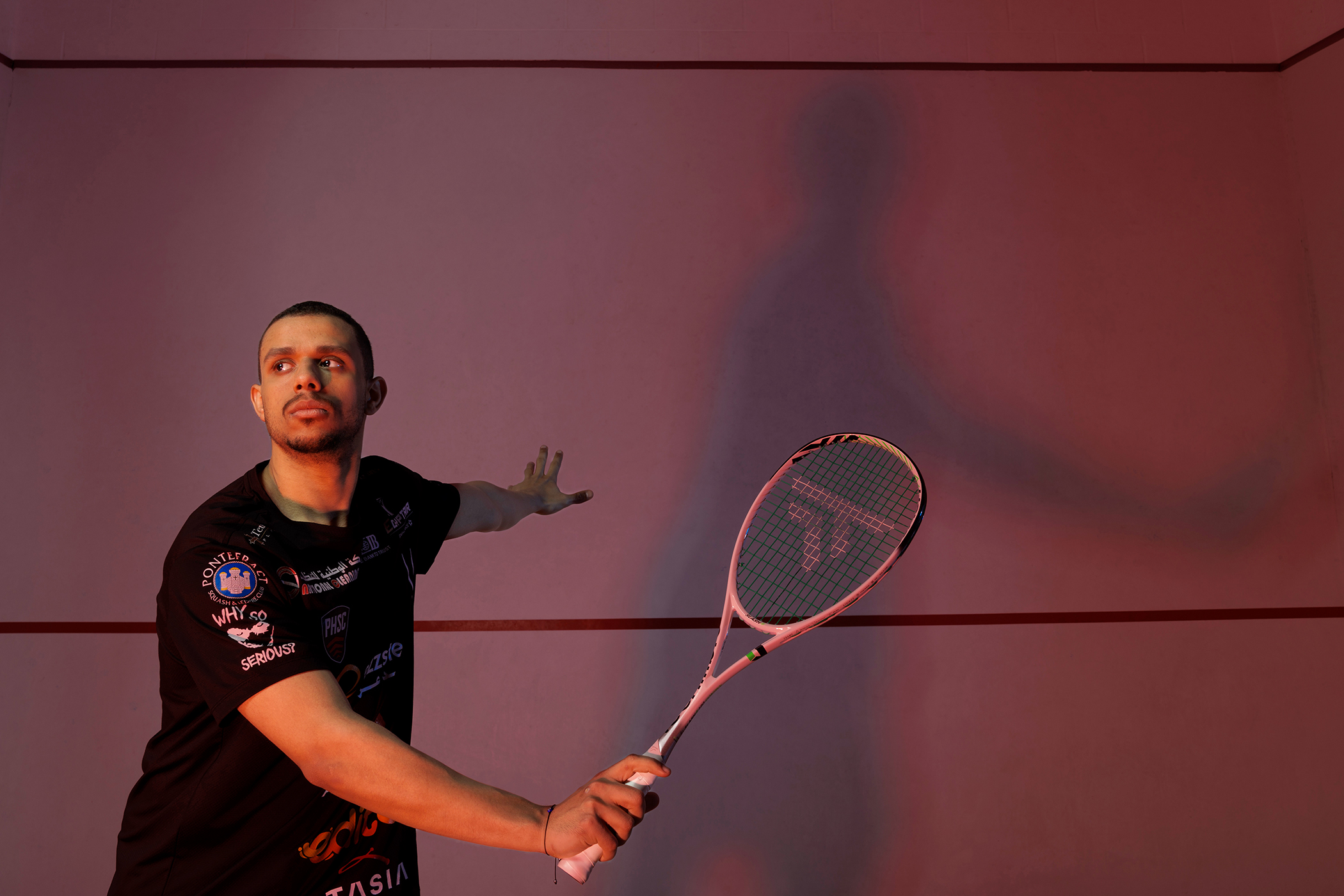
I meet Asal at the Optasia Championships, in a converted gym hall in Wimbledon, where he has just dispatched Colombian veteran Juan Vargas in 31 minutes to reach the quarter-finals. Despite having already played an evening match, he is generous with his time, posing for photos for 30 minutes without complaint. His gap-toothed grin is warm and genuine, and he is about as superficially charming and engaging as elite athletes get. There is a childishness to him, light and energetic and curious in one light, but equally petulant and avoidant when pressed. Even when looking into his eyes, it is impossible to tell whether he is just lying to me, or to himself, too. If it isn’t real, he does an excellent impression of innocence.
He concedes that he has not always behaved perfectly, that his play has been “aggressive”, but claims “there’s also something wrong from the other side”. He talks a lot about being young and making mistakes – “The problem is that the learning process for me came when I’m world No 1, at the top of the game” – but calls accusations of cheating “complete hate speech” which “crosses the line”. He maintains that “I wasn’t thinking that I’m doing something wrong”, but that he “was not good at dealing with all the stress, and you felt like everything is against you and it’s a war”.
The question is whether squash wants him as its snarling face, whether it needs him more than he needs it.
The question is whether squash wants him as its snarling face, whether it needs him more than he needs it.
After his most recent ban, Asal reached out to James Willstrop, a British former world No 1 considered the sport’s great gentleman. Wild-eyed and stringy, Willstrop invited Asal to his base in Pontefract, West Yorkshire, and set about reforming squash’s enfant terrible, an odyssey that he concedes is far from over.
“There’s always stuff that he needs to try and look at and work on,” said Willstrop. “Definitely the criticisms are fair, some of them. That’s what I’m here for. I’m trying not to be a coach that just cheers him on while he’s playing in a way that I don’t like. Constantly there are little criticisms after every match.
“I’m trying to have faith in the fact that in a couple of years’ time he’s the man that people could be watching, and at the moment they can’t get close to him. You’re looking at an Olympic possibility. What I want to see is he does that in a way that people love and enjoy.”
Willstrop says Asal’s conduct “ebbs and flows”, and that “some months it’ll be good in tournaments, then he sort of regresses a bit”.
Asal argues that if you scrutinised any player’s game in the way his has been, you could create similar videos, a sentiment that even Willstrop disagrees with. I ask whether Asal is suggesting that cheating is endemic in squash, but he repeatedly returns to theorising that another player might be behind the videos.
And yet he clearly understood there was enough of an issue to search out Willstrop, who praises his willingness to learn and work. Over the past six months, Asal has lost a significant amount of weight to make himself smaller on the court – none of this is helped by him naturally being both tall and stocky for a squash player, although this also gives him an easy excuse to hide behind.
“I went down to Pontefract and we talked about lots of things – the mentality, not everything being about winning, winning, winning,” said Asal. “There was too much pressure on me, putting lots of fans on your shoulder while you are playing. It wasn’t that easy to go through while I was raging and making problems and problems. The first priority was calmness and movement and not getting much interference in the game.”
Willstrop points out that going “Raging Bull” actually seems to hinder his play. Asal has tried a few different psychologists, but couldn’t find one he gelled with, so Willstrop unofficially assumed the role. Willstrop’s influence feels fundamental given that Asal’s father seems to support and fuel his conspiracies – in January 2023 he was also banned from PSA events for 10 months after confronting an Egyptian squash benefactor during a tournament. Two months later he posted a Facebook tirade claiming that his son’s bans were incited by officials linked to Wadi Degla, Al Ahly’s rivals, citing “consecutive penalties, severe, violent, without any reason, unprecedented in the history of squash”.
Willstrop believes that Asal’s approach to the game is a consequence of his upbringing in Cairo, but given the prevalence of elite Egyptian squash players who don’t share his rough edges, this feels somewhere between a generous if clumsy stereotype and disingenuous.
The majority of Asal’s youth coaching came from his uncle Ibrahim – a former professional squash player himself – as was the case for his 17-year-old brother Marwan, who joined the PSA Tour in 2024 and has become similarly unpopular for aggressive and clumsy play.
But there are genuine signs of progress. Asal has not been the subject of a Quash Bad Squash video for six months, and the account operator told The Observer that “he has definitely been doing the bad things less often, which has made him much more watchable”, but theorised that he has simply not needed to use the “dark arts” given the relative lack of competition.
I ask Asal about the Farag incident – described by Quash Bad Squash’s AI narrator as “a testicle tickle” – and he claimed innocence, reasonably arguing that cheating so blatantly in a moment inevitably going to be watched by the entire sport would be pointless.
“100% there is the reputation. We want to change this,” Asal said. “The game is so clean at the moment. Everything is fine. The movement has changed, my physique changed. Some people aren’t going to change their idea about you. But fair people will say ‘he’s changed’. Every person won’t be perfect all throughout his career, especially when you are very, very young. People can forgive you and give you a second chance to change that.
“I would love to leave the impact that I changed the sport, and that people are talking much about the sport. Whether it’s bad or good, I’m just loving the fact that the sport is growing. It’s good to let people talk.”
He bemoans a lack of characters in squash ahead of its inclusion in the 2028 Olympics, a seminal moment for the sport, and feels a responsibility to fill that void.
The question is whether squash wants him as its snarling face, whether it needs him more than he needs it. In their match, Vargas has only two sponsors on his shirt, Asal more than 15, and yet the audience wildly celebrate each of Vargas’s eight points, a tone set when a hoarse pensioner on the back row vehemently abused the referee over a first-point decision which went Asal’s way.
Only time will reveal whether his Pontefractian conversion is really complete, whether he can really change, or whether he might ultimately force squash to change for him.
Photograph by Jason Alden/The Observer
Newsletters
Choose the newsletters you want to receive
View more
For information about how The Observer protects your data, read our Privacy Policy