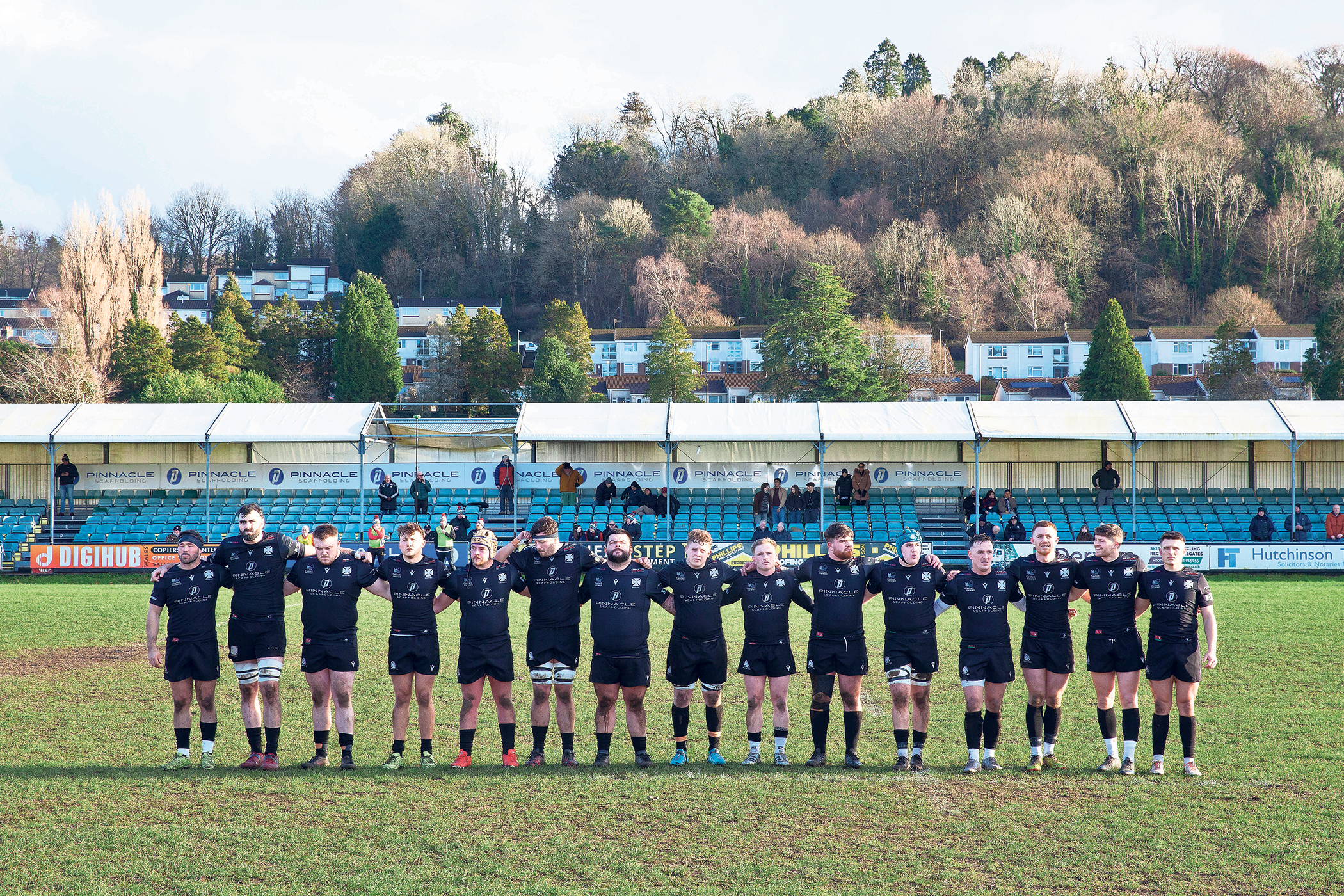

There was a day – an immortal day in Welsh sport – when Neath gathered in the Castle Hotel in town and marched through the streets to the Gnoll to face another team known for wearing all-black kit: New Zealand.
Last weekend, before a lowlier fixture against Brecon, in a ground that feels like a relic of a golden age, Mike Whitson shared memories of confronting New Zealand in October 1989. The Castle Hotel is where the Welsh Rugby Union was formed in 1881. The welcome for WRU bureaucrats now wouldn’t be cordial.
In a hospitality room of a club who played South Africa and Australia too in their halcyon days, Whitson remembered giving up drinking for four months to be sure he made the side against New Zealand.
“People were lining the streets, applauding us, wishing us all the very best,” he said. “The town turned out in force.” There was an echo of the times when miners would walk down from the valleys to play for Neath.
But at the Gnoll for the All Black derby there was a hitch. The New Zealand dressing room was locked and someone had walked off with the key. “We heard a terrible crash-bang-wallop,” Whitson said. “New Zealand had smashed the door in.”
Sustained by history and folklore, Neath are the embodiment of what club rugby was in Wales before the sport was ripped away from its communal heartlands and reconfigured as branded regions.
This month Blaenavon RFC withdrew from their current league (Div 1 East) and announced they would drop five tiers next season. Many clubs are said to be struggling to find players or in dire financial straits.
Neath fight on against the depredations of neglect, and disregard for culture and identity
Neath fight on against the depredations of neglect, and disregard for culture and identity
Rugby went professional in Wales in August 1995. As one history of Neath puts it, euphemistically: “The professional era has not been easy for a club that always placed greater emphasis on personal pride and collective passion than on any material benefits that might accrue to individuals from the game.”
The regions were formed for the start of the 2003-04 season. Neath and Swansea were merged into “Ospreys” but the change left Neath as a minor satellite, with “a pittance”, as one official described it, to live on.
In the winter of 2018-19 the club defeated two winding-up petitions. They had already escaped an HMRC petition in 2012 and another over unpaid business rates in 2014.
Newsletters
Choose the newsletters you want to receive
View more
For information about how The Observer protects your data, read our Privacy Policy
To visit the Gnoll is to comprehend the threat to the link between rugby club and town or village; rugby club and people of all ages who see it as a haven, a second home.
The allure of Neath as shared possession endures but the numbers are ominous. £10 to get in, £1 for a programme and kids go free. A game at Neath is a bargain but the level of rugby has plummeted.
Like Pontypridd, another great Welsh nursery, Neath are in the WRU Premiership, which sounds grand until you count how many famous clubs in Wales have been left largely to fend for themselves in decaying grounds.
“Our main stand needs knocking down,” a Neath official says. It retains the feel of a mining era structure, corrugated, tired and slightly wonky. But if a club is really its people, not the buildings it inhabits, the old Neath vitality strikes you as you take your seat and scan the faces, the pretty hills beyond the adjacent cricket ground.
Gerald Morris, the hospitality and safety manager, says: “I was on a walking holiday in Portugal and a couple from New Zealand said they’d never been to Wales. I said, ‘Come and stay with me in Wales on one condition – that you come to the Gnoll and see where the real All Blacks play.’”
Morris’s pride is founded on decades of self-certainty. Neath are the oldest senior club in Wales. They are the alma mater of Shane Williams, Jonathan Davies, Paul Thorburn, Allan Bateman and Gareth Llewellyn. In the 1980s and 90s they lost only 16-8 to Australia, 16-13 to South Africa in a particularly violent game and 26-15 in that New Zealand match, which Whitson says “we should have won”.
In folklore, there was an illness called “Neath flu”, which opponents would succumb to suddenly, on the day of the match, rendering them unable to face the might of a side built on power and aggression.
They like to remind you too in Neath that in 1988-89 the team set world records with 1,917 points and 345 tries in a single season.
But Welsh rugby’s convoluted self-reinvention has ravaged the grassroots. Recently renovated dressing rooms at Neath are talked about with pride but huge sums would be needed to rebuild the whole stadium. If Ospreys disappear with the latest WRU regional shuffle then Neath would be left looking for a new alignment with an area further away.
Like many clubs in Wales, Neath fight on against an opponent more formidable than any New Zealand side: the depredations of neglect, and disregard for culture and identity.
Photograph by Karen Robinson for The Observer