
The atmosphere is spirited, the crowd encouragingly young. These are the Ospreys, pride of the Swansea region. And threatened with extinction.
On a damp Friday night in Bridgend a Welsh regional side who have supplied seven members of Wales’s 2026 Six Nations squad take on Montpellier not knowing whether they will live or die.
As the Six Nations approaches with the national side in an alarmingly fragile state, the game in Wales is facing another cull of professional teams. The sport is gripped by panic, riven by bitterness and locked into an identity crisis on a scale not seen before.
The national sport – certainly of South Wales – is stumbling in the dark on its future composition. More profoundly a rift is widening between the ancient grassroots culture and what critics of the Welsh Rugby Union (WRU) see as a hollow franchise system.

Five days after the Montpellier game, one major question was answered. The WRU responded to indignation from players, fans and politicians by clarifying Ospreys’ fate. Their owners, Y11 Sport and Media, will take over Cardiff, the region that went into administration in April 2025 and is propped up by the WRU. The Ospreys, the WRU says, will continue until “at least the end of the 2026-27 season.” Until then, incredibly, Y11 will own both clubs – or 50% of the Welsh regions. Ospreys’ prospects from 2027 are unknown and not promising. “Our Blood is Black,” the club’s slogan runs. The Cardiff news has made that blood run cold. On Friday night during a 24-24 draw with Johannesburg Lions in Bridgend, a crowd of 4,052 were asked to light their phone torches to indicate that “they will not ignore the disgraceful treatment of Ospreys players, staff, and supporters”.
From visits to Dragons in Newport, Neath at their famous ground the Gnoll, and Ospreys in Bridgend last weekend, it was obvious that Welsh rugby as we know it is in a doom loop. Everywhere you go you hear elegies, as if there is no way back.
People feel sorry for Wales. I don’t know if it’s worse. We’re driving a generation away from the game
People feel sorry for Wales. I don’t know if it’s worse. We’re driving a generation away from the game
Ken Owens, former Wales captain
The gloom stems from territorial fighting over how many professional clubs (ie “regions”) the country can afford and the deracination of the community game in the old heartlands, the collapse of the player development “pathway” and the embarrassing state of the Wales men’s side, who were Grand Slam winners seven years ago, and Six Nations champions in 2021.
The recent vintage of those triumphs suggests Welsh rugby might just be in a periodic slump. But that is not how it is being framed, as annoyance with the WRU turns to anger and threatens to shade into apathy.
Ken Owens, the former Wales hooker and captain, told a recent ITV News documentary: “People feel sorry for Wales. I don’t know if that’s worse. We’re driving a generation away from the game.”
The former WRU chairman Gareth Davies told Wales Online in a December interview: “I am saddened because of what all my mates are saying. They are not interested in the game. The guys I play golf with probably haven’t been to a Test match for 10 years. People have turned their back on it all because they are so disappointed.”
Newsletters
Choose the newsletters you want to receive
View more
For information about how The Observer protects your data, read our Privacy Policy
South Wales is home to one of the most evocative cultures in world sport: founded first on the heavy industry heartlands of the valleys and coastal towns and cities, then on remarkable upswings from 2008-13 under coach Warren Gatland, a New Zealander, and again from 2019-21.
This week the WRU chair, Richard Collier-Keywood, and its chief executive, Abi Tierney, were called before Parliament’s Welsh affairs select committee in Westminster to explain what is going wrong.
Ruth Jones, the MP for Newport West and Islwyn who chaired that hearing, tells The Observer: “Of course the Ospreys are the preferred bidder for Cardiff. It’s the easy way out for them [the WRU]. The supporters were vehemently against it. And the evidence is not there. Why are we going from four to three [regions]? My frustration is the WRU spends more time talking to the banks than it does the clubs.”
At Bridgend’s Electric Brewery Field, every Ospreys fan told the same story. Theirs is essentially the Swansea team but play further east in Bridgend because Swansea Football Club’s stadium is too big and the local council won’t back construction of a new £5m ground at St Helen’s, on the Swansea coast, until they know whether the team will exist beyond 2027.
Swansea council has threatened legal action if the city is left without a side and local Labour MP Torsten Bell and Senedd member Mike Hedges are on the case.
The Ospreys’ Wales players Jac Morgan and Dewi Lake aren’t waiting until 2027 to sort their futures. Morgan and Lake will join Gloucester next season in the English Prem. James Fender, the Ospreys lock, said this week that he is off to Grenoble in the French second division.
If Ospreys fold, the United Rugby Championship (URC) will be a team short in Wales. Conjecture says a team could be parachuted in from another country – another misunderstanding, campaigners say, of how allegiance works. The WRU, meanwhile, boasted at Westminster about new financial arrangements with HSBC and Goldman Sachs to stabilise the budget for funding clubs. It says the nadir has passed.
“We [the committee] seem to think there’s a massive disconnect between the WRU and the communities it serves,” says Jones. “We’re underestimating how serious it is. There are some fundamentals like the URC. Are we expecting fans to travel to Italy and South Africa? Why not go to Bristol or Bath? An English-Welsh league would be much more sensible.
“I had hundreds of emails saying – ask ’em this, tell ’em that. They [the fans] are passionate about it. They support a club for a good reason. They’re not going to change that lifelong identity by saying, at Ospreys – we’ll go and see Cardiff instead. It’s not going to work. What’s the socioeconomic impact of closing the Ospreys down? They haven’t done an impact assessment.”

The WRU claims there isn’t enough money in Welsh rugby to support four professional teams. Before the MPs, Collier-Keywood said: “We found a system that was fundamentally broken,” with each region subsisting on £4.5m per season. “The future of Welsh rugby was imperilled.”
He talked of development centres and restoring the player production line that so recently supplied Sam Warburton, Alun Wyn Jones, George North, Jamie Roberts, Dan Biggar and Leigh Halfpenny.
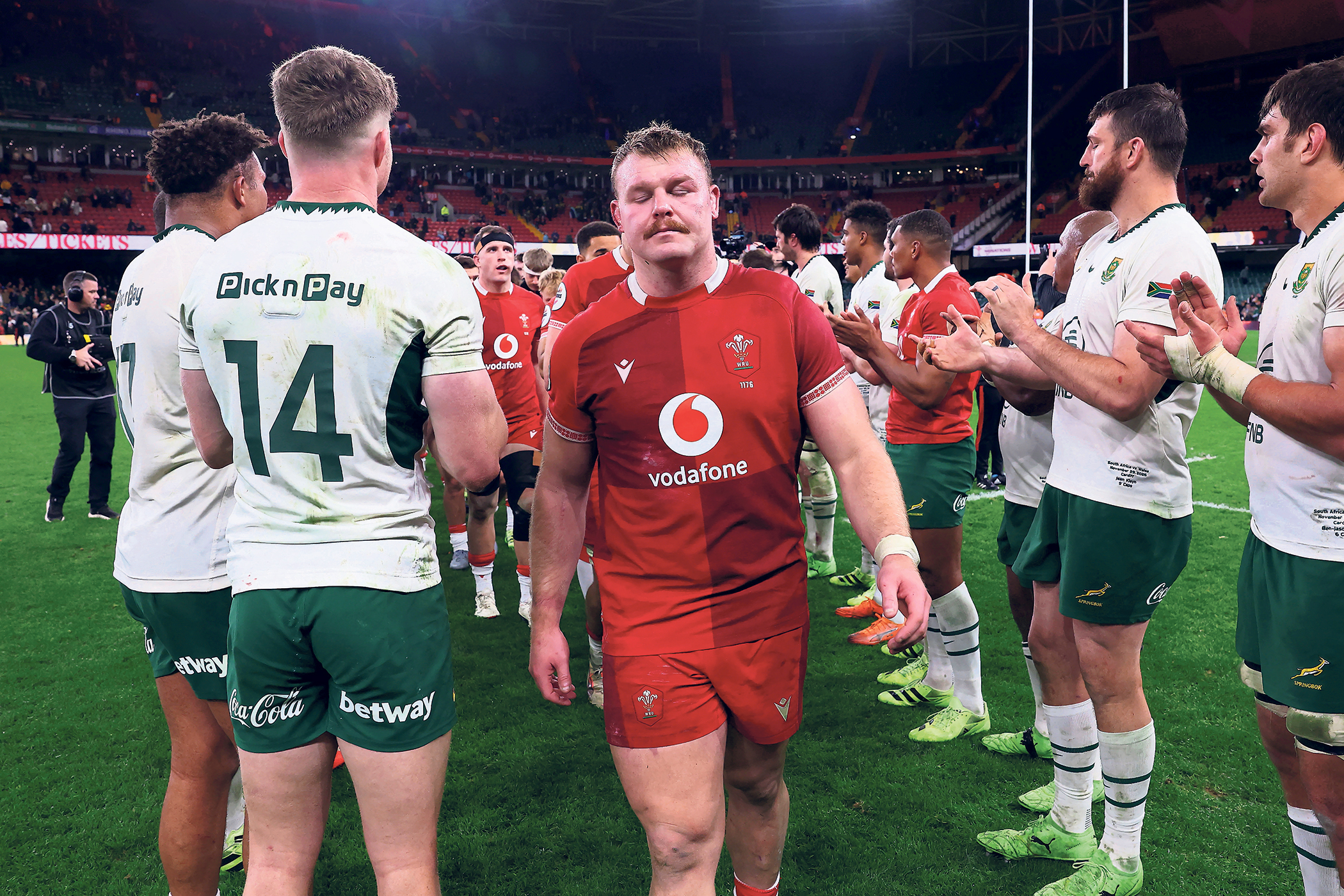
Briefly the world No 1 team in 2019, Wales ended an 18-match losing run with a 31-22 win over Japan in July last year. After that they conceded 52 points to Argentina, 52 to New Zealand and lost 73-0 to South Africa. In the 18-game stretch they lost 43-0 to France in Paris and 68-14 at home to England. The first target is to shift all the unsold tickets for home games in this year’s Six Nations and avoid a third consecutive wooden spoon.
“In Wales, rugby comes from a different place,” Ruth Jones says. “In England it’s come from the public schools – and in Scotland – but in Wales it came from the working-class communities. The coal, the choir, the steel. Never mind which church you belong to, it’s which rugby team do you support?”
A more urgent question recently has been: which teams are still standing, and for how long?
The way out of the crisis – six suggestions
• The WRU insists it will rebuild the pathway structures that produced waves of talent from 2008-2021.
• An Anglo-Welsh league is seen by many as the best hope for building rivalries and restoring sport’s profile.
• Anger over the backroom Cardiff/Ospreys deal has galvanised fan resistance to the WRU’s policy of regional contraction. That impetus could force bureaucrats to take the public’s wishes into account.
• Numerous retired legends want to help. Allowing them in would improve decision making and reconnect clubs and administrators.
• The WRU claims funding for regions will increase with HSBC and Goldman Sachs offering banking support.
• Any improvement on three lamentable Six Nations campaigns will feel like progress. The return of Louis Rees-Zammit from the NFL adds some celebrity sparkle amid slow ticket sales in Cardiff.
Wales’s descent into crisis
January 2023
BBC Wales Investigates reports widespread claims of “sexism, bullying and sexual harassment” at the WRU. An independent report finds damning evidence. The WRU says it’s “truly sorry”.
February 2023
Days before a men’s Six Nations home game against England, Wales discuss a strike over contracts.
October 2023
A run of 18 consecutive defeats starts with a loss to Argentina and continues until July 2025, with two consecutive Six Nations wooden spoons.
October 2024
Wales women are told the team will be withdrawn from the 2025 World Cup unless they sign new deals. They threaten to strike. At the World Cup they lose all three games in Pool B.
February 2025
Warren Gatland resigns as head coach. Interim Matt Sherratt steps in until Steve Tandy takes over for the autumn internationals.
April 2025
Cardiff go into administration and are taken over by the WRU.
October 2025
The WRU announces that four regions will be reduced to three – one in Cardiff, one in the east and a third in the west: a death sentence for either Ospreys (Swansea) or Scarlets (Llanelli).
November 2025
Wales lose 73-0 at home to South Africa to end a dismal year.
December 2025
Ospreys stars Jac Morgan and Dewi Lake announce they will be leaving Wales next season to join Gloucester. Aaron Wainwright, the best player at Dragons, will join Leicester Tigers.
January 2026
The WRU calls a demand by the Central Glamorgan Rugby Union for an EGM an “irresponsible nuclear option”. The rebels propose a vote of no confidence in chair Richard Collier-Keywood and in Malcolm Wall, chair of the Professional Rugby Board. The WRU responds: “We have a plan. It was shaped by you. It is published. Let’s deliver it together.” EGMS were held in 2014, 2020 and 2023. Reports claim 20,000 tickets remain unsold for Wales’ Six Nations game against France in Cardiff on 15 February. After the deadline for a Cardiff bids passes the WRU moves into a “period of exclusivity” with the Ospreys owners Y11 Sport & Media. Cardiff and Ospreys fans unite in opposition. MPs and council officials in Swansea promise to fight the proposal.
Photograph by David Rogers/Getty Images