
Phil Labas has been on the road, now, for 25 straight days. He set off from his home in Chicago on June 6, picking up the start of Route 66 and heading west, all the way to Santa Monica, before shuttling up and down the Pacific Coast Highway. Together with a friend, he has racked up more than 5,000 miles. They have also been through three vehicles.
He would be the first to admit that it has been no hardship. “The Pacific coast is magnificent,” he said. “Even when we took the inland route, we had Mount Shasta in California, Mount Hood outside Portland and then Mount Rainier at Seattle. They’re all above 14,000ft. So you’re basically chasing these snow-covered peaks all the way.”
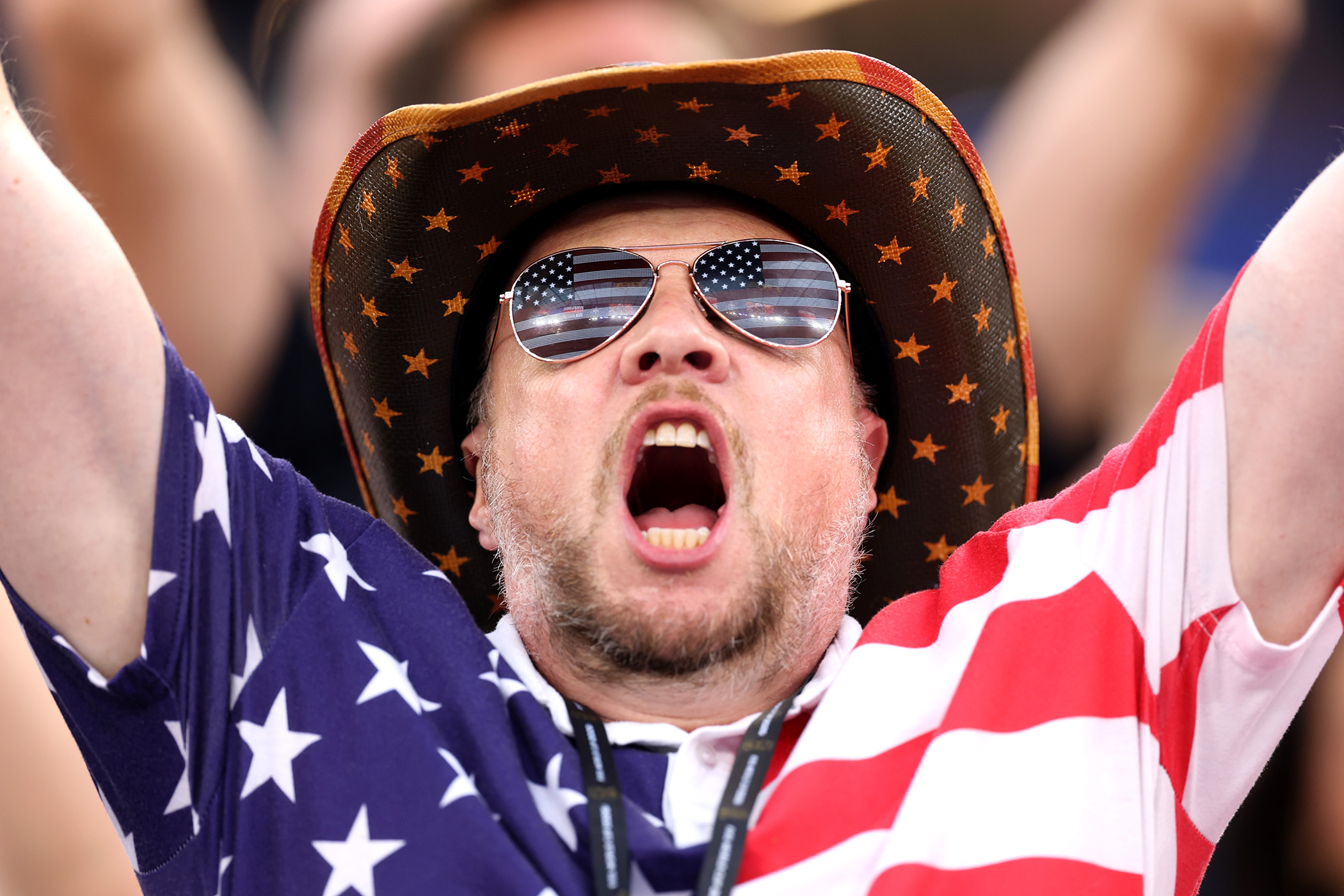
But it has been a pilgrimage of sorts. Labas is the lead capo of the American Outlaws, the fan group that coalesces around the United States’ various national teams. It is his job to get songs going, to generate atmosphere, at games; for the last month, it has also been his responsibility to transport the group’s drums to the team’s games in Los Angeles, Seattle, and now Santa Clara.
His reward for all of that effort, all of that dedication, has been a torrent of criticism.
“There has been a lot of lip about our chants, all the stuff about how cringe we are,” Labas said.
Most (if not all) of it has come from outside, from European fans who are so quick to condemn American fan culture as cheesy, inauthentic or, ideally, both, that in certain lights it might look like eagerness.
In this assessment, the chants that Labas and his colleagues instigate fail in one of two ways. Some are scorned as derivative. They have a version of the Icelandic thunderclap that is borrowed from, well, Iceland. They have a song based on Peggy March’s I Will Follow Him, lifted from Crystal Palace. Another – Oh USA! – has a tune more often associated with Paris St-Germain.
Labas does not reject that charge. But he does point out that it hardly makes the US fans unusual. “Creativity in soccer culture disappeared decades ago,” he said. “We are all shamelessly stealing from each other.” This is basically correct. There are still occasional flashes of originality, but the vast majority of songs are cover versions: Allez Allez Allez, for example, came to Liverpool via Napoli and Porto. Palace’s adaptation of March’s I Will Follow Him was originally used by German side St. Pauli. “In a way, you’re paying homage to the ones that make it,” Labas said.
The second is more complex. When the Outlaws lean into more uniquely American chants – most notably, and possibly notoriously, I Believe That We Will Win, a staple during the World Cup of 2014 – they are not only (predictably) mocked by outsiders as being a sort of invasive species, an imposition from another sport, they tend to be dismissed by their own, too.
“There’s a type of American soccer fan who follows the Premier League and sees that as not being authentic,” said Ryan Shirah, who organises the drum line that accompanies the Outlaws at games. “They think that we should go full British. But my response to that is always: ‘Why do you want to gatekeep it?’”
Newsletters
Choose the newsletters you want to receive
View more
For information about how The Observer protects your data, read our Privacy Policy
That leaves the Outlaws with a fine line to tread: working out how to create a culture that is both organic – to the sport and the country – but also somehow distinctive, not only from European or South American football but from a challenge that is particular to them: the crowd dynamic that pervades the other major leagues of North America.
“You have to remember that soccer is not the dominant sport here,” Labas said. “There are others with bigger canvases, longer bloodlines.” The Outlaws are told frequently that they would be better off looking to the NFL, Major League Baseball and the NBA for inspiration. “There are people who think we should use a screen, or a DJ, to get the atmosphere going, like those sports do,” Shirah said.
That can work at times, of course. After Mauricio Pochettino’s team had beaten Australia in Seattle earlier this month, the strains of Take Me Home, Country Roads blared out over Lumen Field. Quite how that happened is not clear: US Soccer, the game’s governing body in the country, said that it had been one of a handful of songs it had suggested to Fifa to use after matches, in much the same way as England have deployed Sweet Caroline and Wonderwall.
That account has been disputed, gently, by Amy Hopfinger, the chief strategy officer of the Fifa-adjacent local organisation responsible for delivering the World Cup. She told The Athletic that she had seen England singing Wonderwall and started workshopping what an American alternative might be. Together with Lance Brass, the tournament’s events coordinator, she decided that the John Denver standard – as well as Bon Jovi’s Livin’ On A Prayer – was ideal.
Regardless of the genesis, the rendition of the song has come to represent what is currently the emotional high point of this World Cup for its principal hosts. “The words to that song reflect specifically on American culture,” said Labas. “It’s so well-known. It ties into an America-core. It speaks to the beauty of what the United States is.”
But it is not, Shirah said, the sort of song to hype up a crowd. And besides, relying on those external prompts to generate noise would fail the authenticity test; one of the appeals of football is that its sonic backdrop does not rely on the external manipulation of Jumbotrons and kiss-cams and music blared over the action. The aim, according to Shirah, is to embed the idea that football’s atmosphere is different to anything else in the American consciousness: this is a place where you come to sing.
The question both of them – and the broader Outlaw movement – are wrestling with, then, is how that might be achieved and, crucially, sustained over the United States’ geography. “We don’t have a home stadium,” said Shirah. “When we go to different cities, they have chants they like and rhythms they like, and they vary.”
For this tournament, the solution the Outlaws have settled on is encapsulated in the slogan “Unapologetically American,” an attempt to blend football’s traditions with American tastes. That has involved leaning into what many agree to be the closest parallel to football in the American landscape: college sports.
Before the USA’s last group game, a defeat to Turkey, Shirah and his colleagues on the drum line played Neck, a song traditionally associated with Louisiana State University’s American football team. “People went wild,” he said. The plan, now, is to build on that: for today’s meeting with Bosnia in the round of 32, he has invited a full marching band to join them.
“We’re trying stuff that’s new,” Labas said. “We’re experimenting. College football is an interesting idea. Let’s see if it sticks. We’re trying to pull people in, to make it meaningful, to get everyone involved. You have to remember we’re a younger culture. Other sports have bigger canvases and longer bloodlines. We’re helping to build something here.”
Whatever form that takes, Shirah knows, cannot be borrowed from somewhere else in its entirety, whether that is another country or another sport. “We have to be who we are,” he said. “We’re silly. We know we’re silly. We’re not pretending we’re going to fight the Bosnians. We’re just wearing a load of red, white and blue and having a good time. That’s who we are, and that’s better than acting like we’re someone or something else. We are authentic. We’re authentically American.”
Photograph by Jamie Squire/Getty Images