
World Cups do not belong only to the winners. The team that lifts the trophy at MetLife in two weeks will have the final word, of course; it will always be their tournament, their crowning glory. But that does not mean they will have an absolute monopoly on our collective memories. The moments that are scored on to our imaginations are much more varied than that.
Take 1990: West Germany won that, but its most indelible, its most lasting images were produced by Cameroon, by Roger Milla and Benjamin Massing. Or 1994, which ended in grinding Brazilian glory and piercing Italian pain. Even now, though, more years on that it feels, it still conjures images of Yordan Letchkov’s flying header, of Hristo Stoitchkov’s brilliant Bulgaria.
We can now say that – whatever else happens between now and 19 July – this will always be the World Cup of Cape Verde.
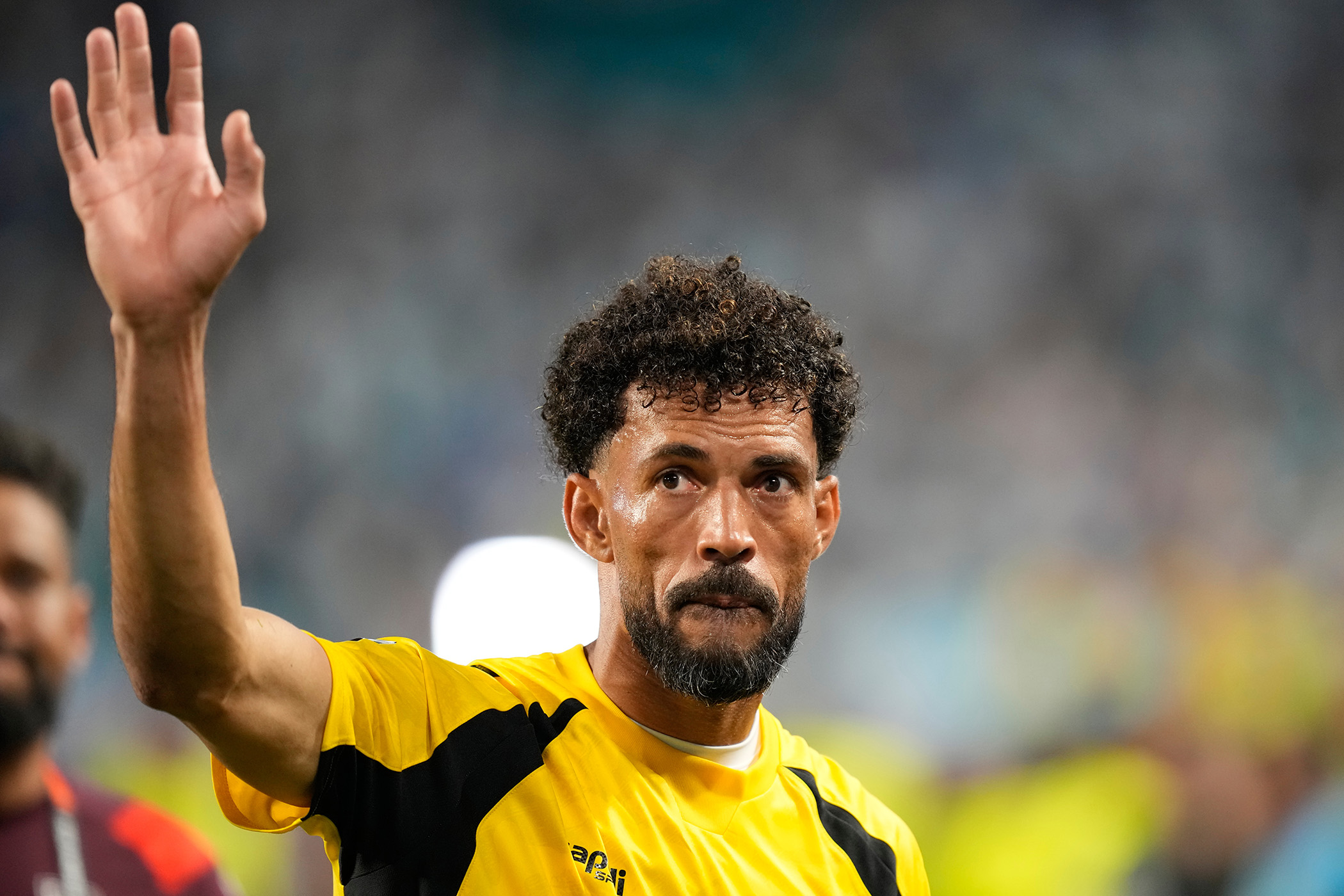
Their first game, in truth, might have been enough to secure that status: Vozinha, their 40-year-old goalkeeper – currently without a club – a picture of defiance as he and his team-mates held Spain at bay.
It was instant legend stuff: a country with a population of just half a million, drawn from an archipelago of islands in the Atlantic, holding one of their favourites in their first ever World Cup game. It was sufficiently captivating that Vozinha spent most of the next week on various talk shows. Cape Verde, though, were not done. They took another point against Uruguay – diminished, yes, and riddled with infighting, but still Uruguay – and then, almost anticlimactically, secured another goalless draw with Saudi Arabia. Three World Cup games played, no World Cup games lost, and qualification secured. They had more than played their part as plucky underdogs.
They were also not finished. The result of their round of 32 game against Argentina in Miami on Friday evening seemed so certain that Mohamed Salah, when asked if he was looking forward to playing against Lionel Messi in the last 16, had to remind a television interviewer that they did actually have to face Cape Verde first.
Most would have assumed he was just being polite. When Messi scored his 20th World Cup goal – Kylian Mbappé’s breath hot on his neck – after half an hour, it seemed as though the spell was broken. But Cape Verde came back, through Deroy Duarte, and then resisted everything that the reigning champions could throw at them.
The game yawned into extra-time. Lisandro Martínez put Argentina ahead. Sidney Lopes Cabral, with what may well prove to be the goal of the tournament, drew Cape Verde level again. Argentina’s players and fans looked nauseous, haunted, terrified. Even watching on television, it felt a little like a fever dream, as though what we were seeing could not be real: the greatest shock of all time – quite possibly in any sport – playing out on a broiling Miami night.
The magic did not hold, not quite: a combination of Cristian Romero and Diney Borges bundled home a third for Argentina, deep into extra-time, and the world champions held on. They get to breathe again. They will, as they were expected to, face Egypt in Atlanta on Tuesday. But the glory, in its entirety, belongs to Cape Verde.
There is, helpfully, what might be seen as actual evidence of how engaging the public at large has found their story. Before the tournament, Vozinha had a couple of hundred thousand followers on Instagram, as might be expected for a relatively low-profile player. He is now on 21.7 million. He, and his team-mates, have won a whole new fanbase.
Newsletters
Choose the newsletters you want to receive
View more
For information about how The Observer protects your data, read our Privacy Policy
Stories like Cape Verde, and Cameroon before them, function in one sense as the tournament’s subplots: they are the distractions that keep us engaged while the central narrative is working its way to a conclusion.
That some of them, the best of them, last is partly because it is easy to fall in love during a World Cup: it is a shared cultural moment, one that the planet watches all at once, all together. But it is also because they lend the whole event its human quality: they are stories of resilience, of determination, of waiting and working for a single beautiful moment in the sun. There is something in that which speaks to us, which stays with us, which means that whatever happens from now on, this will always be Cape Verde’s World Cup.
Photograph by Rebecca Blackwell/AP