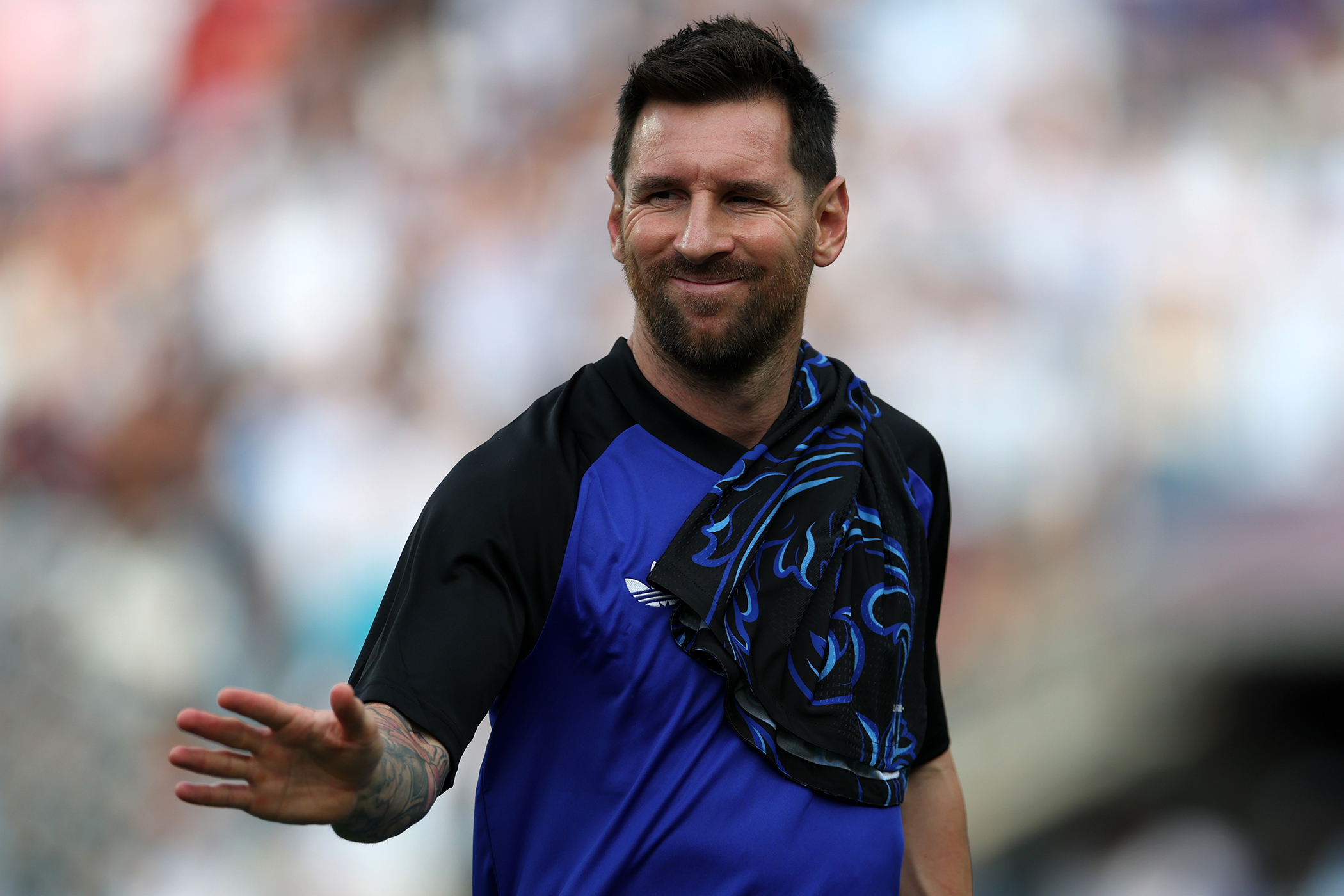


Maybe the best example is Lionel Messi. It often is. Not quite four years ago, his Argentina teammates hoisted him onto their shoulders, the bulbous, glittering form of the World Cup clasped in his hands. Here was the golden coda to his brilliant career, the perfect way to say goodbye. Except that it wasn’t. Messi is back for one last job, a tribute act to himself.
Or maybe it is his permanent counterweight. The passing of the torch from one generation to the next is not normally the sort of thing that is broadcast live on television, but it was for Cristiano Ronaldo. After a disappointing group phase in Qatar, he had been scandalously/predictably dropped for Portugal’s last-16 game against Switzerland.
His replacement, Goncalo Ramos, duly scored a hat-trick inside 67 minutes. If anything, the message was a little too on-the-nose. Even Ronaldo had not been able to outrun time. And yet, here we are. Ronaldo is back, too.
Then there is Neymar, forever doomed to be the Crassus in this particular triumvirate. The Brazilian is 34. He has not, by common consensus, been fully fit for the better part of three seasons. Returned to his first club, Santos, after two seasons lost to injury, he has featured just eight times this year. He last played for his country in 2023. Carlo Ancelotti has named him Brazil’s number 10.
The past, of course, has always been a central part of the World Cup’s appeal. The reason the tournament has been able to endure the many and varied indignities heaped upon it is the way it connects us to our memories; it provides a framework for the stories of our own lives. The World Cup is an exercise in nostalgia. It’s just unusual for so much of it to be out on the pitch.
Across the 48 teams competing in North America over the next two months, there are countless cases like Messi, Ronaldo and Neymar. Croatia’s squad contains both Luka Modric and Ivan Perisic. Axel Witsel, at 37, has been restored to Belgium’s ranks. Rudi Garcia, the country’s coach, explained his return last year by saying he needed “one more experienced player.” Also in the squad for the World Cup: Kevin De Bruyne, Romelu Lukaku, Thomas Meunier.
Edin Džeko will lead Bosnia’s attack. Guillermo Ochoa has now been in goal for Mexico for so long that it feels like nobody else has ever been in goal for Mexico. The same goes for Fernando Muslera and Uruguay. James Rodríguez will captain a Colombia side that still includes the entire defence that lost to England on penalties in Russia in 2018.
It would be wrong to dismiss the credentials of all of these players based purely on grounds of age, of course. In many cases, they have been selected for the World Cup on merit, because they are the best choice a team has in a particular position. The context, too, is important. Croatia has a population of 3.8 million people; it is not exactly a surprise the country has not found it easy to replace someone of Modric’s shimmering talent.
But the sheer number of exceptions does rather hint at a rule. This group of players – those who came of age alongside or in the shadow of Messi and Ronaldo – have become football’s eternal generation; a collection of stars so bright, so celebrated that it feels like the game cannot quite bring itself to say goodbye.
In part, that is because it does not have to. If Messi and Ronaldo have both moved to what might kindly be described as lower-impact leagues in order to prolong their careers, the same cannot be said for Modric, who moved to AC Milan last summer, or Džeko, who has just helped Schalke win promotion from Germany’s second tier. These are players who remain at the coalface.
Newsletters
Choose the newsletters you want to receive
View more
For information about how The Observer protects your data, read our Privacy Policy
That they have been able to endure for far longer than even they might have expected – Džeko said earlier this year that, at 30, he did not anticipate he would still be playing at 40 – is because of their dedication; it highlights, too, just how good the game has become at keeping players fit, at both preventing and curing injuries, at deploying science in order to extend careers.
The longer one generation lasts, the less time the next one has to shine
The longer one generation lasts, the less time the next one has to shine
But mainly it is because it does not want to. Aside from Neymar, the most surprising veteran to be summoned for this tournament might well be Manuel Neuer, the Germany goalkeeper. He had retired from international football a couple of years ago, standing aside after Germany were eliminated from the 2024 European Championship on home soil.
He had even written an emotional Instagram post. “Anyone who knows me, knows that I did not make this decision lightly,” he wrote. “After many intense and long discussions with my family and friends, I have decided that right now is the right time to close my chapter.” That seemed to be that.
Periodically, Neuer reiterated his stance, no matter how indomitable his form for Bayern Munich might be. And then, last month, Sky Germany reported that the 40-year-old’s name had been included on Julian Nagelsmann’s provisional 55-player list for the World Cup. Nagelsmann was coy on the matter: a lot of people were in there, he said, channelling his inner Aerosmith bouncer.
Neuer was duly included in the final squad. More, in fact: Nagelsmann confirmed that he would go into the tournament as his first choice. His analysts had determined that Neuer was one of the three best goalkeepers in Germany, he said, and his glittering career had given him an “aura” his competitors could not match. (The man he has replaced, Oliver Baumann, is not happy about this, saying his exclusion was “not so cool”.)
There is an element of self-fulfilling prophecy here, of course: because neither Germany nor Bayern have ever really committed to the idea of exploring life after Neuer, nobody else has been able to establish that kind of reputation, that sort of presence. Aura, after all, is something earned, not bestowed.
The same is true of Witsel, Rodríguez and all of the others. The longer one generation lasts, the less time the next one has to shine. And this generation has lasted a very long time indeed: 20 years or more, in some cases, at the very point that football metastasized from colossal global phenomenon to infinite content machine.
That timing has done more than make Neuer, Neymar and the others the most famous generation of footballers that has ever existed. It has given them a hold on our imaginations that their successors cannot hope to match, not now that football – like everything else – is now julienned by the whims of various algorithms into predetermined platforms and tribes and siloes.
Even a few years later, the cultural cohesion that powered their fame is broken down completely, replaced by a landscape far more fragmented, far more piecemeal. Lamine Yamal is probably the most talented player in the world, but he will never be quite as famous as Messi.
And so a World Cup without Messi becomes unthinkable, somehow not quite a World Cup at all: not just for fans but for coaches and executives and probably most important of all for sponsors. The same is true for Rodríguez and for Ronaldo and for the rest of the game’s eternal generation. These are the faces we want to see, we expect to see, as though the sport itself has frozen, the clock ceasing to tick, and so we refuse to say goodbye, and we demand once more that they play their hits.
Photograph by Tim Warner/Getty Images