

This article is part of the Rory Smith on Football newsletter – a guide to help understand what is happening on the pitch, off the pitch, and why all of it matters.
Throughout the tournament, Rory will be travelling across America, delivering daily commentary on the biggest World Cup ever direct to subscribers. Never miss a newsletter, subscribe now here.
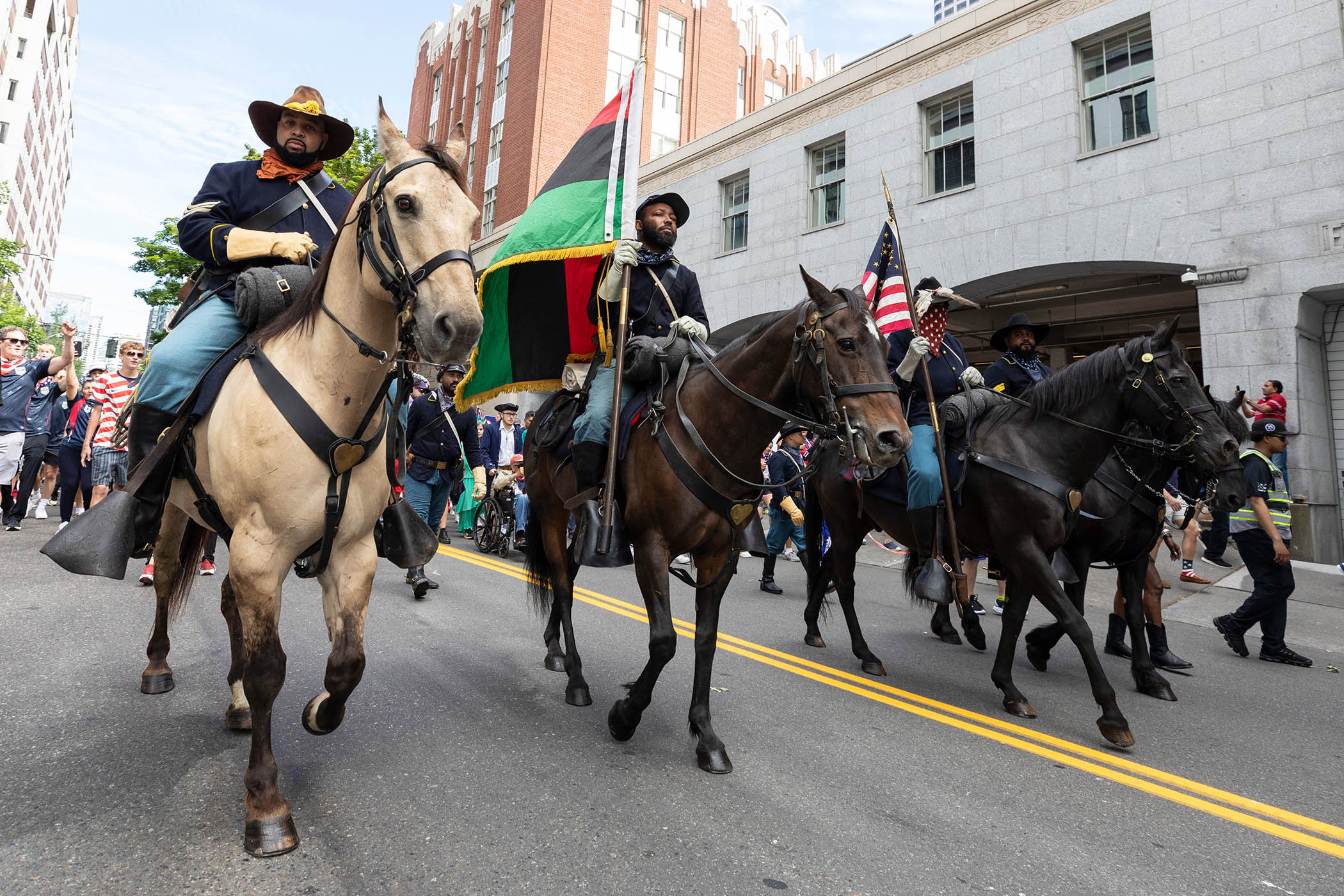
On balance, the World Cup has probably involved more horses than might have been anticipated. Had you asked me before the start of the tournament how many would feature – a metric we might call Expected Mounts – I would probably have suggested somewhere close to zero. Instead, the current count stands at seven.
Four led the United States fan march through Seattle a few days ago, each guided by a member of the city’s battalion of Buffalo Soldiers, a group honouring the all-Black units that served on the frontier in the 19th century. On Tuesday, three more appeared in Houston at the head of Uzbekistan’s parade, bringing an unexpected touch of the steppe to Texas.
This sort of pageantry is not new to the World Cup. Fans have long used it as an opportunity to perform a concentrated version of their national identities, playfully indulging in the sort of clichés they might otherwise resent. You can go weeks in Mexico without seeing someone in a sombrero. Scots, contrary to popular belief, rarely wear kilts in the course of their day-to-day lives.
But it does seem to have become more pronounced, perhaps even more competitive, over the first couple of weeks of this tournament: this should not particularly need saying, but often the World Cup passes by without anyone thinking to get any horses involved.
The Dutch cohort, for example, spent a considerable amount of money shipping their Oranjebus to Galveston, Texas, so it might lead their march. They did so with institutional support: the country’s football federation, the KNVB, contacted the mayor’s office in Kansas City months ago and inquired whether it might be possible to close a street for the procession.
The Tartan Army, meanwhile, has now become a tremendous logistical operation. It is one thing getting a few dozen of your number to take their bagpipes across the Atlantic; it is quite another to organise a shipment of dozens, perhaps hundreds, of bright orange traffic cones for the purpose of decorating the statuary of the United States.
Some, like the Norwegians, have displayed a level of choreography that suggests actual organisation: their “Viking row” has now taken place in a number of stadiums, Times Square and the New York subway, and has won the approval of the actual squad. Others have become stars: the delayed arrival of the Congolese fan who stands stock-still during games, mimicking a statue of the country’s first president, Patrice Lumumba, was hotly anticipated.
Everyone, it would appear, has their bit. Well, almost everyone. The Americans, so used to borrowing elements of other football cultures, are still searching for a single half-decent chant; although it may well be distorted by my personal algorithm, there seem to be a few too many travelling England fans who have decided that Ten German Bombers is the song of the summer.
Newsletters
Choose the newsletters you want to receive
View more
For information about how The Observer protects your data, read our Privacy Policy
It is probably not a coincidence, of course, that this has happened at a World Cup that is being consumed as much on TikTok and Instagram as it is on television. We are all accustomed now to constructing our realities so they can be disseminated to and consumed by strangers; we exist in the meta, our projections of our lives attuned so that they can be shared and, ideally, liked.
That is not to dismiss it all as artifice, cynical plays for follows and clout. What makes it so appealing – the World Cup at its purest, its best, its least Fifa-tinged – is that it is precisely the opposite: innocent and silly and heartfelt, a way both of projecting your identity to and celebrating it with the world at large. The best word for it is not one ordinarily associated with football fans. It is knowing and playful and a little bit silly. It has a distinctly Eurovision quality. It is all, when it comes down to it, quite camp.
The only question, then, is whether the escalation is going to prove something of a problem. The Dutch have their bus. The Norwegians raised them a row. The Americans and the Uzbeks topped that by wheeling out – well, not literally – horses. Where do we go from here? At what point do the Japanese put on some kabuki, or the French go full stripes-and-onions, or the Spanish set sail in replicas of the Niña, the Pinta and the Santa María?
Where, precisely, does this end?
Photograph by Zuma Press/Avalon