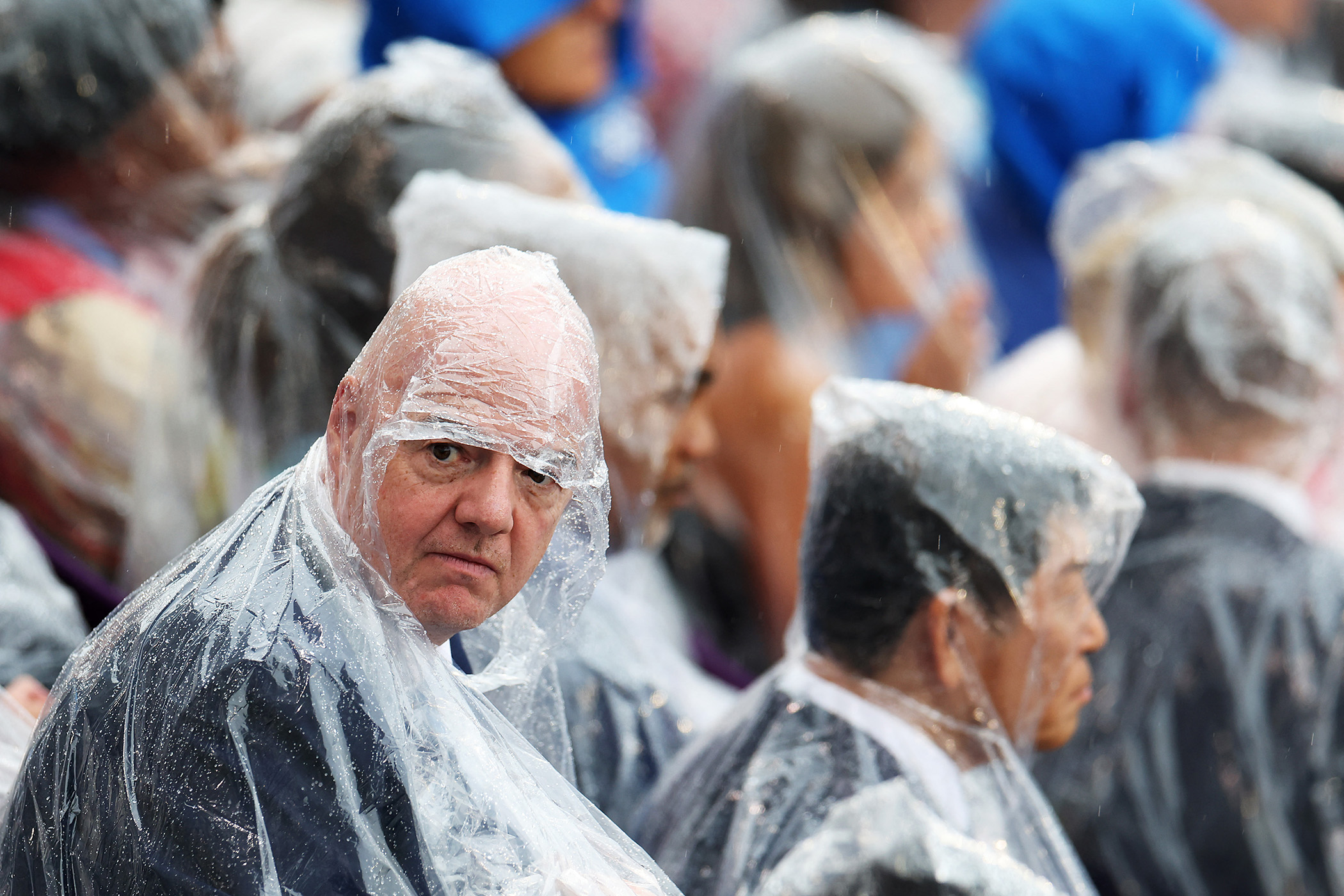


And lo, it came to pass, at the 42nd match of this World Cup, that the heavens opened, as foretold in the build-up by the meteorologists and the doomsayers alike. There was lightning in the air in Philadelphia, and therefore, by extension, over Salford, where the BBC’s Kelly Cates bravely turned her face into the coming storm while processing the no doubt intimidating realisation she would now be obliged to shelter in place for an indefinite period with only Gaël Clichy, César Azpilicueta and Olivier Giroud for company.
I mean, don’t get me wrong: nice guys, clearly. But none of them, I would tentatively suggest, had done anything at the tournament up to that point to make them anyone’s first pick for a potentially limitless unscripted conversation during an extended suspension of play between France and Iraq. Giroud, in particular, seemed at that moment poised on the verge of an experiment that might definitively establish whether having indisputably lovely eyes is, on its own, enough to sustain two hours of live television in an emergency.
I can’t remember time hanging so heavily since double physics in Year 9. Talk about airless. Those Salford windows, you sensed, would have been misting up if they hadn’t been fake. As Monday became Tuesday, the producers sensibly resorted to naked gap-plugging – a repeat of an Ollie Watkins press conference, extended highlights from Argentina v Austria, another chance to see Eilidh Barbour’s report from the Scotland camp, a further opportunity to appreciate how Uruguay v Cape Verde had panned out the night before… And then they gave up altogether and switched to BBC News for an hour, which, I would speculate, few of us watching would have wanted because we can get that at home.
By the time we returned, just before 1am, Cates and company had called it a night and it was left to Steve Wilson and Stephen Warnock to see this one out from the commentary box. At which point it became uncomfortably apparent that you can screen World Cup football fairly successfully without any kind of studio, any kind of presenter or any kind of pundits. But let’s whisper this, in case we give the BBC ideas.
In their open-backed Manhattan loft, the ITV team must have breathed a sigh of relief that lightning had struck the opposition first. Would they have coped any better? Probably not. Then again, that viral outbreak of memes in week one has shamed their producers into upgrading Emma Hayes from a blackboard and chalk to a magnetic tactics board with coloured checkers, so I guess that’s at least 25 minutes covered in the event the weather turns nasty again.
Which you wouldn’t bet against. Pierluigi Collina, the head of Fifa referees, has, unsurprisingly, failed to persuade the climate to join him in his war on tempo disruption at this World Cup. Then again, he’s also failed to get Fifa itself to come on board. For all the loopholes – carefully closed around substitutions, throw-ins, goal kicks, injuries, etc – each game now has two gaps you could drive a lorry through in the form of the hydration breaks, ritually booed in the stadiums along with shots on the big screen of Gianni Infantino.
Join in at home, why not? These three-minute pauses for fluids, even in a relatively crisp 19 degrees in Boston, are a “player safety” matter, allegedly, and coincidentally worth about $250m (£189m) in additional advertising revenue. ITV’s personnel, quite rightly, speak darkly of them, but at the same time the channel is making enthusiastic use of the dead air to tout its pay-to-enter World Cup prize draw, so it’s fair to say its money isn’t quite where its mouth is on this one.
But there’s no underplaying it: football is being quartered in front of our eyes, and those of us who love the game must rise up to wrestle this craven development to its immediate post-tournament death, much as we did the vuvuzela after South Africa 2010. One notes the hydration break was scrapped for that delayed second half between France and Iraq. So much for the tournament’s crucial integrity, then. But so much, too, for weather delays bringing only harm.
Photograph by Pascal Le Segretain/AFP via Getty Images
Newsletters
Choose the newsletters you want to receive
View more
For information about how The Observer protects your data, read our Privacy Policy