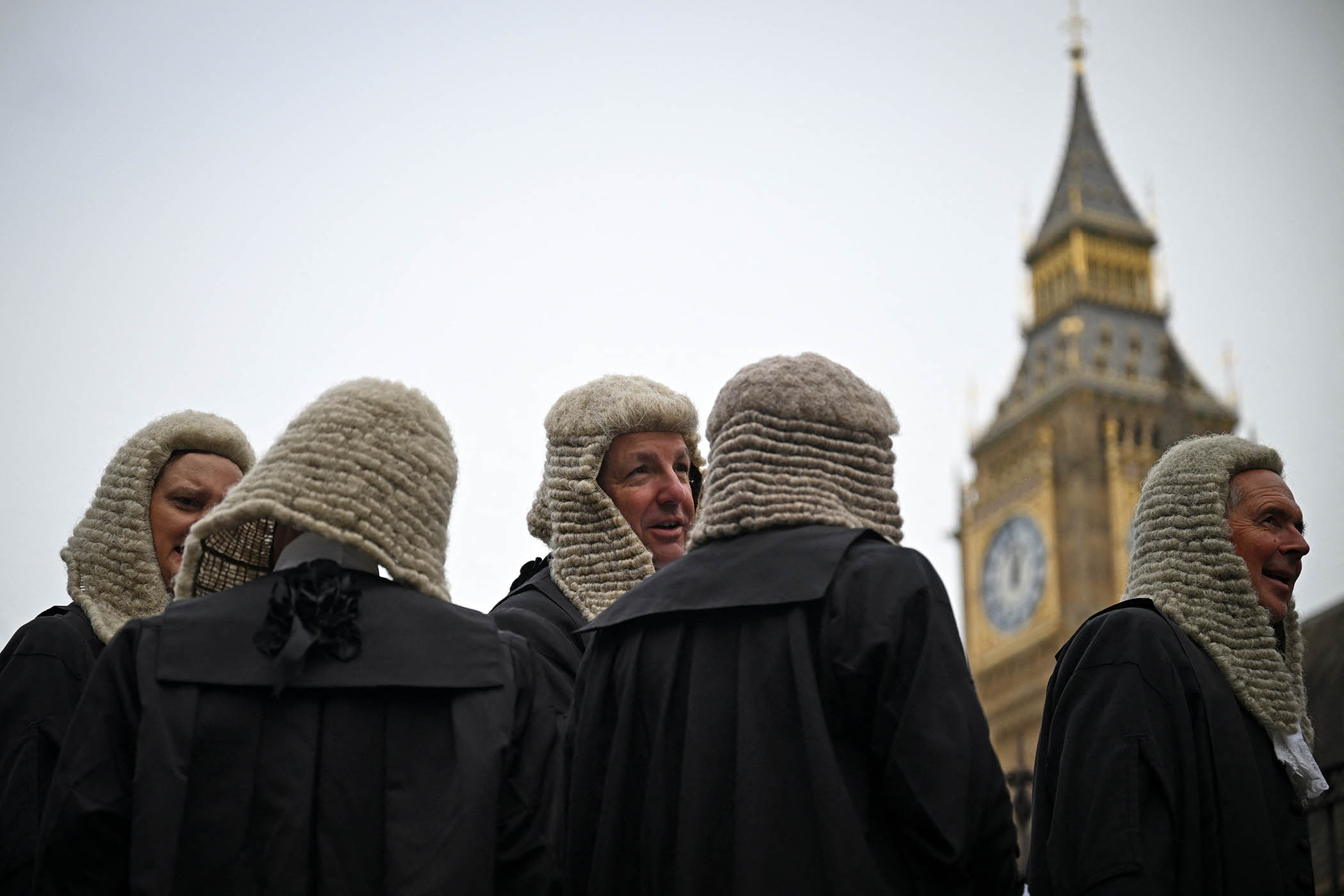


Paul Foster, Labour MP for South Ribble says that this is “the Lords at its worst” (“MPs who opposed assisted dying seek to revive bill in face of Lords filibustering”, 26 April). He states that he will bring the exact same bill back if he gets high enough in the ballot. He would be wrong to do so.
Claims that the House of Lords filibustered the bill’s second reading strikes me as both inaccurate and unhelpful. A filibuster implies a coordinated attempt to run down the clock and block progress through procedural delay. What happened in the Lords looked to us healthcare workers far more like the chamber operating exactly as it is designed to: giving space for detailed, concise and often deeply personal contributions on an issue that touches ethics, medicine, faith and autonomy. The Lords debates included discussions on amendments on coercion, prognostication and mental capacity. These are areas that affect our practice in health and social care frequently, and are a reason that a number of medical associations have spoken out against this particular bill.
To label this as obstruction is to misunderstand the nature of the revising chamber. Many peers who spoke did so because they have expertise and believe the stakes are profound. Debate has been detailed and nuanced. These discussions are essential, and those of us who will be affected by this legislation should rightly be able to raise potential future pitfalls and concerns.
Prof Mark Taubert, Clinical Director & Consultant in Palliative Medicine Velindre University NHS Trust, Cardiff
Rejoining, seriously
The economic case for EU membership has always been unanswerable (“Rejoin EU to boost economy and revive your premiership, prime minister is told”, 26 April). The problem has been that the EU’s political structures are a democracy-free zone, an environment where William Keegan’s creation Sir Douglas Corridor thrived.
Restoring a sensible economic link with Europe will be seriously difficult if the significance of the political isn’t taken into account. The EU won’t want other member states to think that getting back in will be painless if they opt out. It will take a serious government with a serious long-term view of the nation’s interests to solve this. What are the chances of us getting one?
Nik Wood, London E9
Your editorial on rejoining the EU (“The Observer view: Keir Starmer must find the courage to rejoin the EU”, 26 April) ends by stating that it is “not too late to say out loud that governments, like voters, can change their minds”. A necessary condition for an application to rejoin being favourably received by the EU will be demonstrable strong public support, not solely the current policy of a political party that happens to be in government with the potential for it to be reversed after a general election.
I suggest that a referendum will be imperative. And, for reasons outlined in the editorial, with consistent polling evidence showing increasing support for rejoining, why wait any longer to initiate the process? The courage needed by Keir Starmer is not to break manifesto red lines, but to seek a new mandate by initiating a referendum.
David Newens, Milton Keynes
Newsletters
Choose the newsletters you want to receive
View more
For information about how The Observer protects your data, read our Privacy Policy
Finance isn’t AI-ready
While concerns from banks and regulators around the risks of Anthropic’s AI model, Mythos, are understandable, cybersecurity threats are only one of many AI risk vectors in sectors like financial services (“Anthropic’s Mythos AI heralds a new era of cybersecurity warfare”, 24 April).
Prematurely deploying AI systems into critical financial infrastructure without the necessary levels of assurance, traceability and control, pose a far greater threat. Reports of unauthorised access to Mythos, via a third-party, underline that the vulnerability is not just what these models can do, but how they are being managed and deployed.
Currently, AI models lack the skills to audit, explain and govern independently in high-consequence environments. Without this, institutions risk embedding opaque systems into the very infrastructure they are trying to protect.
In the banking sector, AI systems must be transparent and controllable, with a clear understanding of how decisions are made. It must be engineered with robust guardrails, clear accountability and the ability to intervene when behaving unpredictably. As AI moves into real-world deployment, performance at the operational layer will matter as much as governance.
The question is not whether AI will become embedded in financial systems; it will. But rather, how we build the foundations first, or risk retrofitting them after failure.
Amy Nauiokas, CEO, Anthemis, London W1T
Peer review
Plans to strip disgraced peers of their titles acknowledge a problem, but focus on the aftermath rather than the cause (“King’s speech will present bill to strip disgraced peers of their titles”, 22 April).
Too often, those in high office face limited or inconsistent consequences for serious breaches of standards. Some move on to other prominent roles or honours, reinforcing the sense that the rules are not applied evenly.
If standards are to mean anything, they must be enforced. That requires clear rules, independent oversight and sanctions that reflect the seriousness of the offence.
In the most serious cases, that should include proper criminal investigation and, where appropriate, prosecution.
Without that, reforms risk looking like symbolism rather than genuine accountability.
Olly Buston, Director, Clean Up Westminster, London EC4V
Gandalf knew best
Is it too fanciful to believe that US policy is being driven by a mid-century UK novel written by a professor of Anglo-Saxon? One of the most powerful tech companies in California is named after the seeing stones in The Lord of the Rings. The US president posted a picture of his healing hands on a sick man, referencing the healing power of the rightful King of Gondor, in Return of the King.
JRR Tolkien’s saga may give encouragement to Palantir and Potus, but Gandalf the Grey warns “Perilous to us all are the devices of an art deeper than we ourselves possess.”
John Rowley, Wolverhampton
Hate to break it to Leeds…
I enjoyed reading Rory Smith's article (“Sixty years of hate: Leeds fans on the roots of their Chelsea grudge”, 25 April).
However, some Chelsea supporters feel they too have good cause for their antipathy towards Leeds.
I attended the FA Cup Final at Wembley in 1970, as a 13-year-old, my friend and I having inexplicably got tickets in the, albeit friendly, Leeds end of the ground.
Their good nature belied the tactics of the day employed by Don Revie, which I would call “a process of intimidation”. Young though we were, it was not lost on us that the Leeds side were better than Chelsea by a country mile, especially in that first encounter. But the difference between Chelsea and other sides of the time was that they, with Ron Harris, Eddie McCreadie and Tommy Baldwin, were not prepared to be steamrollered into submission by the likes of Jack Charlton, Norman Hunter and Billy Bremner. Hence the irresistible forces v inanimate objects battle of Old Trafford, which we had to watch on an old black and white TV because our dads wouldn’t let us go to Manchester for the replay.
Many years later Bremner was asked in a documentary “What was it between you and Chelsea?” His answer was, uncharacteristically, diplomatic: “Oh, you know, it was six of one and half a dozen of the other.” Baldwin’s characteristically blunt response to this was, “No. They hated us and we hated them.” And that, for me, was the whole situation in a nutshell.
Ashley Gunstock, London E11
Photograph by Justin Tallis/AFP via Getty Images