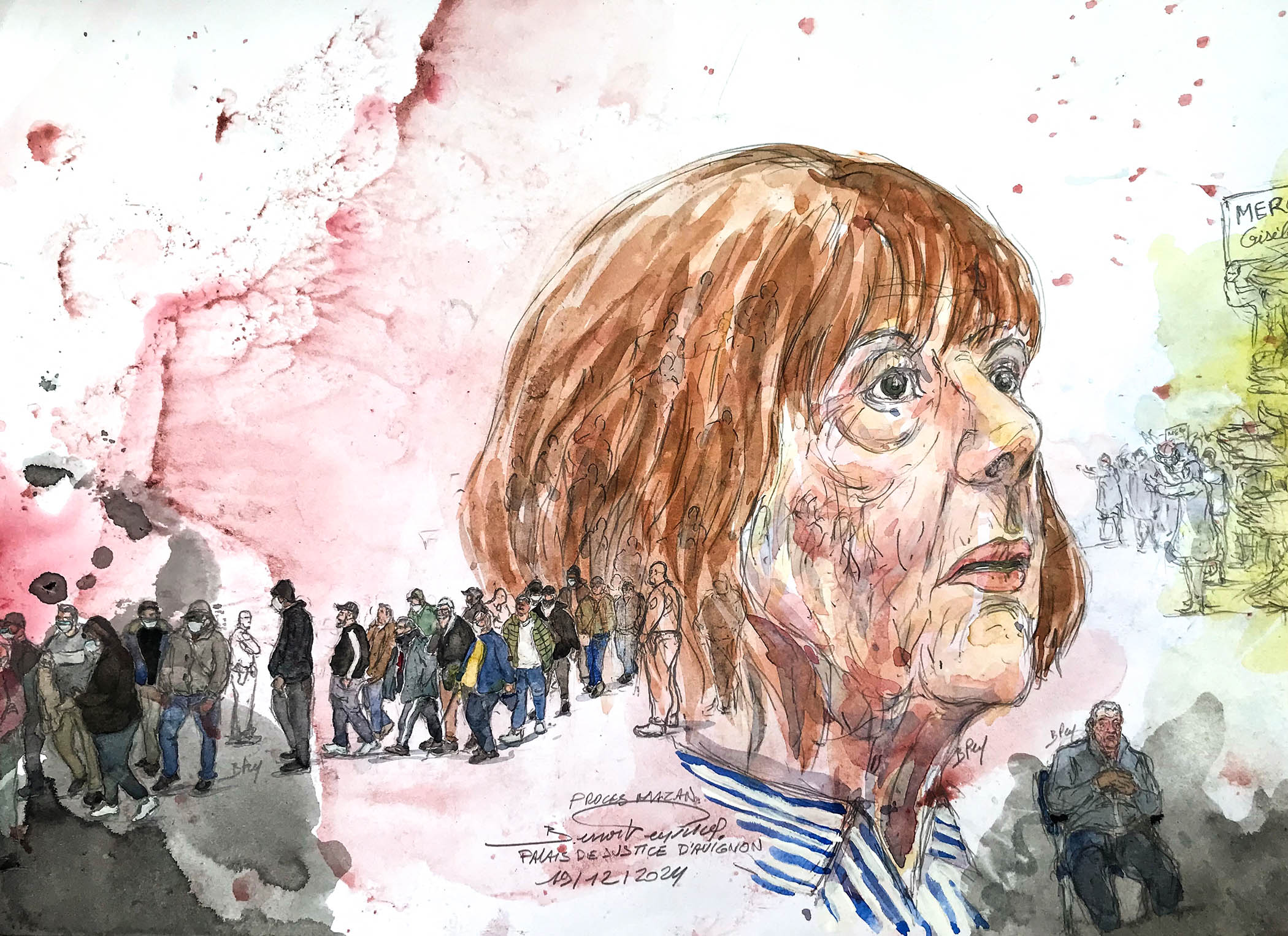



The judge didn’t like the word “rape”. During the 2024 trial of the then 71-year-old Dominique Pelicot and 50 other defendants, hundreds of videos would be played to the court in Avignon, showing in graphic detail the sexual crimes committed against his unconscious wife, Gisèle Pelicot, over nearly a decade. But to describe what was happening in the footage as rape, the presiding judge claimed, would be to deny the defendants the presumption of innocence. The videos should instead, he suggested, be referred to as “sex scenes”.
The defendants had the legal right to be considered innocent until proven otherwise. But that phrase, “sex scenes” (rather than, say, alleged rape or myriad others), evocative of fiction or pornography, played into the hands of the defence. The men who raped Pelicot often framed themselves as participants in a make-believe.
Mahdi Daoudi, 36, claimed he believed he had entered “an agreed-upon scenario” between husband and wife. Saifeddine Ghabi, 37, said he too assumed he was acting out a “scenario”. Cendric Venzin, 44, who raped Pelicot on two occasions, said they were part of a “fantasy”.
It’s an old defence – she asked for it – updated for an era of amateur porn and fetish chatrooms. Never mind that in some footage, she snored; never mind that her body was so limp that multiple defendants admitted they thought she was dead. If it was all a kind of fiction, if she was only pretending to be asleep, then the crime never took place at all. If this was a sex scene, there is no crime scene.
These tricks of language enabled so many of the defendants to insist over and over that they were not “rapists”, even when they accepted they’d had sex with Pelicot without her consent. Simoné Mekenese, 43, declared: “I’m not a rapist! People say that I’m a rapist, just because there is this word: ‘non-consent’.” Another said: “The word doesn’t represent me.” The wife of one defendant insisted her husband could not be a rapist. “Is it the term that bothers you?” the prosecution asked. Yes, she replied. “It’s the word that is violent.”
As she listened to the judge ban the word rape, Pelicot remained silent. “I was fuming inside but from where I sat, I couldn’t react,” the 73-year-old recalls in her memoir, A Hymn to Life: Shame has to Change Sides, written with the help of the French journalist Judith Perrignon. When it was her time to speak, Pelicot told the court: “Don’t talk to me about sex scenes. These are rape scenes.” Watching her assailants deny what they had done to her, despite all evidence, Pelicot observed: “There were old men, bald men, men with paunches, men who were young and athletic … But they did share one thing: a sense of entitlement. An attitude of complete indifference to whatever anyone said or thought, because power had always been on their side.” They believed they had the power to deny what was evident. But after every denial, the prosecution would ensure a video was shown. “Ghastly as this was,” Pelicot notes, “it was a searing refutation of all the devious falsehoods.”
In her memoir, Pelicot is attentive to the language of sex and violence – be it in the bedroom, the chatroom or the courtroom. As she describes her ordeal – learning of the crimes committed against her, going through the criminal investigation, attending the trial and seeing her life reflected back at her in global media coverage – in matter-of-fact, defiant prose, she insists that the way we talk about rape, and the way men talk about women, matters.
She notes that in his final cross-examination, her ex-husband stated that he had wanted to “force an insubmissive woman into submission”. She pauses in her book over that word, “insubmissive”, wondering what it might really mean. “He expected me to be the plaything of his expanding fantasies,” she concludes. “In the end, I was punished for saying no.”

Pelicot was in her 60s when she started to forget. She had no memory of what she had done on her birthday, the previous day. She couldn’t recall going to the hairdresser, but her reflection showed a new haircut. She knew her children had come to visit: had she said goodbye? She would become lost when talking with friends, who would ask her: “Don’t you remember our conversation?” She became afraid to drive. She was moving through “an immense fog”. She found a bleach stain on her trousers. She joked to her husband: “You haven’t been drugging me, have you?” She was confused when he reacted to the joke with alarm.
She suspected she had Alzheimer’s, or a brain tumour like the one that killed her mother. Her husband beside her, she went for a brain scan. When it was inconclusive, she booked an MRI. She developed physical symptoms. She had lost 12kg. Her hair was falling out. A crown on one of her teeth came loose. She was prescribed vaginal pessaries: she had unusual gynaecological problems and seemed to be losing her continence. She told her husband that she had experienced something comparable to the moment her waters broke. He quipped: “What have you been getting up to during the day?” He reassured her nothing was wrong. But she felt she was a shadow of herself. She was convinced she was dying.
On 2 November 2020, Pelicot walked into Carpentras police station and discovered she was not in fact dying, though her life as she knew it came to an end. A police officer showed her images of her, in her own bed, in lingerie that was not hers, being assaulted by strangers. “I did not recognise those men,” she writes. “Nor that woman. Her cheek was so floppy, her mouth so limp. She looked like a rag doll.” She recognised her bedroom, but insisted: “That is not me lying lifeless on the bed. It’s a photoshopped picture.”

‘My body was telling me what was happening but I couldn’t understand its message’: Gisèle Pelicot
Pelicot uses the third person whenever she describes the images of herself. The woman’s features “melted on to the pillow … she doesn’t even have a face”. She describes her body as “a blow-up doll”, “a broken marionette”, “a doll made of flesh and blood”, “a dead weight”, a “dumping ground”, “a sack”, a coma patient and “a corpse”. She splits herself in two: there is herself, and then there is “a dead woman in darkness”.
The police revealed that Dominique Pelicot had been drugging and raping his wife for many years (the crimes date back to 2011). He was arrested when he was caught attempting to take upskirt photographs of women in a mall for the second time. The first time, in 2010, he escaped with a €100 fine, and his wife never heard “a thing about it”. (How different things might have been, Pelicot wonders now, had she only been told.)
His devices were confiscated by police, and 20,000 photos and videos of his crimes were discovered. Officers also found photos of their daughter, Caroline Darian, posed in unfamiliar underwear, and of their daughters-in-law, taken with a secret camera without their consent. He also remains a suspect in an unsolved rape and murder in 1991 and has admitted to an attempted rape in 1999. Darian believes she was a victim of further sexual abuse by her father, which he denies.
He would sneak the prescription sedatives – hidden in a hiking boot in the garage – into Pelicot’s food. He discussed the dosage with other men online (“Whatever you do, don’t give her more than 8 grams, you could kill her,” one warned.) When his wife was unconscious, he would undress her, photograph her and rape her. On the anonymous website Coco.fr, he bragged of his crimes, posted evidence of them and recruited other men to join in, asking strangers in a forum called “À son insu” (without her knowledge) if they also enjoyed “rape mode”.
Then he would invite them to abuse his wife: “I’m looking for a perverse accomplice to take turns abusing my sleeping wife at my house. She takes her sleeping pill every day and won’t even see you.” He gave the strangers that agreed directions to the house, told them not to smoke or wear aftershave, and asked them to undress outside and warm their hands with water.
It was my body, but it was also not quite mine, the way you have no memory of the scalpel cutting into flesh when you come out of the operating theatre
It was my body, but it was also not quite mine, the way you have no memory of the scalpel cutting into flesh when you come out of the operating theatre
He filmed the assaults while making demeaning comments about his wife and stored them in a folder on his computer helpfully labelled “abuse”. Between the date of his arrest for upskirting and the date of his arrest for serial rape, as police gathered their evidence, Dominique Pelicot raped his wife a further three times.
“My body did not remember anything,” Pelicot writes. “It was my body, but it was also not quite mine, the way you have no memory of the scalpel cutting into flesh when you come out of the operating theatre.” She began scouring her memory for signs – a “jigsaw puzzle in my head that I was relentlessly trying to piece together”. Her husband’s habit of photographing her when she left the bathroom. How he suggested filming her during sex (she declined). How he used demeaning language in the bedroom. The name of his email address, “Fétiche45”.
Then there were the mashed potatoes he prepared in different dishes, “since he liked his with butter and I liked mine with olive oil and parsley”. The cocktail he hurriedly tipped into the sink when she said it tasted strange. The beer that turned green. The bleach stain on her trousers, evidence of his cover-ups. The wet pyjamas she would wake up in (after the rapes, her husband would give her a vaginal douche). The loose crown (it had been dislodged by violent oral rape). “My body was telling me what was happening,” she writes, “but I couldn’t understand its message.”
Despite all this, she could not stop herself reflecting on happy memories with her husband and struggled to resolve the inner conflict she felt towards him. “I partitioned Dominique into two, the same way I somehow managed to separate my violated body from my sense of self … The man with two faces, the rapist and the man I used to call Doumé.”
The horror of the Pelicot case in the collective imagination lies in its outlandishness, its scale, its local concentration and the surreal grimness of these ordinary details. (As Pelicot herself writes, it seems “too violent, too many men, too many times”.) But even among the terrible specificity of what she has experienced, Pelicot draws parallels between herself and other women.

People march in support of Gisèle Pelicot in Mazan in October 2024
At an appointment at the forensic medicine unit in Versailles, her hair was taken to test for traces of drugs. (“My body,” she writes, “was a piece of evidence.”). It was 9pm before she entered the gynaecological examination room. She climbed into the stirrups, “as all women have done at least once in their lives. Our bare feet on cold metal, our bare buttocks on the edge of the table, our legs spread to reveal that part of our bodies that we ourselves never see.”
Pelicot only slowly developed an awareness of those women who have gone before her – and those who will come after. She is surprised to find herself, in her 70s, “a martyr, the symbol of a new feminist wave that I hardly know a thing about”. She still proudly refuses “to set women and men against each other”, even if “this might disappoint a few campaigners”, and writes lovingly about her new partner, Jean-Loup, who she met in June 2023: “I needed to love again. I wasn’t afraid ... I know my story has fuelled disgust for men, but it has not done that for me.”
In the 1960s, she and her friends talked about Simone de Beauvoir (“we’d heard of The Second Sex though it never occurred to us to read it”) and read about the fight for birth control and legal abortion. “I understood,” she writes, but “these were not my battles.” When it was first suggested to her that she waive her right to anonymity, “as a way of staging a massive public trial of violence against women”, she “categorically refused”. Later, she would even identify with the wives and mothers of the accused, who defended them. These women “held up a mirror to the person I had once been. It reflected nothing more than the inner conflict we all feel, the wars we wage against ourselves.”
But as the investigation progressed, she began to realise “the ordeal that women go through when they report an abuser”. One day, on the beach near her new home on Île de Ré, she had an epiphany, imagining the 51 men, including her ex-husband, she would face in court. “Their voices would be louder than mine. And all their eyes would be on me as they stood shoulder to shoulder.”
In staying anonymous, she was “handing them a gift … No one would ever know what they had done to me,” she writes. “There would be no journalists present to say their names and describe their crimes. No one beyond those involved in the trial would see their faces, look them up and down and wonder how to pick out the rapists among their neighbours and colleagues, though apparently it is so very easy to recruit them.
“Perhaps most importantly, no woman would be able to enter the courtroom and feel a little less alone; if I hadn’t noticed anything, it must surely have happened to others.”
The majority of the assaults on Pelicot happened in the home she shared with Dominique Pelicot in Mazan in south-east France, the village the couple had retired to in their early 60s. Most of her confirmed assailants, of which there were at least 72, were recruited from within a 60km radius. People wondered how this could be possible. Could it really be that rapists so densely populate all our societies? Or must this be a vile and seedy place? Dominique Pelicot was described in the media as “the monster of Mazan”.
When asked by the media how such an obscene series of crimes could have happened in this quaint place, the mayor of Mazan was defensive. Most of those men weren’t actually from here, Louis Bonnet said. His village should not be forced to bear the memory of the ordeal. What happened to Madame Pelicot wasn’t nearly as bad as the recent rape in the nearby town of Carpentras: that woman was conscious when she was attacked. And it’s much worse when children are hurt, or women are killed. None of that happened here. No one died. (He later apologised.)
Surrounded by vineyards, orchards and mountains, Mazan is a quiet medieval village. But there was another “monster of Mazan”. The village is home to the Chateau de Mazan, the former family seat of the 18th-century writer the Marquis de Sade, one of France’s most notorious sexual criminals.
In an essay from her book Pornography, Andrea Dworkin condemned Sade as “the world’s foremost pornographer … rapist and writer twisted into one scurvy knot. His life and writing were of a piece, a whole cloth soaked in the blood of women imagined and real. In his life he tortured and raped women … In his work he relentlessly celebrated brutality as the essence of eroticism; fucking, torture, and killing were fused; violence and sex, synonymous.”
Some see his books as records of his crimes, while others caution against conflating fiction and reality, interpreting and defending his writings as mere sex scenes; harmless fantasies, absurd – maybe even comic – in their violent extremes.
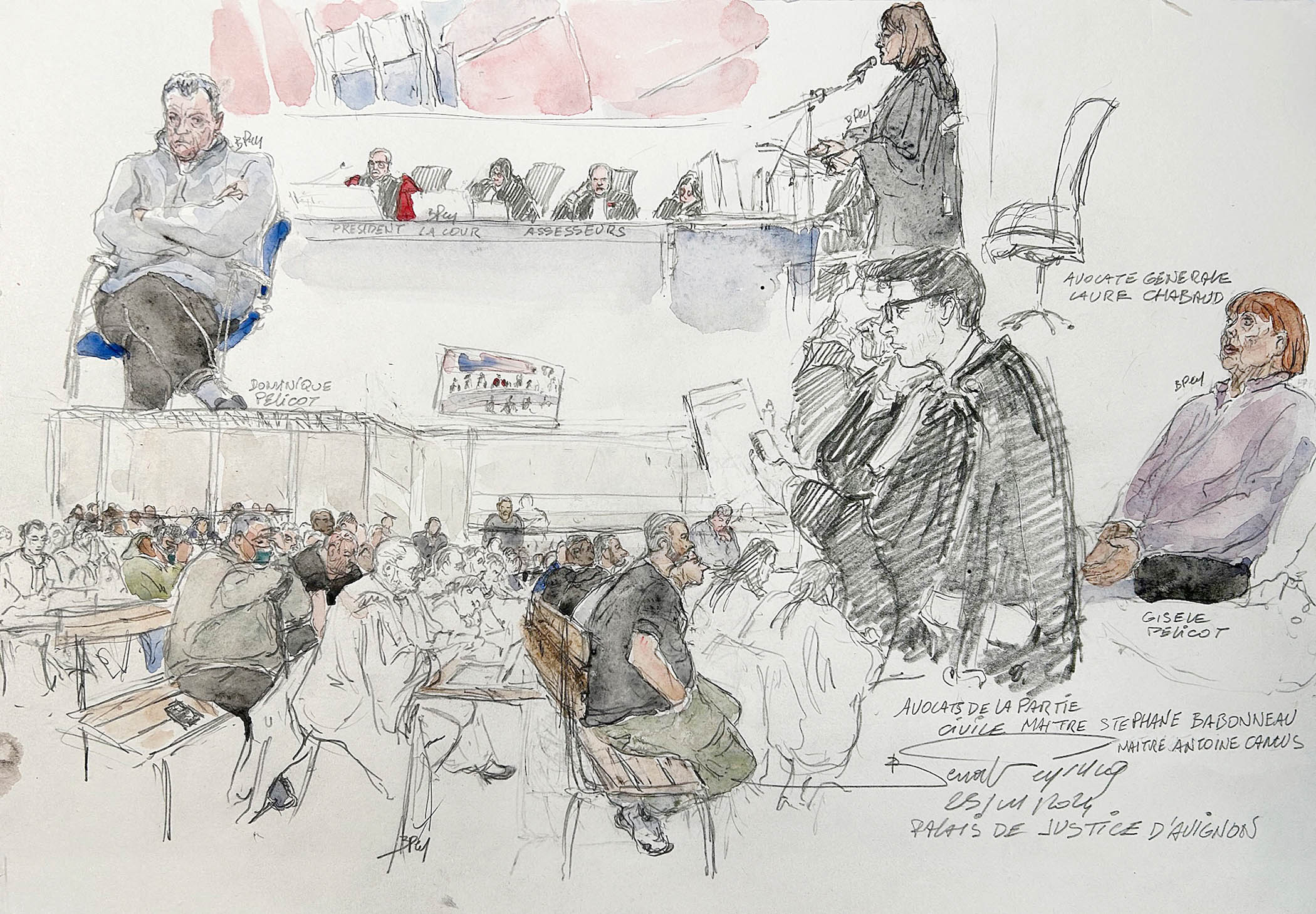
A court sketch depicting Dominique Pelicot, top left, from November 2024
Among Sade’s many documented crimes was an incident known as the “Marseille affair”. In 1772, Sade was living in Mazan when he travelled to Marseille to procure several sex workers, whom he drugged with sweets laced with poison, euphemistically referred to by exonerating biographers as “aphrodisiac candies”. Subdued, the women were whipped and forced into sex. Two became very sick, vomiting black blood. After one of them went to the police, Sade was sentenced to death in absentia on charges of poisoning and sodomy. He fled to Italy under the pseudonym the Count of Mazan.
“Chemical submission” may be new language: a phrase that is far more widespread as a result of the Pelicot case. But it is not a new crime, even to this small village. Many people believe, or want to believe, that the men who raped Pelicot are not ordinary men, but monsters. And yet here were so many of them, in one small place. In her book on the trial, Living with Men, the philosopher Manon Garcia notes that, in court, reference was repeatedly made to Hannah Arendt’s concept of “la banalité du mal” – the banality of evil – which, in French, sounds the same as “la banalité du mâle”: the banality of males. Many people want to believe that these rapes are so extreme, so inconceivable, so offensive as to be a totally isolated phenomenon. The truth – harder to accept – is that they may well not be.
In mid-December 2024, while the five judges of the Pelicot trial deliberated over the sentences to be handed out to the guilty, a group of German journalists published an investigation into the app Telegram that uncovered multiple “rape group chats” in which more than 70,000 users advised each other on how to drug and assault women: their girlfriends, wives and friends, as well as sisters and mothers. They gave each other tips on dosage, to ensure their victims were unconscious while avoiding killing them. They posted footage of their crimes. A user bragged that one of his videos had gained more than 75,000 views: “She’s a pornstar and she doesn’t even know it … I fantasize about drugging her and bringing men home to use her regularly.”
Between late 2018 and 2020, South Korean chatrooms full of sexually exploitative content emerged on the same platform. Young women and underage girls were tricked into uploading sexually explicit images of themselves, which were then distributed to tens of thousands of users. The victims were often ordered to film themselves performing further acts of degradation, including violent self-mutilation. If they didn’t, the perpetrators threatened to share explicit content with their friends, families and schools.
If the last 50 years of my life were taken away from me, I would never have even existed. I would be dead
If the last 50 years of my life were taken away from me, I would never have even existed. I would be dead
Last summer, an Italian Facebook group called “Mia Moglie” (my wife) was removed. Its 32,000 members used the group to share seemingly non-consensual photos of their naked, “sleeping” wives. Other users commented on the pictures, praising men for remaining undetected by their partners, telling them they “wanted to rape” the women pictured.
Just last month in the UK, in a disturbing echo of the Pelicot case, former Conservative Swindon borough councillor Philip Young pleaded guilty to 48 crimes against his ex-wife, Joanne Young, including rape, sexual assault, assault by penetration, voyeurism and administering a substance with intent to overpower to allow sexual activity.
The incidents took place between 2010 and 2023, after Philip Young stepped down as a councillor in order, he said, to devote more time to his family. He also admitted to publishing more than 500 intimate images and videos of his ex-wife online without her consent. In the same case, five other men were charged with offences including rape and sexual assault: one pleaded guilty to rape this month, while the other four have denied the charges. Joanne Young, like Pelicot, has waived her right to anonymity. She watched on silently as the pleas were entered in court.
The role of the internet – online pornography, dark web crime networks, covert chatrooms – in encouraging and facilitating these crimes is murky. We can see that someone such as Dominique Pelicot borrowed language and imagery from pornography, was coached by strangers online and recruited his co-conspirators on fetish sites. (Coco.fr was shut down after it was linked to more than 23,000 criminal reports in France, including rape, paedophilia and murder, but comparable sites – among them, one with a similarly themed name that presents itself as an “alternative” – have appeared since.)
In an ironic inversion of De Beauvoir’s famous maxim on womanhood, Dominique Pelicot told the court: “One is not born a pervert, but becomes one.” But to what extent did pornography and online reinforcement feed into his violent desires and enable him to dehumanise his living, breathing wife?
To blame such extreme acts of violence on something as commonplace as the consumption of taboo or misogynistic pornography seems wildly reductive; worse, it may lead us to fail to distinguish between sex scene and crime scene. But to attempt to create a neat and tidy boundary between dehumanising sexual fantasies and the widespread, real-world objectification of women – as if one had no overspill into the other – seems criminally naive.
For Pelicot, the horror of what happened to her was not limited to the rapes themselves, but spilled out into the way she was depicted and objectified – in image and in language – by her husband in his private documents and public brags online, by her assailants in official statements, by the investigators in police stations, by the magistrate ahead of the trial, by the prosecution in court, by the media, by onlookers – and even by her own lawyer.
As a victim with no bodily memory of the attacks themselves, but with access to an unusually large body of evidence of the crimes, witnessing them and hearing them described became its own trauma – “like being raped all over again”. She is sickened by the “sordid”, pornographic comments her husband made about her. In one video, he affixed a sign to her unconscious body that read: “I’m a submissive slut”; the file names he gave to the videos, read out repeatedly in court, similarly take their terminology directly from pornography and are too obscene to list. Caroline Darian is similarly horrified by her father’s language, writing in her own memoir: “His vocabulary is crude, humiliating, demeaning … Who is this man who proclaimed a boundless admiration for his wife and yet talked about her in such degrading terms?”
The interviews with other men, let alone the videos, were “sufficient to haunt” Pelicot: “Afterwards I could only recall fragments, I couldn’t take it all in, it was too crude.” Reading the facts of the case, “written down in black and white in language that managed to be both vulgar and official”, was “unspeakably cruel”. When Pelicot’s own lawyer, from whom she parted company before the trial, read her interview transcripts, and “added her own coarse, even crude, comments as if we were old friends, or some kind of commando taking revenge on the filthy bastards who had used me like a blow-up doll”, Pelicot “wished she would filter her words, protect me from them”. The lawyer appeared on a TV show called True Crime Tales; Pelicot was horrified. “The woman they were talking about on television, who ‘had been raped two hundred times’, everyone constantly banging on about the number as if it was a world record – two hundred times! – was obviously me, but I couldn’t reduce myself to that.”
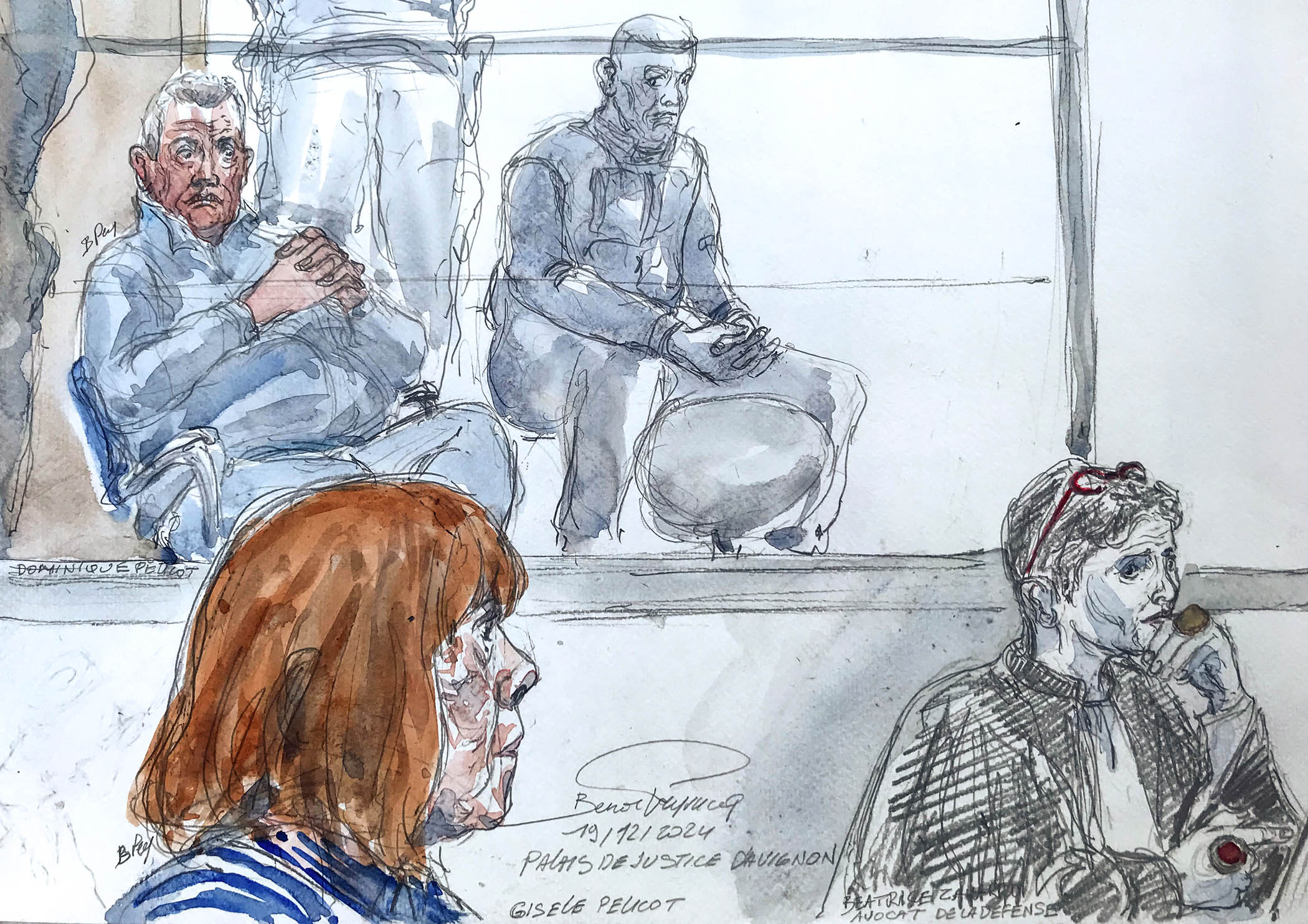
Gisèle Pelicot reserves the greatest scorn in her book for the defence lawyers
The case, she writes, was “catnip for the lurid tabloid newspapers at the backs of newsstands,” publications that “have no merit apart from reminding us that there is no hell except on Earth”. (Darian, too, condemns the journalists who “dip into the trough with their speculations, extrapolations, and hunger for salacious detail, before stepping back, wiping their chins and congratulating themselves on their table manners. I had no idea a press card absolved its bearers from such a multitude of sins.”) In court, one of Pelicot’s assailants casually declares: “I didn’t have time to shop around, so I just went for whatever came up first. [Given the choice] I would have picked a prettier one.” Pelicot writes that hearing the comment “was like being punched”.
At other times during the trial, she would choose to let the words of others “rise and float away in the courtroom. It was humiliating to listen to their dissections of my life, my mind and my body. As the proceedings went on and one after the other medical and psychological experts gave evidence, I heard discussions of my age, of women of my generation, of my average IQ, of the number of my orgasms; I heard detailed descriptions of each of my orifices, its colour and secretions, as if I were laid out before the whole assembly, as well as appearing naked and unconscious on the screens.”
Even the positive coverage of the trial was its own objectification, as it became an international story, and Pelicot was turned into a symbol of feminist resistance around the globe. Leaving the Palais de Justice at the end of the trial, amid singing, banners in French reading “Thank you, Gisèle” and camera flashbulbs, Pelicot writes, “was all too much for me. I was no more than a reflection, the object of public discussion.”
Her greatest scorn is reserved for the lawyers, especially the women, who theatrically demeaned her in court. One of “the heavyweights in a black gown” insisted that a video showed her pelvis moving: proof that she was conscious. She refuses to name the lawyers or the defendants in her book: “Not out of any consideration for them – their identities are easy enough to find online or in the court records – but so that they will be remembered only for what they are: parrots, deplorable mouthpieces, violent, cowardly little people. I want all that remains of them to be the words they used to trample upon me, to reduce one woman – and therefore all women – to absolute submission in the name of male domination.”
In Pornography, Dworkin writes that if “male supremacy is fused into the language … No transcendence of the male system is possible as long as men have the power of naming ... As Prometheus stole fire from the gods, feminists will have to steal the power of naming from men.” Names and renaming, the vocabulary of objectification and the vocabulary of empowerment, and the healing role of memory and memoir are important in Pelicot and Darian’s books, albeit in starkly different ways, illustrating their distinct approaches to the crimes of Dominique Pelicot and the rift that both acknowledge has opened up between mother and daughter.
Darian believes she is a forgotten victim in the case, also abused by her father: she is also a victim of lack of evidence, of doubt, of disbelief, of absence. Pelicot does not share her daughter’s unshakeable belief. She writes that “without evidence, without a confession, I could not bring myself to say that the irreparable had taken place”.
Both feel hurt and abandoned by the other. Pelicot writes, quoting her daughter: “‘My mother was raped, yes, under the influence of drugs, yes. The only difference between my mother and me is that in her case there is proof. For me, it’s an absolute tragedy,’ Caroline said in court. That ‘yes’ she repeated felt like a blade to me; she was cutting her pain from mine, setting the two in opposition.”
Pelicot admits that “my daughter, in her woman’s body, is haunted by a horrific, tragic experience,” but adds: “I find it harder to understand [her] violent words.”
Pelicot has determinedly kept her married name in public, wearing it like a badge of honour, refusing for it to become shameful. Darian – whose memoir is titled I’ll Never Call Him Dad Again – has separated from her father’s identity, taking a new one of her own, forged from the names of her brothers, David and Florian, who have stood by her. Darian, hearing of what had happened to her mother, was so upset she tore up family photographs and other mementos: “All our holidays and Christmases, our youth, their childhood – she ripped up the lot,” Pelicot writes.
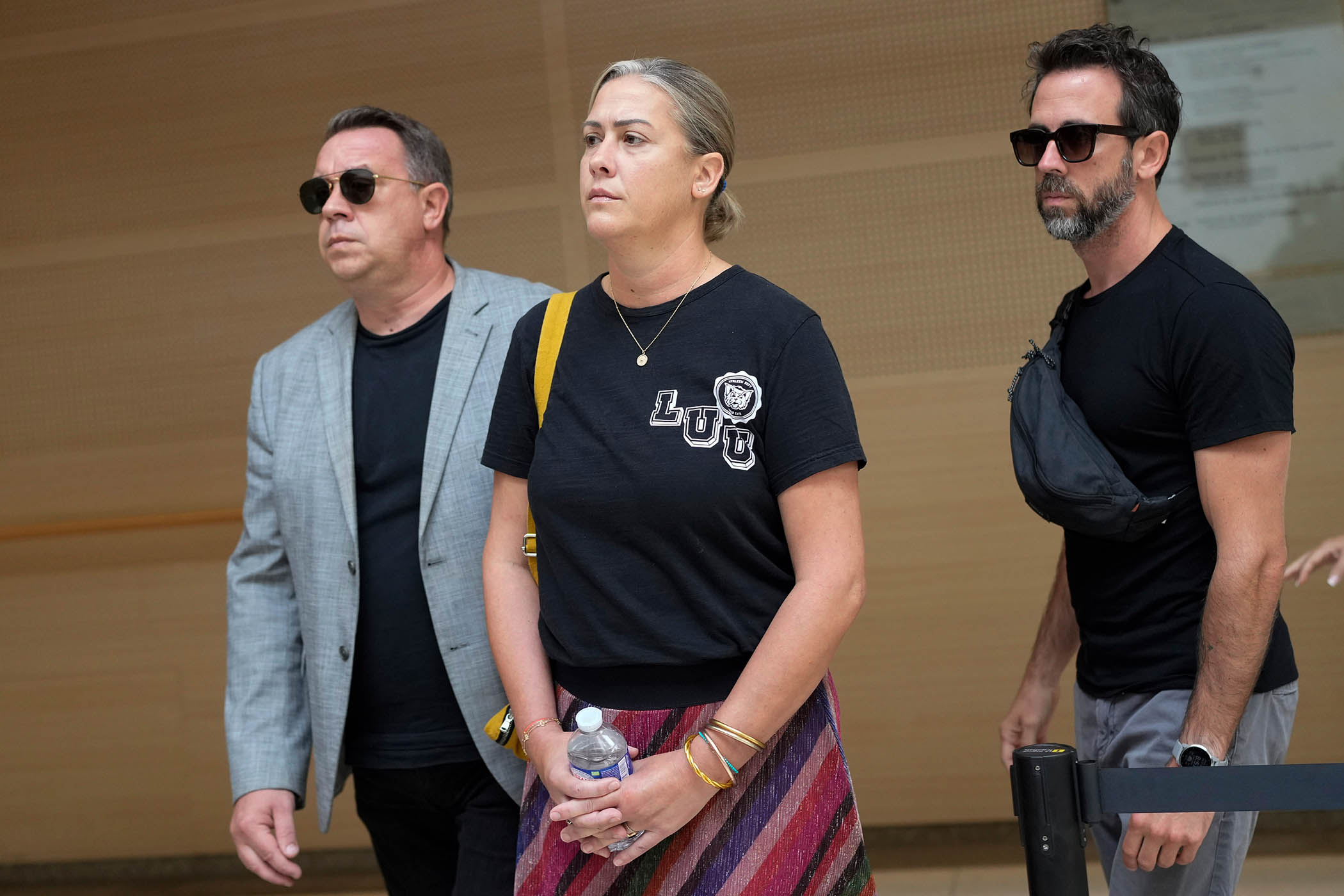
Caroline Darian with her brothers David Pelicot, left, and Florian Pelicot
Pelicot clung to her memories as an act of defiance. “I wanted to hold on to those pictures of a father, a husband, a family built by two messed-up kids.” She repeatedly mentions how she tried to remind her children of “happy”, “lovely” times in the family and was baffled when this only seemed to hurt them more. Her children find her mixed emotions evidence of unfathomable denial. To Pelicot, they “dumped the past at a recycling centre where everything is separated into glass, paper and plastic, but they were unable to distinguish their father from the poisoner and the rapist”.
Meanwhile, Pelicot took on the job of “protecting our memories”. “Sometimes, after a house fire, a few walls are left standing; though blackened and burnt they are still there, perhaps showing the outline of an old staircase, a pattern of wallpaper that needed changing, or a trace of footsteps and moments of togetherness … I was looking for a few relics among the ashes. I could not face losing everything. I was fighting to keep those walls standing, to keep myself upright. If the last 50 years of my life were taken away from me, I would never have even existed. I would be dead.”
Though so many of Pelicot’s memories were stolen from her, she still believes “in the power of memory” – and the power of memoir. “It fills me with relief to think that a woman who wakes up, unable to remember what happened the night before might think of me – or rather my story,” she writes.
Ultimately, she insists that hers is not a fantastical tale of “a procession of monsters”, but one of “ordinary men and women … our bedrooms, our relationships, our families, our sewers. This story stirs up our violence, our barely concealed sordidness, our dormant traumas, our silences, our equivocations. It is the grubby reflection of the domination and predatory activity that still structure our world.”
For both mother and daughter, memoir is an act of rebellion against what happened to them. It is the end of silence, unconsciousness, forgetting, unknowing. It is the start of consciousness; the start of change.
Illustrations by Benoit Peyrucq / AFP
Photographs by Dorian Prost/Pasco&co, AFP/Getty Images, AP