There was definitely nothing strange about my childhood. Which child in the early 1980s didn’t devote her primary-school lunch breaks to learning calligraphy and reading Pepys’s diary (abridged; I’m not a freak)? Who, dressed to kill in their Free Nelson Mandela sweatshirt and navy Kickers, didn’t spend weekends whittling bows and arrows, trying to master Ancient Greek and digging for flint axe heads? Absolutely normal. Nothing to see here.
At least, by Oxford standards. For every cool kid, into drugs and, er, [insert cool thing here] there was a little me, trying to build a scale model of a Roman catapult with used matchsticks, and worrying about the decline of Mayan civilisation. It made me the weirdo I am today. I offer this column, and most of my novels, in evidence. And, no, it hasn’t been easy, being at the back-front – no, front-back… OK, the rear – of fashion, particularly once (the moment I could) I moved away. Even now, nobody would say I pass as standard, but I do try not to go Full Niche among my peers.
The problem comes when I meet my father: a brilliant man self-dragged by his bootstraps into academia, and even more peculiar than I am.
What child hasn’t thumbed through Confessions of an English Opium-Eater and longed to know more?
What child hasn’t thumbed through Confessions of an English Opium-Eater and longed to know more?
In childhood our museum visits were limited, but now I am an “adult”, and we can go to exhibitions almost as often as I like. Last time it was the Pitt Rivers, the museum to which all others should aspire. Incredibly, miraculously, you can enter for free. Britain still has a few points in its favour. Have you ever seen a parka made of seal intestine? Do you wish to fashion armour from a rhino, or turn insect parts into fishing hooks? For excellent reasons its shrunken heads, along with certain other dodgy colonial plunder, are now out of sight. But its ancient cabinets are still stuffed with anthropological and archaeological treasure: English wart remedies and Manitoban sphagnum-moss cradleboards, penis sheaths, obsidian archer’s thumb-rings, a German military helmet repurposed as a Naga dancing headdress, Panamanian pelican-bone flute necklaces and Sarawak bear-tooth charms, all charmingly identified in handwritten sepia. We stuck to Arms and Armour, for reasons of time, and – as usual – got quite serious giggles; if you saw a dishevelled father and daughter tottering about the upper gallery, snorting and clutching their sides as they viewed profoundly violent weaponry, you should have said hello.
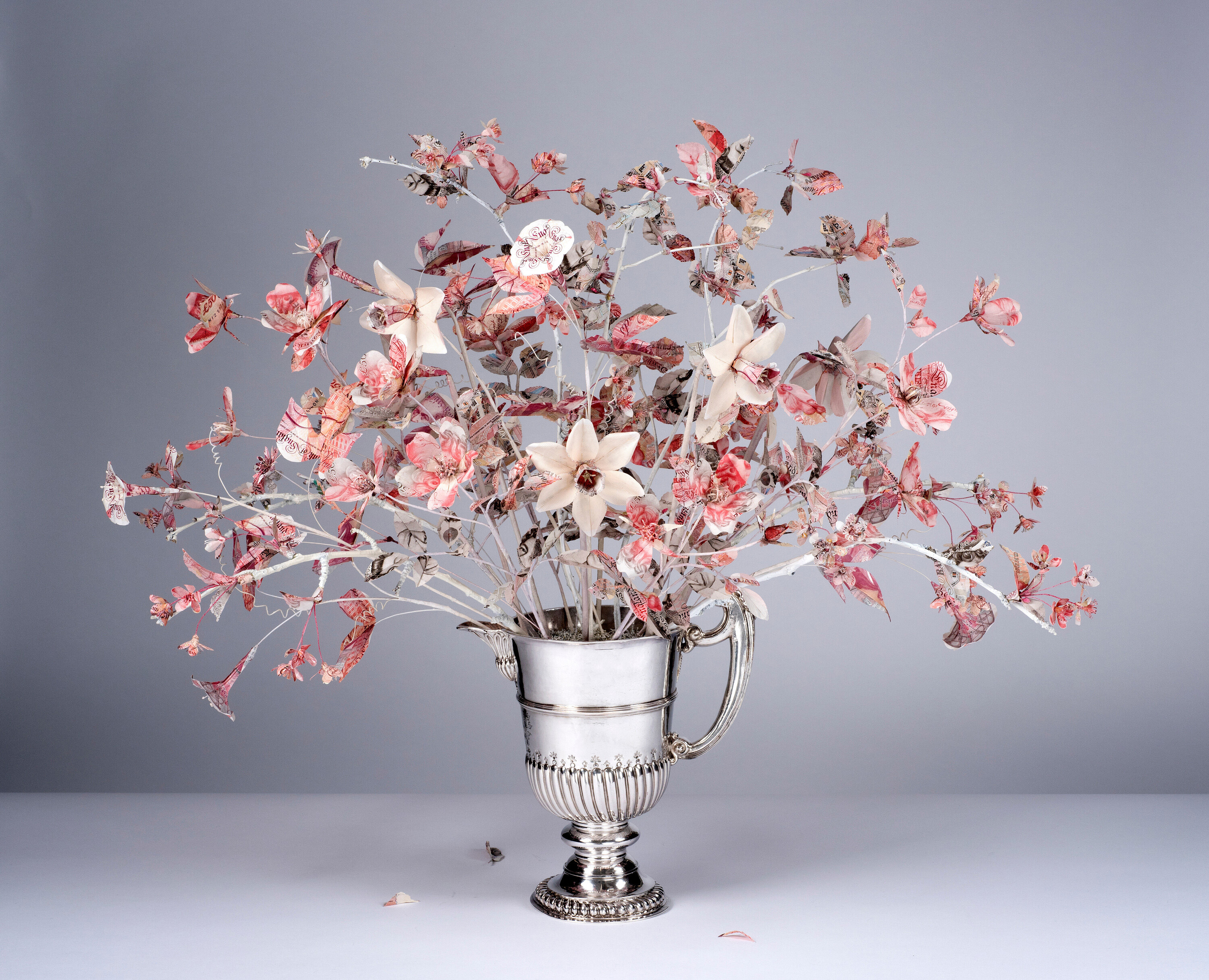
But on this visit, such fripperies were not for us. There were flowers to see at the Ashmolean Museum’s In Bloom exhibition: a wide-ranging, intelligent, satisfying show about humanity’s fixation on exotic plants, and the orchid collectors, merchants, smugglers, scientists and artists who have been fuelled, or felled, by this obsession. I’d hoped to see beauty: Turkish plates; French roses; gorgeous modern botanical art (Fiona Strickland’s splayed parrot tulip, Justine Smith’s seed-pod-threaded Venezuelan Bolivares bank-notes sculpture); and the infinitely fascinating Dutch still lifes, including those by my favourite master, Rachel Ruysch – top-level painter, mother of 10. Whose day wouldn’t be brightened by a really close look at a rotting morning-glory, moths and worms doing their bit, or the life-cycle of a bullseye moth as it chomps through a banana blossom? What I wasn’t expecting was the strangeness: amazing 17th-century hairstyles; cheap Victorian rubber mourning jewellery; King Mithridates’s complicated antidote in case he was poisoned by his own mother; a toddler-sized pressed-flower album four centuries old; a glob of pickled latex like a brain in a jar.
We didn’t giggle. It was all far too interesting. My father spent most of the exhibition trying to remember the name of “Proust’s girlfriend in À la recherche” of whom he was reminded by Alma-Tadema’s soppy Orchids. I, meanwhile, was distracted by Robert Brendel’s enormous papier-mâché botanical teaching models; willow, St John’s wort and saxifrage stamens in throbbing, OnlyFans-worthy close-up. “Ah,” he murmured. “I think he was from the same part of Poland as my father.” Neither of us remarked on the silver and bamboo Shanghai opium pipe, inscribed with a description of “how intellectuals continue chatting and laughing and ignorance is kept out, even though the humble house has become overgrown by moss and grass”. But we loved the sniffable replica of the smell of burning opium: toffee, burnt nuts, something faecal. Such a brilliant idea: what child hasn’t thumbed her way through Confessions of an English Opium-Eater and longed to know more?
We only laughed at the end, refreshing ourselves in the cafe with paninis and carrot cake. “I don’t usually bother with icing,” he said, dropping most of it on to his corduroy knee. “When I was a child it was all so horrible, made of… plastic and recycled dogs.” I try to write down his sillier comments for rereading, although one day I’ll be too sad. We said goodbye outside as he unlocked his bicycle, a Frankenstein’s monster of mismatched saddle, handlebars, lights. Before I had to watch my beloved 82-year-old father pedal into traffic, I turned away. I had a train to catch.
Newsletters
Choose the newsletters you want to receive
View more
For information about how The Observer protects your data, read our Privacy Policy