
It is playtime at Tate Modern with the art of Julio Le Parc, whose very name sounds like a fairground attraction. Everything in this show is just waiting to spring into life. Spin the handle of a striped disc and a line appears out of nowhere in its whirling surface, mysteriously vanishing when it stops. Press a button and a mirror shivers into action, making a mockery of your face. Press another and a gigantic fan whirs into motion, growling and thrumming and flinging white banners into the air. The visitor next to me ducked.
Le Parc was born in Argentina in 1928, lived most of his life in Paris and only died there last month, on the ascent to his 98th birthday. A photograph – or rather a refraction of his face, fanning out in segments by the entrance – shows the handsome young Julio looking as hip as his work. He comes in just around the time of op art and kinetic sculpture, and you will see a great deal of both in this effervescent show, but always with a stylish Latin American slant.
What might, in other hands, be a vast chandelier of blue Perspex shards twinkles and shimmers, casting fluctuating reflections all over the walls. Blow on the elements, and the cobalt patterns shiver. Bounce red balls up and down on springs, and they send their dancing shadows against a black-and-white striped painting, turning a flat abstraction into a lively moving image.
An early painting from 1959 resembles nothing so much as a gingham tablecloth, but its squares seem to buckle and bend as you look. Closer inspection discloses no obvious method. A grid of umbrellas, black and white and grey, seems to transform into a grid of mushrooms by minute shifts of configuration, like some sort of IQ test, only pleasurable, elegant and serene.
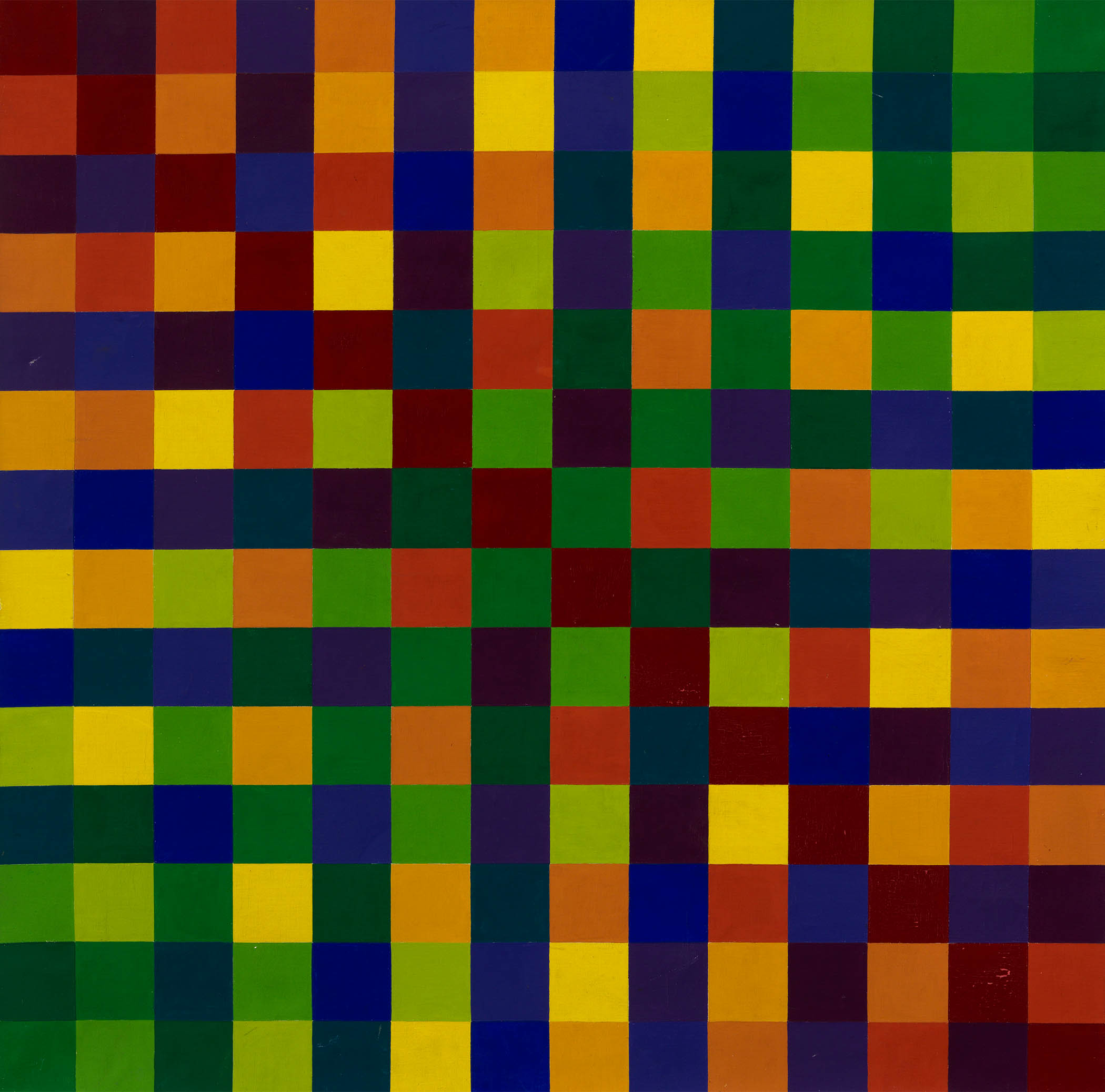
Four Juxtaposed Patterns in 14 Colours, 1959, with ‘squares that seem to buckle and bend’
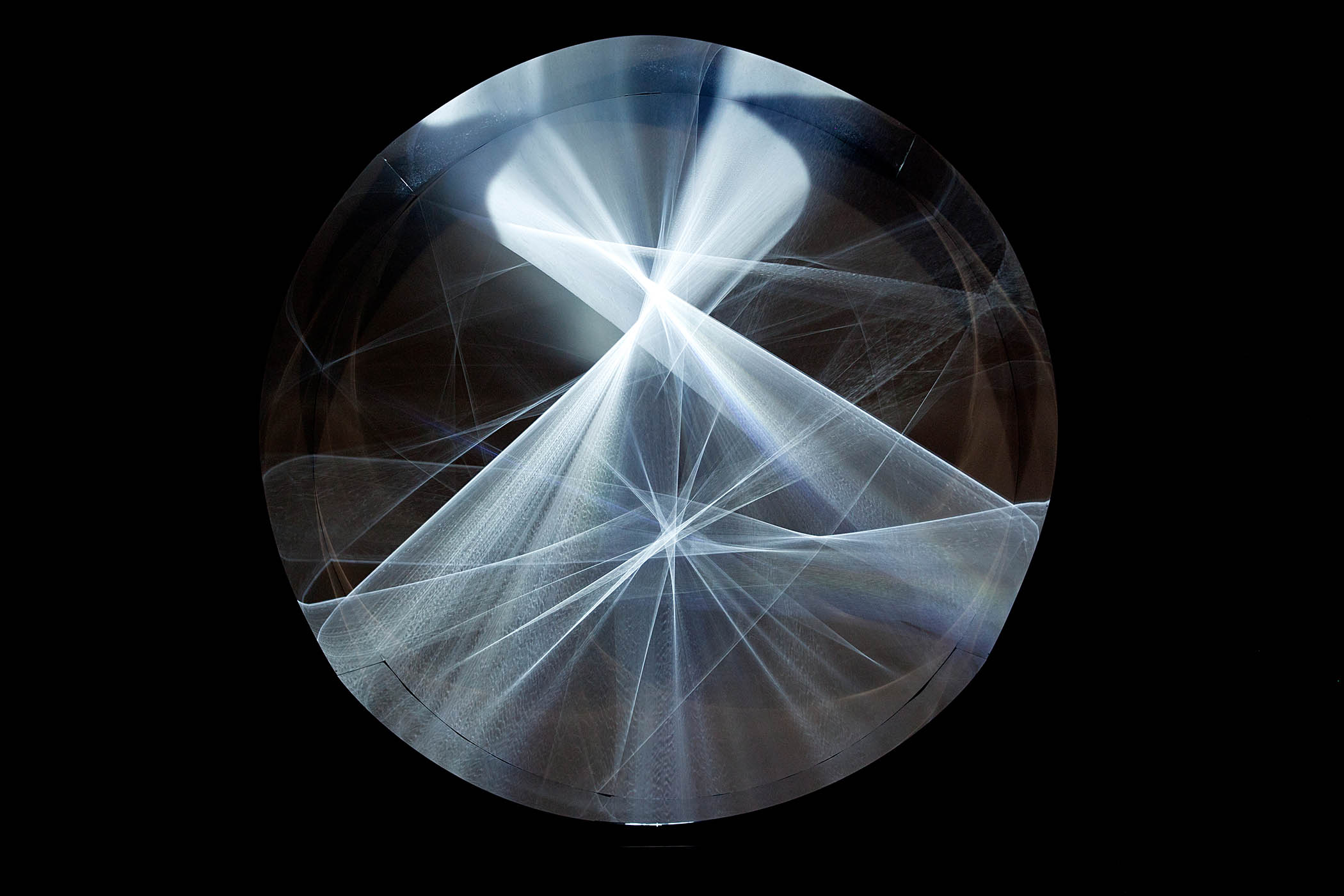
Le Parc worked with light through the 1960s, splitting beams, sending gorgeous rays and undulations all the way up to the ceiling and down to the floor. It’s like being inside wisps of smoke caught in a cinema beam in some arthouse dive. Visitors are meant to pass through his room of vibrating lights, disrupting the beams and no doubt changing the appearance of every human being in endless surprising configurations. But it is not 1968 any more, so the art is segregated behind a no-go barrier.
Still, you can rearrange the joke-shop features on a whiteboard, like the Madrileños in Buen Retiro park in the 80s, making ludicrous faces out of Le Parc’s mismatching eyes, mouths and noses. Or you can be hypnotised by the discs of green and blue slowly revolving in silver light, like the psychedelic eyes of the snake in The Jungle Book. Or simply cavort behind screens of ribbed Perspex to the laughter of your friends. The art comes alive in the moment. You make it active. That is Le Parc’s lifelong ideology.
His politics were revolutionary from the start, a refugee from populist Peronism and Argentina’s military dictatorships, a committed 68er, a member of the Committee of Artists of the World Against Apartheid. He is romantically portrayed in the catalogue as an art school dropout, rejecting “submission and obedience” to spend six years of his youth roaming around Argentina with groups of anarchists and Marxists before moving to Paris and co-founding Grav (Groupe de Recherche d’Art Visuel).
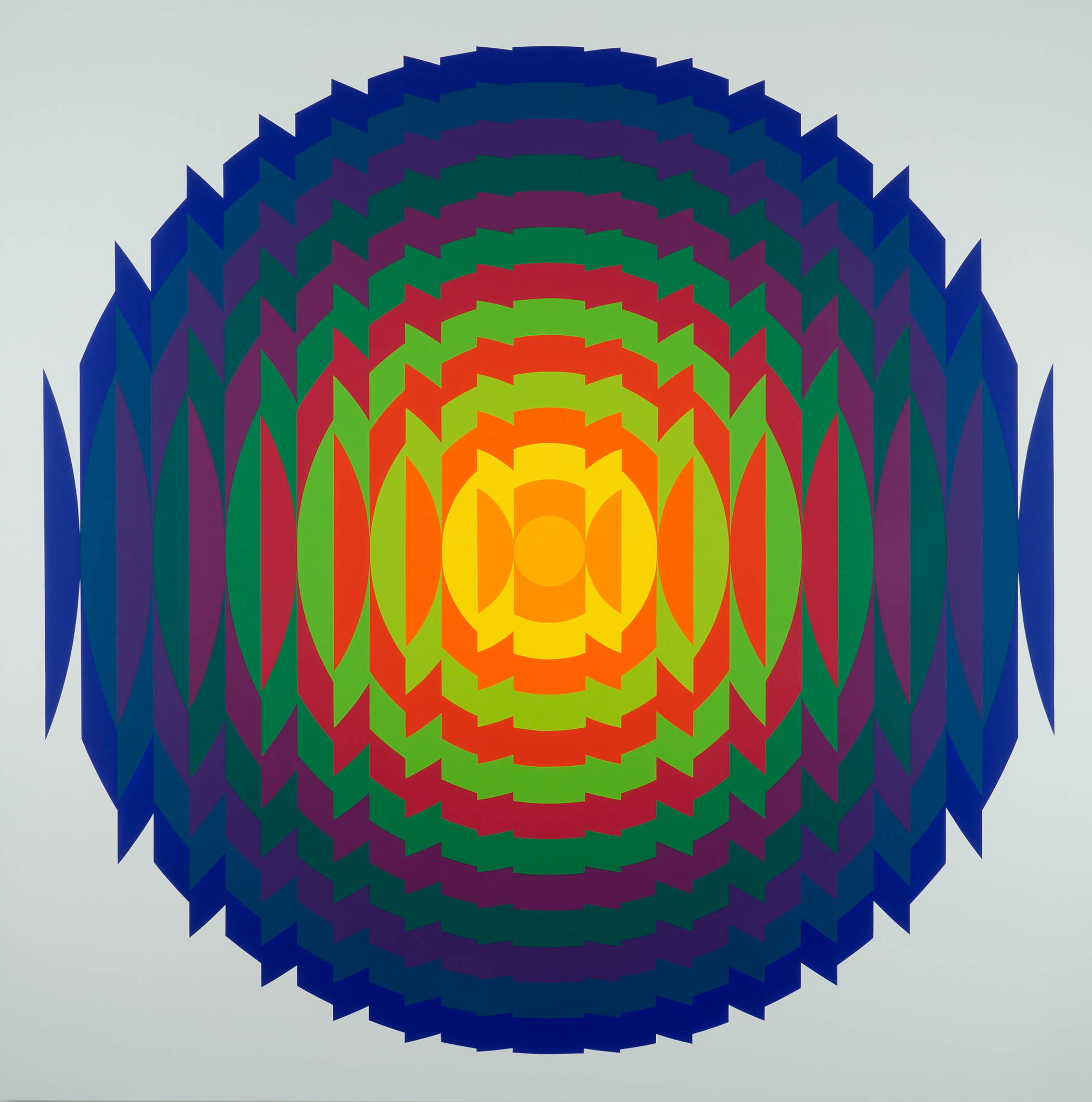
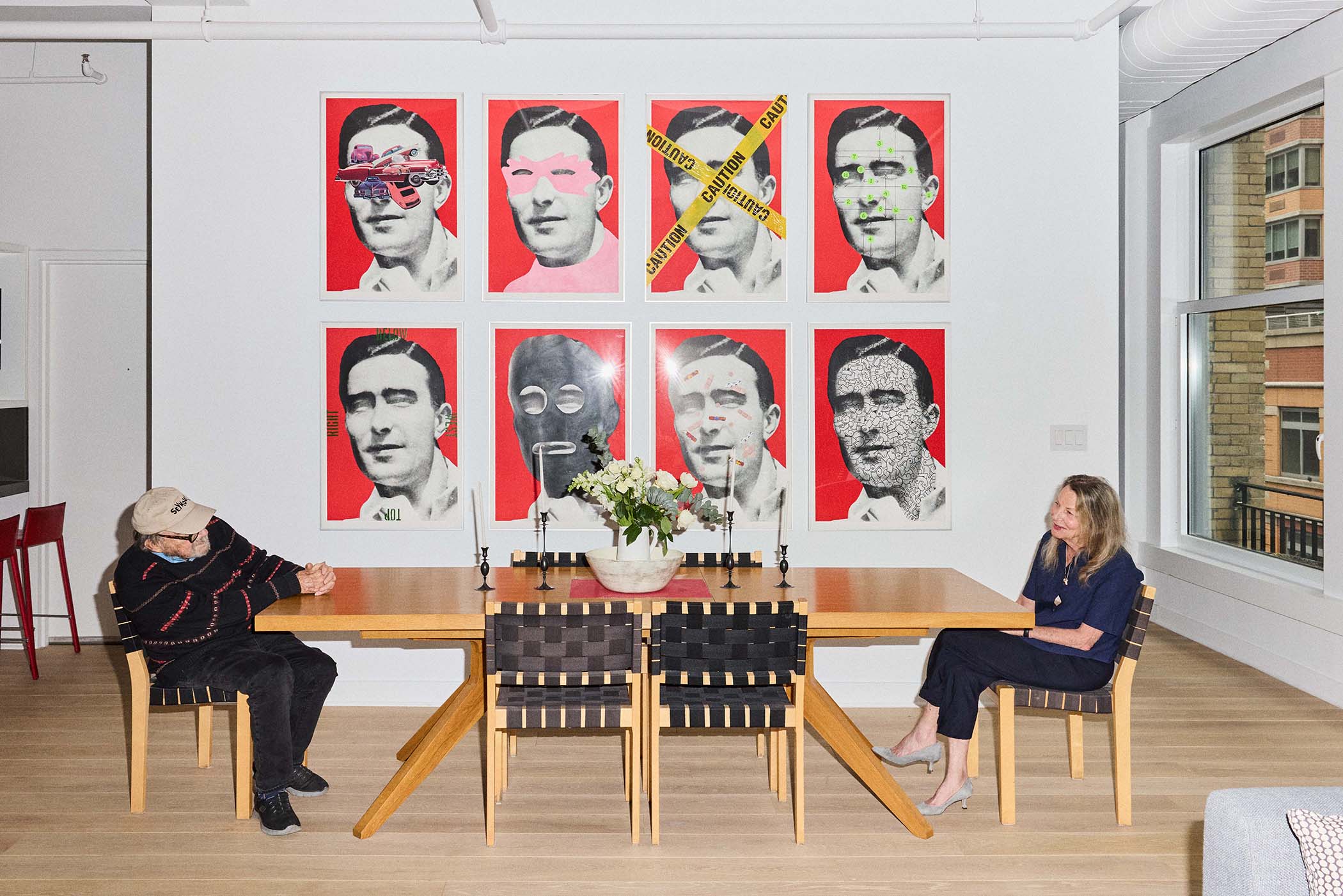
Series 14 - 14 Permuted, 1970-202
Its members did not believe in art as produced by the solo genius so much as collaborations involving lights, mirrors, electricity and the mathematical sequences that underpin so many of Le Parc’s meticulously beautiful op art paintings. Their collective exhibitions were titled Labyrinths, and Le Parc contributed what he called “cells”. Several of these immersive installations are recreated at Tate Modern. The most awesome is Continual Light Cylinder, from 1962, which uses nothing but bulbs, Plexiglas prisms, mirrors and rotators to choreograph a continuously changing aurora of mesmerising light in an enormous circle.
If Le Parc’s art was not one with his revolutionary protests – his brief expulsion from Paris after the street uprisings of 1968, his demonstrations against Latin American regimes – it might seem altogether too fetching and refined. But he is all against the passive consumption of art imposed by museums. Le Parc was there long before the corkscrew slides, multiplying mirrors, theatrical bunkers and spectacular mazes of 21st-century art. He didn’t want the visitor just to stand there and take it.
The last room descends, alas, into the kitsch of so much Parisian art, all airbrushed rainbows and prisms, like prog rock album covers from the 70s. But who cares – you have had your fun and games. Shifting, flickering, buzzing, revolving, this is art for the whole family. Now go home and make something yourself.
Newsletters
Choose the newsletters you want to receive
View more
For information about how The Observer protects your data, read our Privacy Policy
Julio Le Parc: Light. Colour. Action is at Tate Modern, London, until 3 May 2027
Photographs courtesy Atelier Le Parc