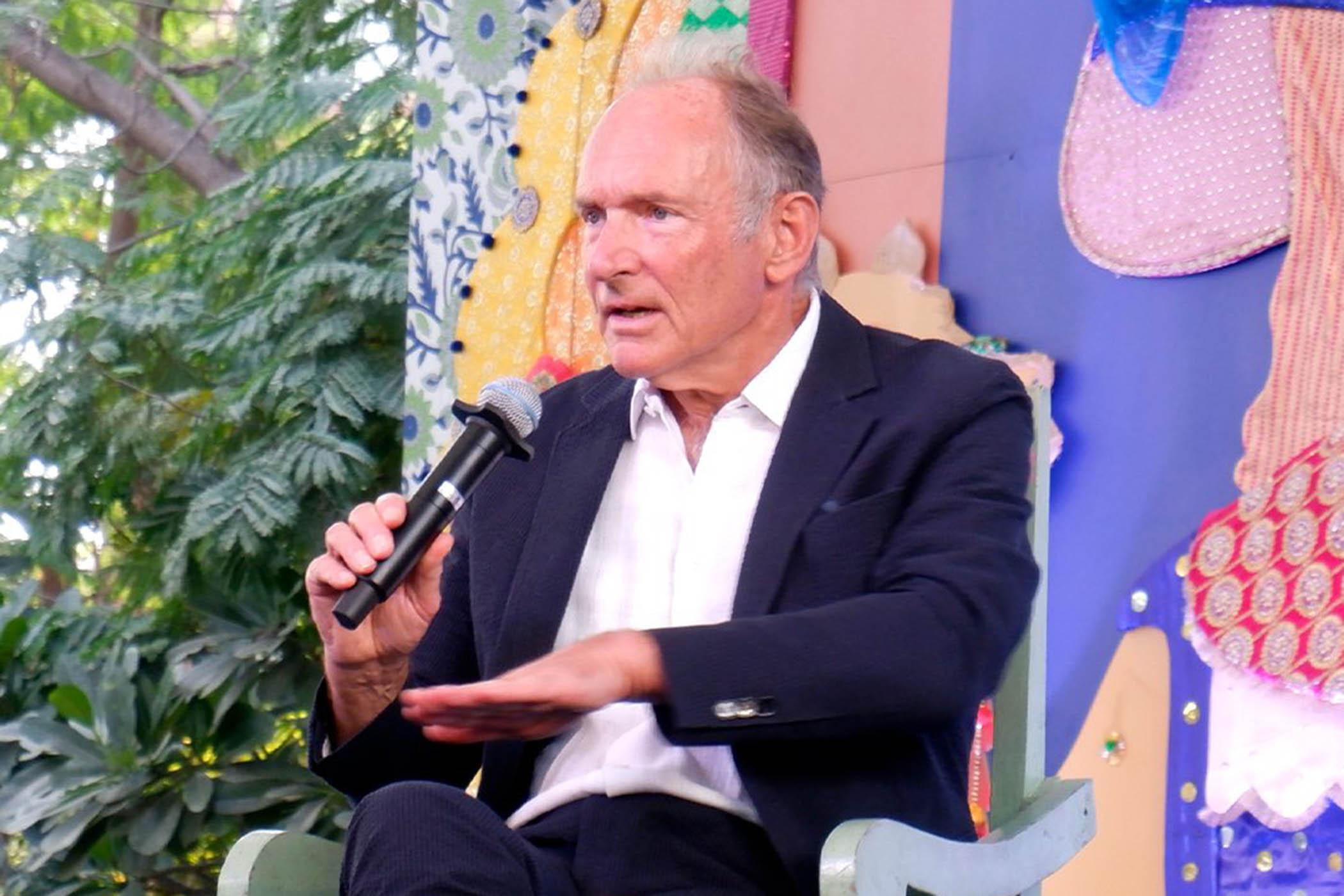
Britain’s Turing Prize-winning computer scientist, Sir Tim Berners-Lee, creator of the world wide web (1989), spoke about the likely outcome of a future face-off between technology and humankind at the Jaipur Literature Festival on Sunday afternoon.
“The tech companies developing AI are very insular,” he said, after receiving a rock-star welcome. “They are all working in these competing silos, so there is none of the collaboration of the early days of the world wide web. And it does not seem that they are going to have a consortium to bring them together, I am afraid.”
In answer to a question from the audience he later confirmed his grim assessment of the threat posed by unfettered AI. “If you create something smarter than you, then at some point you cannot control it,” he warned. “So we need to develop a way to keep this kind of super intelligence contained.”
It’s a gloomy outlook, but a chink of light is provided, Berners-Lee said, by the work of the “open source browser” community of people around the world who collaborate together out of goodwill, without ever meeting in person, and try to discover safer and faster web services by developing new computer codes in collaboration. Their efforts foster innovation and transparency and give him cause for hope, he said. “The spirit of these volunteer collaborators gives me that more positive feeling.”
Berners-Lee, 70, who was speaking to the broadcaster and writer Georgina Godwin in front of an audience from across India, together with the festival’s many visitors from Europe, said he had no real regrets about his world-changing work at Cern, the European Organization for Nuclear Research, in the late 1980s. In linking the computer networks of scientists and academics working at the Swiss research base, he set up the framework that allowed the birth of the internet. He resisted pressure to make his invention a commercial project, he said, not due to altruism but because it was the only way he felt the web would gain enough popularity. Even a nominal fee, he believes, would have stalled its progress.
“It was important that it was free to use so that everyone would feel they could use it. It was a pragmatic decision,” he said. The title of his recent book, This is for Everyone, chronicling his life’s achievements, takes its cue from this egalitarian view. It is also the phrase that was beamed around the Olympic stadium in London at the 2012 opening ceremony, during which it was also sent out around the world on Twitter (now X).
He advocated that those parents with concerns about the use of the internet by the young should consider buying them a mobile handset that blocks many of the more “addictive” and less useful functions of the system. The internet, he said, “has some wonderful things and some horrible things to offer”.
"One of the ways we could tackle this problem more generally,” he went on, “is to make those addictive algorithms illegal, just as we have done with addictive drugs.”
Earlier at the literary festival, the novelist Esther Freud talked candidly about the prospect of now having her version of her own family’s past challenged by the upcoming planned memoirs of her sister, the fashion designer Bella Freud. Both women are the daughters of painter Lucian Freud and the granddaughters of Sigmund, the father of psychoanalysis.
‘I have a very good memory, but I have to accept that there is more than one version of the truth’
‘I have a very good memory, but I have to accept that there is more than one version of the truth’
Esther Freud, author
While Esther, the younger sister, writes fiction, her books draw on her childhood experiences. Her new novel, My Sister and Other Lovers, is a sequel to her first book, Hideous Kinky, which was made into a film. “I have a very good memory, but I have to accept that there is more than one version of the truth. Two siblings can have a different experience of childhood,” she said, adding that a younger child often ultimately is driven to find a voice another way outside the family.
Newsletters
Choose the newsletters you want to receive
View more
For information about how The Observer protects your data, read our Privacy Policy
The book was originally intended as a selection of short stories which she later converted into a novel. Her sister, Bella, approved the title, she said.
Freud told her audience that she suspected that her father also had the “splinter of glass” in the heart, an imagined quality often ascribed to novelists and something that allows a creative person to put their art first, adding: “He did what he needed to do to make his work.”
Photograph by Jaipur Literature Festival / X