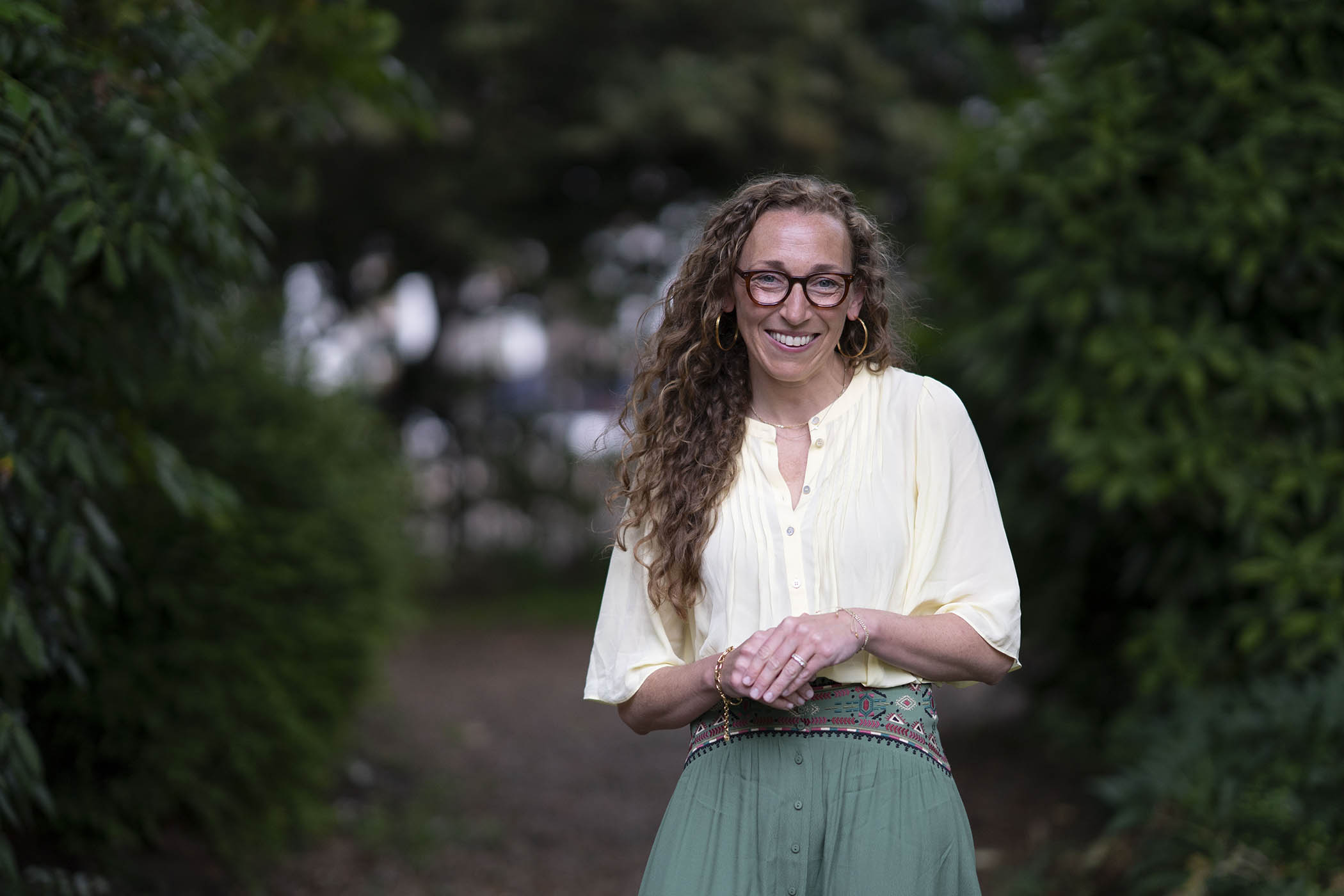
Virginia Evans, 40, was born on the east coast of the US. She has been writing novels since she was 19 but The Correspondent – which is being adapted into a film by Jane Fonda – is her first published work. The novel is composed entirely of letters written and received by the 73-year-old Sybil Van Antwerp, an acerbic woman based partly on Evans’s late mother-in-law. The letters capture her life story: the grief of losing a child; her time as a law clerk; and the impending loss of Sybil’s sight, which threatens her letter-writing.
Yesterday, the novel was awarded the 2026 Women’s Prize for fiction, with the chair of judges, former Australian prime minister Julia Gillard, describing The Correspondent as the novel that “captured all our hearts”. Evans and I met in central London the afternoon after her win.
Why did you start writing The Correspondent?
It was the first winter of Covid. It felt so strange, everybody felt edgy and a little bit lonely. I had been working on another novel that wasn’t selling. I had just read Helene Hanff’s 84, Charing Cross Road, a book in letters, which I adored, and I had an idea for this character, Sybil. I had met this wonderful woman in her 70s who we were trying to buy a house from. I think the female experience, especially in America, means you can begin to disappear as you get to a certain age. But here was this really intelligent, lovely, put-together, funny woman, and I could feel how vast her life was. I wanted to write it.
How did you form Sybil’s voice?
As Sybil was coming to life, there was something in her voice that led me to lean into my mother-in-law, Joyce. Whenever there would be a moment where I wasn’t sure what came next, I would think: what would Joyce say? With older women, it’s so bizarre that we let people disappear who have so much experience and memory. I really value my relationships with people who are older than me, and their stories of times when I wasn’t alive. I can’t have that information other than through those conversations.
The book is filled with flowers. What do they mean to you?
After I wrote the book, I received this beautiful message from [writer of The Names] Florence Knapp. She said that when she read the book she was thinking about the poem Deaths of Flowers by Edith Södergran. The poem is about dying as a flower. Most flowers, I think specifically an iris, close up in death: as they dry out, they clench and go inward. But the summit of the poem is: “But I would die as a tulip dies,” with the petals falling outward. I think about that poem a lot, because that’s Sybil. I knew I wanted to write a story that was hopeful and had lift at the end. I wanted Sybil to find love. We presume she’s lonely, though she won’t admit it. I didn’t know who she’d end up with when I started writing. It was so enjoyable to write her opening up.
Sybil writes regularly to authors she admires and they write back. Do you?
I write letters to anyone I want to, which does include authors, artists and lots of interesting people. Sometimes you hear back and sometimes you don’t. I try to write a letter if I have something meaningful to say. Having had the experience of writing to someone who feels untouchable and then realising they’re not untouchable, they’re just a person, and then having them write back… it levels the playing field. And it’s such a treasure to open the mail and see that somebody wrote to you.
Newsletters
Choose the newsletters you want to receive
View more
For information about how The Observer protects your data, read our Privacy Policy
Are you inundated with letters now?
I opened Pandora’s box without knowing I was doing it! I now get hundreds a week. I was trying to respond for a while and it’s just gotten to be too much. I’ve hired a woman to read them all, so everything gets read. Usually the things people write to me about are really heavy. A lot of people write about losing a child, a death in their family, adoption, mental illness. Sometimes people write a page or two, but sometimes it’s four pages. It’s very emotional, and if I end up in tears over it, which I frequently do, then I immediately have a migraine and still write the response. Now that I receive so many letters, not being able to respond to every one is one of the things I feel sad about. I really was trying.
This is your first published novel, but you’ve written many more. Is there a through-line to everything you’ve written?
Every single book I’ve written is reaching for the answer to the same question: what is home and where am I from? That’s always what I write about. Not intentionally. It just always ends up being what the books are about. I wonder if it’s a universal human feeling. We’ve all moved around. We all come from different places. But where are we really from? I just don’t know.
What books inspire you?
Most books feel either cool or warm. There’s nothing wrong with being cold, but the books I always want to read are warm and accessible, but not cheap, not light. Ann Patchett’s The Dutch House inspires me that way. Anne Tyler, too: Redhead by the Side of the Road. Some of the older Maggie O’Farrells, before her books moved into historical fiction, such as This Must Be the Place and Instructions for a Heatwave, which I love. Books that feel rich and real and true to life.
What did it mean to you to win the Women’s Prize?
I’ve never had a moment like that before, but it feels like you’re watching something happen to you. It’s so exciting and I’m in awe. I’ve been writing for such a long time, and there’s always been this feeling of not knowing when a book has come to a point where it’s good enough. It’s been so surreal, thinking: I guess this means it’s good enough now.
The Correspondent by Virginia Evans is published by Michael Joseph (£9.99). Order a copy from The Observer Shop for £8.49 (15% off RRP). Delivery charges may apply
Photograph by David Levenson/Getty Images