Photograph by Tom Pilston for The Observer
Annabel Croft is taking me for a walk in her beloved Richmond Park, fresh from Queen’s and the Wimbledon qualifiers. The latter begins on Monday and the former British women’s No 1 turned TV presenter, who conducts those emotional post-finals interviews at the trophy ceremony, is telling me what she most loves about this green haven in south-west London.
“When the deers are rutting, that’s my favourite time,” says Croft, 59, who like David Attenborough and Clare Balding is a “friend” of the park. “I’m obsessed with them. You get these ones with these massive antlers. I always liken the deer to tennis matches, because you see them trying to give and take.”
This landscape has been the family’s “sanctuary” for many years. It is just a few strides from the house in Kingston-upon-Thames that her late husband, Mel Coleman, who died in 2023, helped build and where they brought up their three children, Amber, Charlie and Lily. Lily, 28, a TV presenter who usually lives in Dubai with her fiancé, is over for work and accompanying us on this sweltering day, to get in her steps (this is some athletic family; it’s 8am, over 30C already and Lily has strapped on ankle weights).
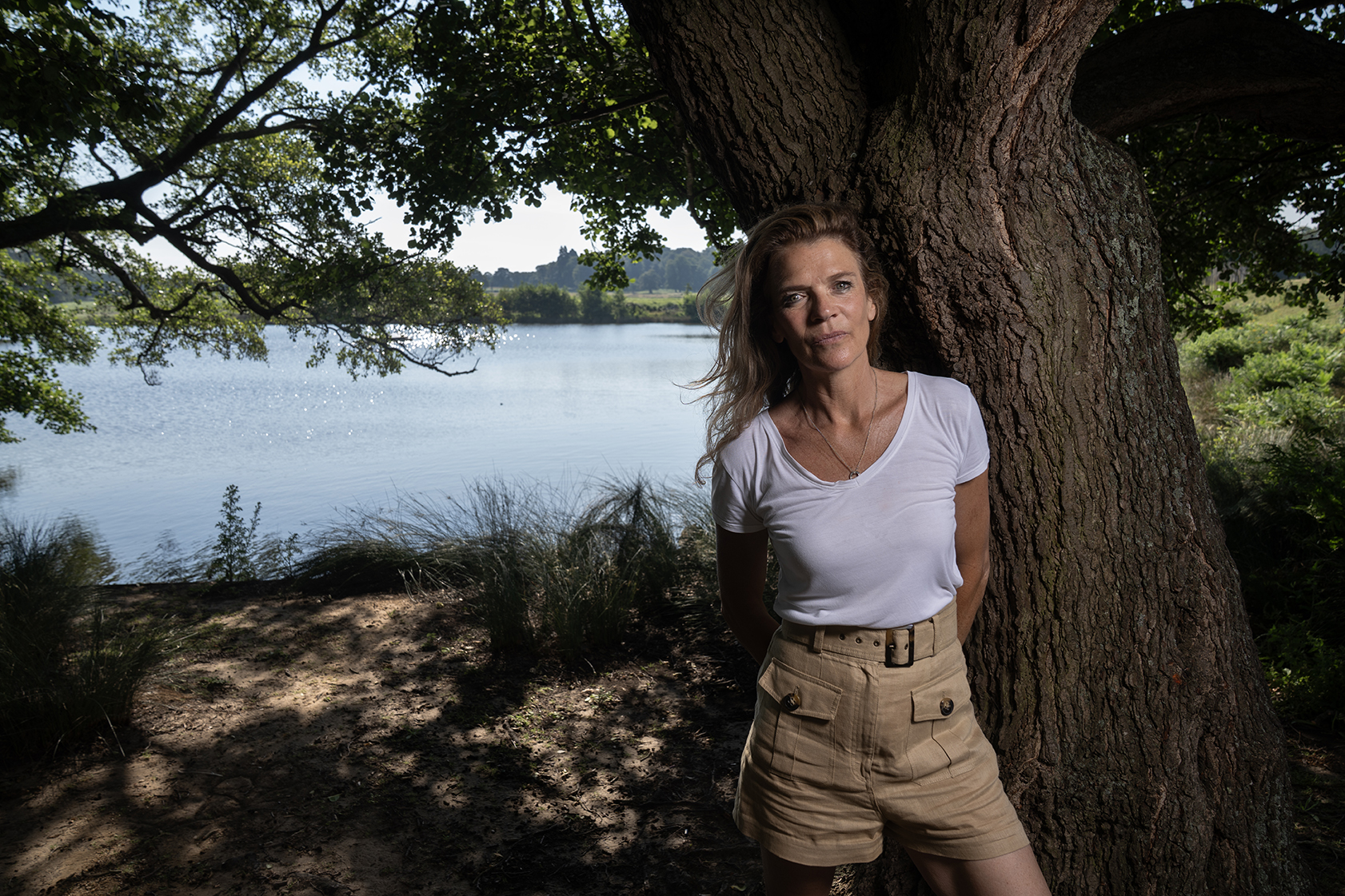
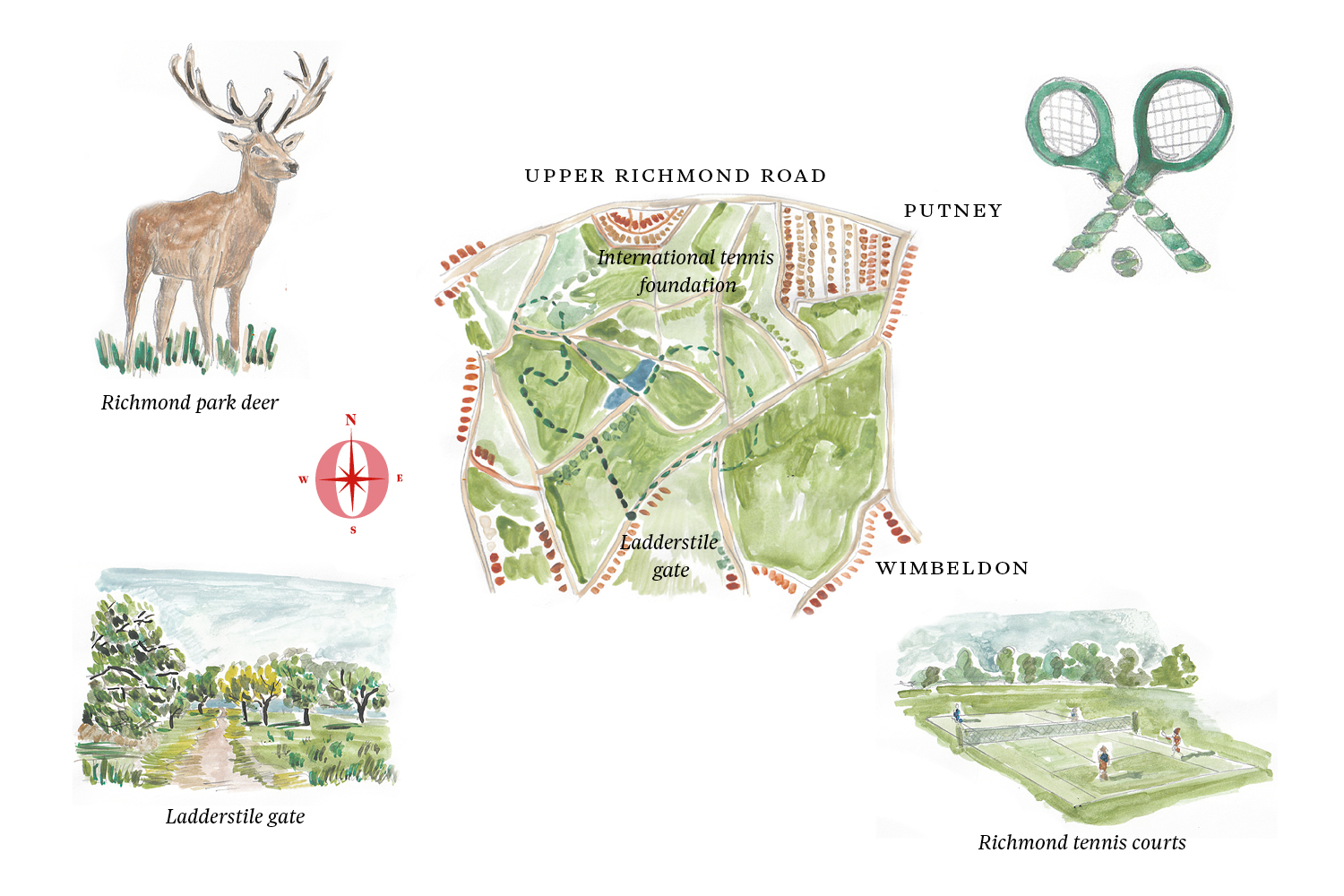
We meet at Ladderstile Gate at the south end of the park, and I soon realise this will not be an amble. I’m reminded of Treasure Hunt, the Channel 4 game show that Croft presented in 1989, taking over from Anneka Rice, in which she raced against the clock to find directions to treasure. Croft, dressed in Zimmermann safari-style shorts, a white T-shirt and trainers, her hair unfairly well-behaved for the temperature, is marching into the searing sun; Tom, the photographer, and I follow, comparing sweat ratings. Croft, who appears cool and dry, walks and runs here every morning, often for three miles or so. “We are a family that is very full of exercise in the morning,” she says.
That “we” includes Amber, 32, her eldest daughter, who moved back to the family home a year ago with her husband when she was pregnant with Croft’s first grandson, Arlo, now nine months old who knows Croft as “Grannybel”. “When he’s in his little playpen, we hand him rackets because it’s an interesting toy … not because I’m going to be a pushy grandmum that demands he plays tennis,” she laughs.
Our route today will take us to Isabella Plantation, a woodland garden in the park. She stops for a moment, we catch our breath: something has crawled into her trainer. She yanks off her shoe, pulls off her sock and the creepy crawly is dispatched. “Got it!”
There is no time to be wasted, this is Croft’s busiest season. Wimbledon is days away and, perhaps, we need the distraction more than ever. “It’s modern day gladiators with rackets instead of weapons, and people can just pick the gladiator and then get involved,” she says. She prides herself on her preparation. “You don’t just want to say ‘Oh, that was a great backhand!’, you want to tell them why it was a good backhand,” she says.
This year’s surprise gladiator is Serena Williams, a return that Croft describes as “quite jaw-dropping”. Williams, 44, was given a wildcard, allotted to some players whose world ranking is not high enough to qualify them automatically for the championships. She is reportedly 15kg lighter thanks to GLP-1s, weight loss drugs which she took to get rid of babyweight and lower her cholesterol after the birth of her second child.
Did Croft predict this? “Not in a million years,” she says. “I would have put my house on the fact that she would never have played professional tennis again.” Should she have been allowed the chance? There is consternation in some quarters that Williams, who will play singles and doubles with her sister Venus, has blocked a young hopeful, merely to invigorate her potential as an influencer.
Newsletters
Choose the newsletters you want to receive
View more
For information about how The Observer protects your data, read our Privacy Policy
Croft holds little truck with that view, but admits she is unsure of Williams’s intent. “I can completely understand how it would be impossible not to give a seven-time champion and somebody who’s that big a star a wildcard to come back and play. If that’s what she wants to do. And I think all of us are intrigued as to the motivation behind why she wants to do this. She’s got two kids, she has said it would be lovely for her children to see her play, and they got to see her play in Queen’s.”
A young friend who also watched her play there told me Williams looked “like a 44-year-old playing, but then these amazing shots would appear”. She and Victoria Mboko, her doubles partner, beat the third seed in their opening match, their victory sealed by a 116mph serve from Williams.
‘There are some players, and it’s in the men’s game as well, where the tour life is so relentless. I think a lot of the trainers now are training them to have a body that can sustain it’
‘There are some players, and it’s in the men’s game as well, where the tour life is so relentless. I think a lot of the trainers now are training them to have a body that can sustain it’
Croft is more generous. “Well, I thought she looked like she never left. I mean, it’s just incredible. She was smacking the ball a million miles an hour with lots of power. Her serve is the most beautiful serve I’ve ever seen in tennis.”
We are distracted briefly when a runner with a rather eccentric gait passes us. Croft, always the commentator, clicks into action. “That’s the most careful running style I’ve ever seen,” she says and we laugh. “I couldn’t describe him as pounding the park, that’s for sure.”
I ask what she makes of GLP-1s. Tirzepatide, which Williams has taken and promoted, is not banned by the World Anti-Doping Authority (Wada), but has been a cause of debate. “I’m not a fan of any of that stuff,” she says, shaking her head. “I’m not a fan of any invasive stuff. I think it would be great if the messaging was about how to improve your health through nutrition rather than quick fixes. A lot of modern life is wanting quick fixes all the time.”
But does it feel a bit cheaty, to her mind? “I have no idea about the doping aspect. But I definitely would worry about the longer term implications for somebody’s health. That’s what I always look at. I guess, having done professional sport, and then with what happened with Mel and his diagnosis, we learned from a biochemist about nutrition and health,” she says.
Her husband Mel Coleman, a fine yachtsman turned investment banker whom she met in 1987 on a sailing show, died of colon cancer three months after his diagnosis of stage three in March 2023. She still speaks “almost daily” to cancer specialist Dr Isabella Cooper, who treated him and advises the family on a cancer-busting diet. “We learned all about the ketogenic diet, and how sugar is the enemy. It’s fuelling everything,” she says. Later Croft tells me she only has full-fat dairy in the house and has given up bread, although she allows herself the occasional slice of banana cake.
She loves fashion almost as much as caring about her health and featured in Tatler’s top 10 best-dressed list last year. (“Did I? Oh yes.”) This morning, at 7am, a stylist came round to her house with her Wimbledon wardrobe – although Lily has final veto. She especially adores the labels Brunello Cucinelli, Farm Rio and Self Portrait. “When you get to a certain age, you need young daughters who are going to say, ‘Mum, no, too much’.” Lily adds that she’s effectively banned Croft from wearing white jeans; just as well as she’s driving an old boiler from her house to the tip later today before an appearance on The One Show.
We talk of our mutual admiration for the wacky style of the Japanese player Naomi Osaka who is scheduled to play Elsa Jacquemot in the first round of Wimbledon tomorrow. “Osaka, her costumes have taken it to a totally different level. I would never have had the confidence. I love the fact that all these girls are so into fashion, because fashion is so important.”
Emma Raducanu, who has left her eight-year sponsorship deal with Nike for a multi-million pound deal with Uniqlo and still represents Dior and Tiffany & Co, might agree. When I ask if so many tie-ups are a distraction for the British player, she says: “I suppose it was too tempting, you know, I mean it’s just so much, there’s so many decisions to be made.”
How do you think she’s doing? Raducanu was back on form at Queen’s, despite losing to Croatia’s Donna Vekic in a hard-fought final. “She’s turned around her season from being very low in confidence and short on match play, and suddenly everything has ignited,” says Croft. She puts it down to Raducanu’s reunion with her old coach Andrew Richardson, who she was with when she won the US Open. Yet she’s very prone to injury.
“She is, and I think that, unfortunately, there are some players, and it’s in the men’s game as well, where the tour life is so relentless. I think a lot of the trainers now are training them to have a body that can sustain it. But I think she’s going to have a good Wimbledon,” she says.
Croft thinks the weather will have an impact on who wins. “The sunshine will have been hardening everything up,” she says. Her tip is Elena Rybakina, the Russian-born Kazakhstani who’s won it before as well as the Australian Open this year. “She’s got one of the biggest serves. I think she’s going to be very tough to beat.” Of the young ones to watch, she suggests the American Iva Jovich, no 17 in the world, who lost to Raducanu at Queen’s.
Croft, who grew up in Farnborough in Kent – her father was a chartered surveyor, her mother had been a stewardess for Pan Am – won the Junior Wimbledon and Junior Australian Open girls’ titles in 1984 aged 17, the year she turned professional. Yet she retired at just 21, having received a WTA ranking of 24. When I ask her if she regrets that now she says it’s complicated.
“I think I did absolutely the right thing, but equally… I wish I had the mind I have now to understand what I was doing.” Back then, she only had her coach for support. Now each player has a team. “I think I wish I could have played more in this era. But I also think I couldn’t develop as a person until I’d come out of the sport.”
“I always look at kids on the tour now, and I see a lot of unhappiness, but I also see that they come out of tennis and go straight into a commentary job, and they don’t realise that back in the day, that didn’t exist.” In an era before Sky Sports and Eurosports she had to make do with turns in pantomimes.
We are at Pen Ponds where a heron is sunbathing; the water looks positively delicious after our hot tramp.
I congratulate her on the BBC winning the Wimbledon contract, taking them to 2033, a coup amid competition from the streamers. “Oh, have they announced it?” she asks. The pay row is in danger of casting a shadow over this year’s tournament. For the first week, players will limit their interviews to 15 minutes (a blessing, perhaps!) reflecting that Wimbledon currently pays slightly below 15% of revenues to players as prize money.
“I wasn’t very good at maths at school, but … there’s a very big difference between share of profit and share of revenue. If you want Wimbledon to be the greatest tennis tournament with high standards, that all has to come out of revenue before you’re sharing out. So I think something’s a little amiss with this debate over share of revenue and share of profit. I think it should be share of profit.”
The prize money this year for men and women winners is £3.6m each. If you get knocked out in the first round you go home with £80,000. When Croft played her first Wimbledon, aged 15, the youngest for nearly 100 years, the prize money for the women’s winner (Martina Navratilova) was £37,500. But she concedes that modern entourages cost. “It’s like being on holiday all the time, only you’re not on holiday,” she says.
‘Every day I say, ‘I cannot believe you’re not here’. I said it to him last night, to the picture next to my bed. It’s just so bizarre. How can somebody just evaporate?’
‘Every day I say, ‘I cannot believe you’re not here’. I said it to him last night, to the picture next to my bed. It’s just so bizarre. How can somebody just evaporate?’
By now we are at the cafe, where talk turns back to her husband, Mel. “He and I, we came here nearly every day. We sat there,” she says, tapping our table and pointing to others. “This is very much him.”
Is it getting easier? Having a busy home must help. She nods. “Two years of just rattling around in the house on your own and now the house is full of life,” she says.
“I don’t cry every day, all day, like I used to, but I don’t think life will ever be the same again. It won’t be. He was such a big character and filled the house.”
Lily calls up some videos of her dad dancing in the kitchen and funny TikToks made in lockdown to show me. He’s a handsome, joyous figure with a big smile. “I just feel like he’s still there,” Croft says. “Every day I say, ‘I cannot believe you’re not here’. I said it to him last night, to the picture next to my bed. It’s just so bizarre. How can somebody just evaporate?”
Coleman eventually died of sepsis — “a terrible way to go”— and I ask about his decision not to do chemotherapy; my mother, who died of colon cancer, chose the same. “I’m glad he didn’t [do it]”. Lily tells me she would come walking with him here and he was in pain, but she thinks he had a high threshold and didn’t complain. “We couldn’t understand what was going on. We were a bit naive. None of us knew that he was dying,” says Croft.
Thoughts of a future romantic relationship after 36 years together are inconceivable:
“It’s impossible, I think. I have lots of friends that you can do nice things with, but I don’t know how you can ever replace someone. I can’t find another, I don’t want to find another.”
One of Coleman’s dying wishes was that the family keep up Croft’s tennis academy in Portugal — Coleman loved running it in his last years; Croft says it’s thriving.
More surprising is another new kind of consolation: the belief that there is something else out there. She shows me the jacket of a book she’s reading: Jonathan Caplan’s Not for Disclosure, UFOs: the world’s best kept secret. “It’s made me realise that we’re not alone,” she says. “It’s impossible not to be convinced.”
So, do you believe in aliens, I ask, secretly thrilled. I loved it when the pop star Robbie Williams came out for them. “I have met him [Caplan],” she says. “He said it’s just been covered up. But there’s not just one type of alien.” How so? “So we think that we are the centre of the universe as humans, but there are multi-dimensional ways that the world could be. Isn’t that interesting? You should read the book.” I promise I will, but, first, humour me, do we think that aliens play tennis? She smiles, ready to return my serve: “I don’t know! Maybe, maybe it all started with them.”
Illustrations by Ellie Wintour