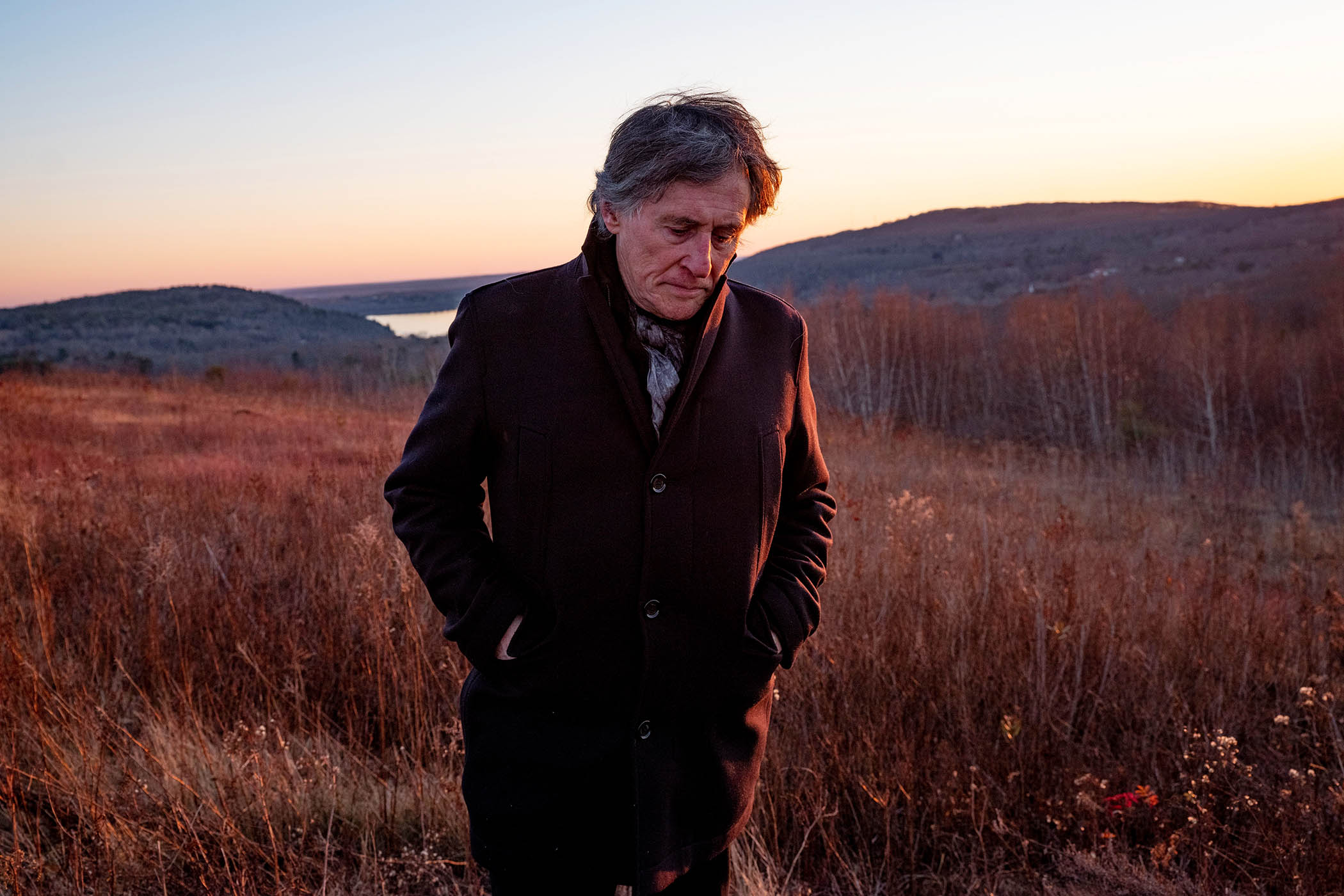
Gabriel Byrne is a Golden Globe-winning Irish actor who has starred in Miller’s Crossing, The Usual Suspects, In Treatment and War of the Worlds. Born in Dublin, he worked as a teacher before starting to act at 29. He has three children, two from his marriage to Ellen Barkin and one with his current wife, Hannah Beth King. The couple live in Rockport, Maine. Byrne is co-starring with Geraldine James in 45 Years, based on Andrew Haigh’s 2015 film about a long-married couple approaching their wedding anniversary when the husband’s past catches up with them. It runs at Chichester Festival Theatre until 11 July.
What’s 45 Years about for you?
Marriage, especially a long marriage, and how connected people can really be. There’s a private part in everybody that’s not revealed, even to the most intimate partner. Unlocking that room requires courage and intimacy, but that can veer into toxic secrecy. This man carries a secret that he’s never shared with anybody and over the course of this week he’s forced to reveal it. How can you trust somebody who has lied through silence for all that time? You leave examining your own life. The hallmark of anything that’s worthwhile artistically is that it changes the way you see, not just the world, but yourself.
Forty-five years is very roughly the length of your screen career. What has changed in that time?
We are shaped by morality, politics and societal attitudes. My parents’ lives were products of Victorian thinking. They went through the First World War, the recession of 1929, the Second World War, the Cold War, miniskirts, the pill – huge things for people to take on board. Meanwhile, we talk about movies like they’re part of our identity, but they tell us nothing. They tell us that the only people who can save us are heroes. That’s a fallacy. The real superpower is us together.
Your life goes from working-class Dublin to Hollywood…
Not quite. I worked in factories in England when I was 18. There was camaraderie, a sense of belonging, a collective identity. Then Thatcher came in, and the cruelty that she imposed on ordinary working-class people was outrageous.
You started acting late.
I had been teaching for eight years in a working-class school in Dublin, and I could see the trajectory of my life – retire at 55, might be a headmaster. Then I did a little bit of amateur dramatics and suddenly I was in this other world. When you go into acting you begin to be judged and criticised in a very public way. I’ve always thought it’s a paradox that actors are wounded, introverted and shy, and acting is the antithesis of what they need to be doing in life. Actors don’t believe the praise but believe the criticism.
Did you focus on the criticism?
I did struggle with it. [Being from the] working class, if someone gives you a compliment you’ll crush it down.
And one way you dealt with that was alcohol, until you gave up. Did you see any cautionary tales?
I got to know Richard Burton. I was at a dinner one night in Vienna with Burton, Olivier, Gielgud, Richardson and [actor and producer] Cyril Cusack. Burton had not been drinking for a while, then Olivier made some remark that Burton took money instead of art. Burton got drunk and laid into Olivier, but kept talking about going back to do Lear, like he was repaying British theatre. He was a very unhappy, lonely man. I saw what fame and wealth beyond your imaginings could do.
You arrived in Hollywood in the 1990s, which must have been a good time to be in the movies.
People like Rodriguez and Tarantino could make movies for small amounts of money and retain absolute power over what they were doing. They were more willing to take risks because they didn’t have to listen to studios. But honestly, at the time, nobody was saying, “Hey, this is a great time to be making films.”
Then the movies you took on got bigger.
The studios said, “Do you want to?” and I did. That was an utterly different world – corporate before algorithms. I remember Arnold Schwarzenegger saying, “Why am I always playing the same guy?” Well, Arnold, I don’t know that people are going to believe you as a guy filling up a gas tank in a petrol station.
How did that affect you?
Once you’re in a hit film, things change. It’s like being in a band that suddenly has a hit single. It was an identity shift going from theatre to Excalibur, working with Ken Russell, then America. You get an agent, a manager, a lawyer, a publicist, a physical trainer. They form a bubble around you, telling you what you want to hear. Coming from Ireland, I didn’t believe any of them.
What’s your relationship with being Irish?
We were brought up to believe that the enemy was England, but actually we were the victims of colonial occupation. That’s different, because the working class in England was treated the same. Any post-colonial society wrestles with who we are, and one of the most damaging things about colonialism is that it attacks the culture. Ireland is reclaiming the Irish language – beautiful, complex, philosophical, poetic. And we are shaking off the awful pernicious influence of the Catholic church. It’s not 100% gone. I wish it was. They still haven’t repaid society, they deny everything. Well, I say fuck them. They were the Taliban of their time. They were always on the wrong side. We’re no longer colonial people ashamed of who we are.
At 76, how do you see yourself?
All of us go through a process of changing identities. Socrates said know thyself, and that’s the purpose of a life. At this stage in my life, I do know that I’m no different to anybody else, and we are all in this community, the good, bad and indifferent. We struggle with ourselves right up to the end. Maybe that is the purpose of life. David Cassidy, the actor and pop star, his last words were “so much wasted time”. Try to avoid that.
45 Years is at Chichester Festival Theatre until 11 July
Photograph by Cig Harvey / New York Times / Redux / eyevine