

Portrait by Antonio Olmos
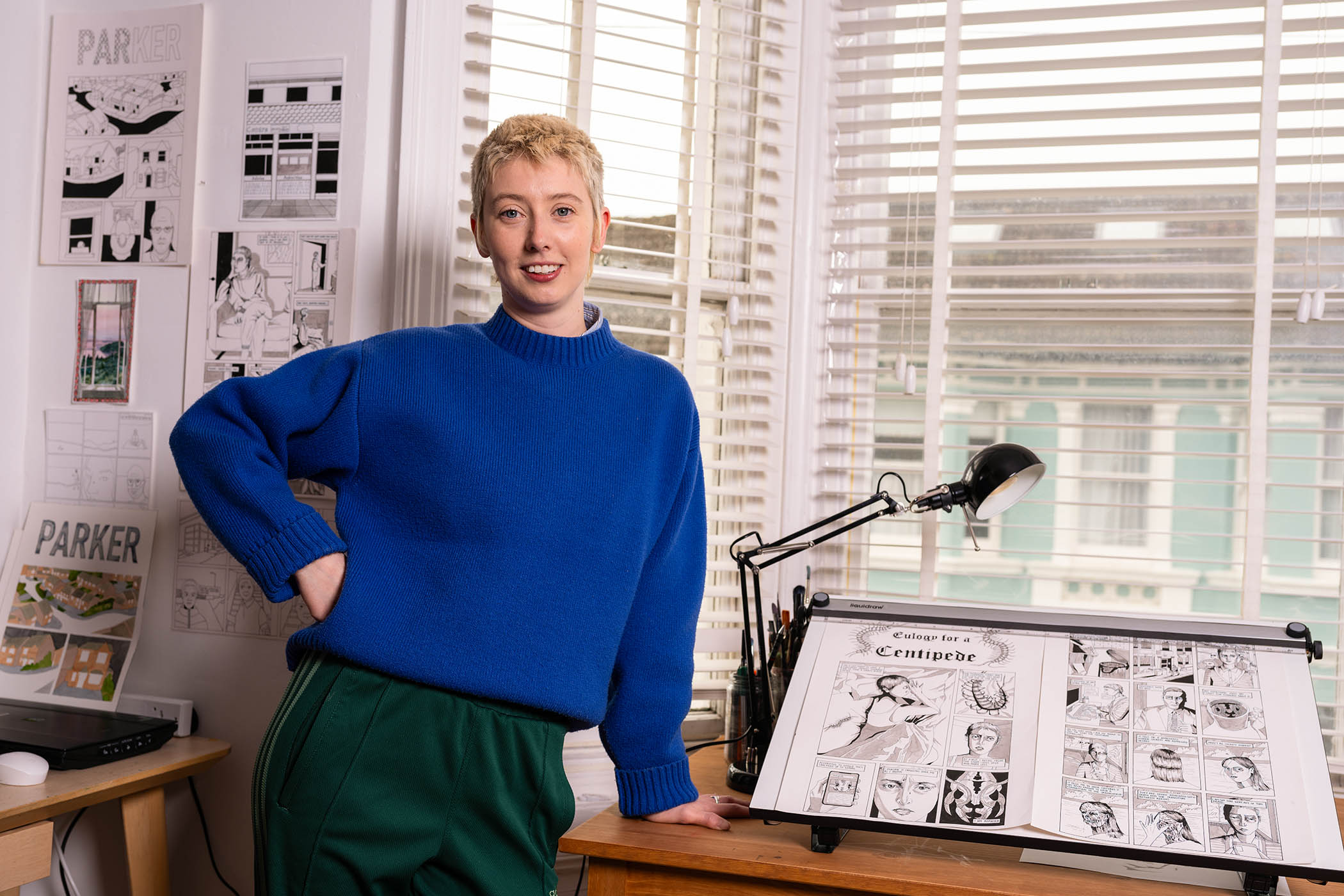
‘I’m a bit embarrassed,” says Kirsten Campbell of the moment she heard she’d won the 2025 Rachel Cooke graphic short story prize, “but I did not play it cool at all. I think I was like, ‘No, no, no, no, no!’” – she laughs – “but in a good way. I was pretty ecstatic about it, to be honest. Obviously I wanted to win, but you never really know, do you?”
In a bumper year with more than 100 entries, Campbell’s Eulogy for a Centipede, which you can read in full below, is the story we judges kept coming back to, sensing deeper meanings lurking beneath its beautifully illustrated surface. It begins with a centipede crawling towards the sleeping narrator in search of a warm place to die. The next morning the narrator recoils from it, then begins to fixate on the many-legged creature to the point where she’s seeing it everywhere. As she burrows into her fixation, Googling centipede symbolism and mulling over the cycle of death and rebirth, we begin to wonder what’s fuelling her feverish preoccupation.
This is Campbell’s second time entering the competition. On her first attempt a few years ago, “I was in a very different headspace”, she says. “And I don’t really think I gave it my all.” This time was different. The idea arrived in the middle of term – Campbell works as a primary school teacher in Brighton. When the summer holidays began, she threw herself into illustrating so intently that she sometimes had to remind herself to eat.
Campbell, 30, fell in love with graphic novels after discovering Charles Burns’s Black Hole as a teenager in Birmingham. “I was obsessed,” she says. “My A-level art piece was inspired by his work.” Subsequent obsessions while studying illustration in Brighton included the stories of the American comics artists Adrian Tomine and Nick Drnaso. “It’s like I’m in a completely different world when I’m reading one of his books,” she says of Drnaso. “I love how subtle they are, and how much mood he can create with such simplicity.”
The origin of Campbell’s winning story was, for all its mysteries, quite straightforward. “I woke up one day and there was a dead centipede in my bed,” she says. “That’s genuinely just what happened.” Like the narrator, she found its appearance meaningful in a way she couldn’t quite articulate. In the story, the encounter stirs up secrets and repressed desires in the narrator’s life that Campbell alludes to without making explicit. When I ask about the long-haired woman who crops up in the red-shaded panels midway through, her face becoming a death mask before our eyes, Campbell declines to reveal anything about her.
This elusiveness appealed to the judges. While some of the contenders for the prize spelled out their intentions too clearly, Campbell’s entry afforded us room to wonder.
Joining me around the table were Angus Cargill, publishing director at Faber, our partner on the prize; Paul Gravett, the genial and knowledgable director of Comica festival; and Tom Oldham of Gosh!, the London shop where I’ve made some of my happiest comic book discoveries. Our special guest judges were Aimée de Jongh, whose latest release is a terrific adaptation of William Golding’s Lord of the Flies; and Jonathan Coe, distinguished author of What a Carve Up!, The Rotters’ Club and The Proof of My Innocence.
This was the first year since the competition began in 2007 without Rachel Cooke, The Observer’s much-loved graphic novel critic who died in October. We have renamed the prize in her honour and I imagine Rachel would have been thrilled by the sheer variety of stories and drawing styles on display this year.
A few patterns emerged. A good number of submissions were autobiographical, shedding light on poorly understood medical conditions or painstakingly researched family histories. There were some enjoyably bonkers entries, including one about beavers making a David Attenborough-style TV show about humans. One story in contention for the top spot, Joe Stone’s Absolute Cinema, imagines a world in which talking at the movies is a crime heinous enough to turn perpetrators into social outcasts. But it was pipped to the runner-up spot by Paul Hatcher’s Azad, a charming story about a chance encounter in 2004 between a British man and a refugee newly arrived from war-hit Iraq. (You can read the full story below.) Azad, who has only a few words of English, needs help collecting a parcel from a Royal Mail depot across town, so the pair set off through Hull, making little discoveries about each other along the way.
Hatcher has been cartooning on and off for more than 30 years – he wrote The World Stare-Out Championship Final, which became a skit in the 1990s TV series Big Train – but this was his first time entering the competition. “I’m over the moon,” he says. “What I was hoping for was an honourable mention.”
It was based on an event in Hatcher’s own life, but, he’s quick to point out, “the strip’s not really about me, even though I’m the narrator. This young Iraqi guy, who gave me a lesson in humility: he’s the hero.”
It could be read as a riposte to those who complain that immigrants aren’t integrating into western cultures. “Integration is a two-way thing,” says Hatcher. “I have lived abroad, wanting to get my knees under the table of the culture, and it’s really hard. And I’m from a rich country, and I speak English. When people talk about immigrants not integrating, I think, well, what are you doing to help them?”
Hatcher lost confidence in cartooning at various points, but since 2023 he’s been at it again with renewed vigour, and the compassion and detail of his storytelling really shines through here. Coming second in the Rachel Cooke prize is a huge boost, he says. “This competition is the only one of its kind in the country. I know so many people who are interested in entering it.”
We would encourage any aspiring comics writers who have an idea for a story up their sleeves, or lying half-realised in their desk drawer, to dust it off and send it our way for the next edition. We can’t wait to see what you’ve come up with.
Details for how to enter the Rachel Cooke graphic short story prize 2027 will be announced soon in the New Review and at observer.co.uk
Newsletters
Choose the newsletters you want to receive
View more
For information about how The Observer protects your data, read our Privacy Policy
Jonathan Coe’s top graphic novels
The judge and What A Carve Up! author’s recommendations.
Ducks: Two Years in the Oil Sands by Kate Beaton
A recent graduate takes a job in a remote outpost of Canada’s oil industry, where she witnesses misogyny and shocking environmental damage. Beaton’s long, complex novel brings wonderful empathy and nuance to this challenging story.
Ethel & Ernest by Raymond Briggs
In this warm and joyous, but also heartbreaking, story of his parents’ marriage, Briggs combines decades of social and family history to create a timeless classic. I couldn’t have written my own novel Bournville without this magnificent example in front of me.
Capital & Ideology: A Graphic Novel Adaptation by Claire Alet and Benjamin Adam
Translated from the French, this adaptation of Thomas Piketty’s essay is a great example of what a flexible form the graphic novel can be, with Benjamin Adam’s richly textured drawings bringing humanity and life to abstract ideas.
Aimée de Jongh’s top graphic novels
Where to start, according to the Lord of the Flies graphic novelist.
Blue Pills: A Positive Love Story by Frederik Peeters
One of the first graphic novels I ever read. When Fred falls in love with a woman who is HIV-positive, just like her son, he is introduced to a life of medical appointments, fear and prejudice. But despite the complexity, he finds a deeper love than he ever experienced before. An intimate portrait, based on Peeters’ own experiences.
Portugal by Cyril Pedrosa
A semi-autobiography about a French comic author suffering from depression who returns to his country of birth: Portugal. Can returning to his roots solve the problems he faces in daily life? A warm, colourful ode to Portugal, but also to family, identity and the things we lose along the way.
Of Mice and Men: A Graphic Novel by Rébecca Dautremer
A heavy, visual masterpiece of 420 pages, based on the book by John Steinbeck. The drawings are superb, the graphic design is completely original and each page is a surprise. Nobody draws dusty American landscapes like Rébecca Dautremer.