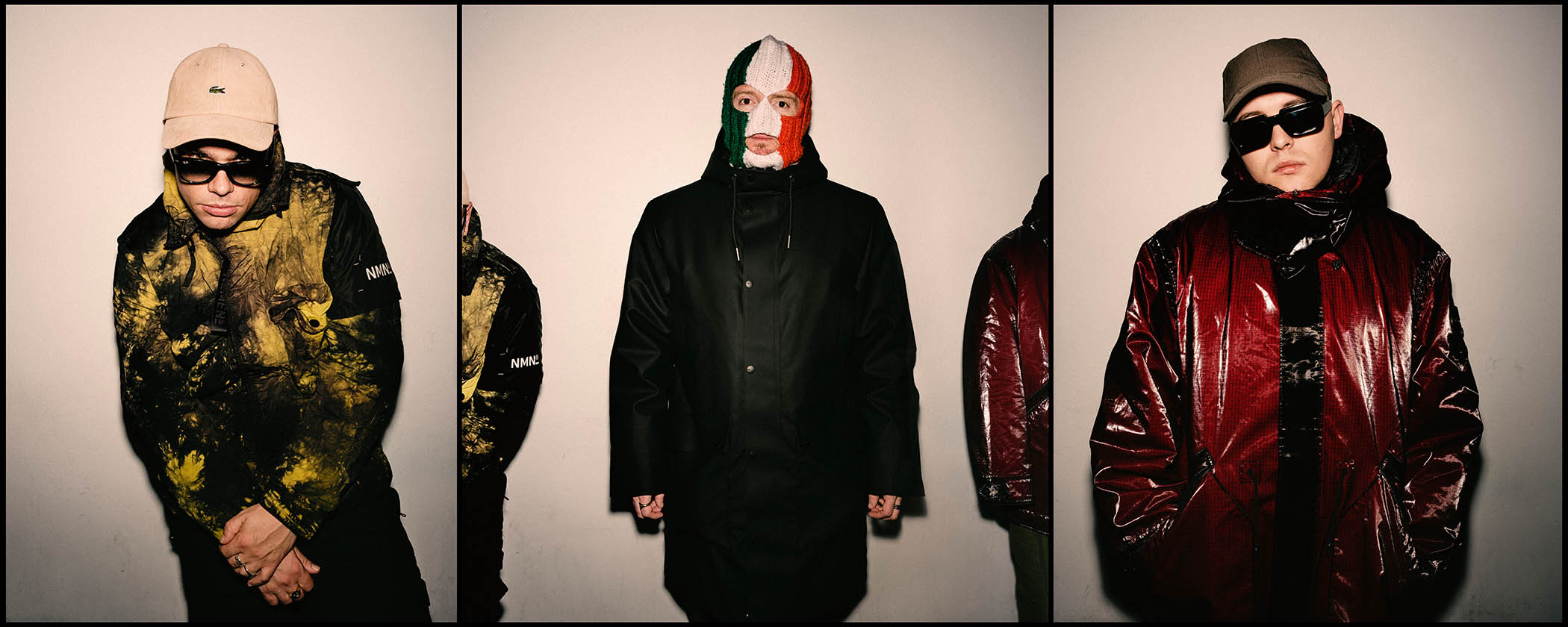


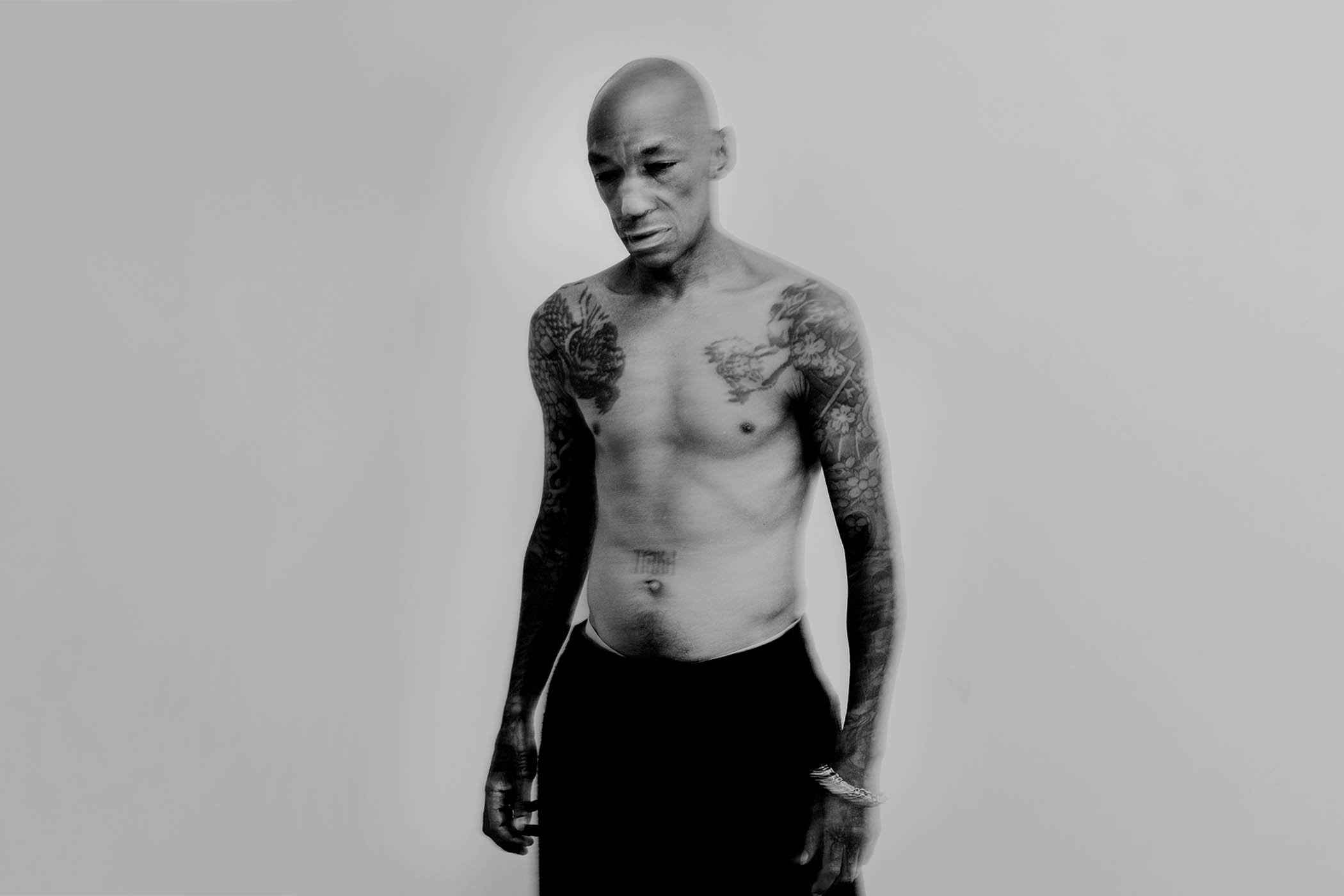
Portraits by Julian Broad
‘We got busy last year,” says Móglaí Bap. “And then we got un-busied.” In September 2025, the Irish-language hip-hop band Kneecap were due to tour the US. The trio – rappers Móglaí Bap and Mo Chara, plus the usually-balaclava-ed DJ Próvaí – had enjoyed a successful year building on their 2024 album Fine Art, and the award-winning semi-autobiographical film Kneecap. Their thrilling, incendiary gigs were rammed full of fans; they’d toured Australia, headlined Laois’ Electric Picnic festival and London’s Wide Awake festival. Their Glastonbury West Holts performance had been so popular that the field had been closed off for safety. But a court case brought by the UK government against Mo Chara, and the loss of their US work visas, meant they had to cancel their scheduled autumn shows. Twelve gigs, all gone. Un-busied. So Kneecap went into the studio.
It was the band’s second attempt at a new album. Their first effort had sounded too much like Fine Art and they’d scrapped it. Not to worry: they’d always wanted to work with Dan Carey, producer of Fontaines DC’s first three albums, and suddenly they could. Móglaí Bap and Mo Chara parked up in Streatham, south London, in a house four doors away from Carey’s studio. They stayed there for seven weeks. Próvaí, who usually provides Kneecap’s music, was happy to remain in Ireland with his young family and let Carey do the job. “Ahh, Dan’s a genius,” he says. “Our rise as a band happened a lot quicker than the rise of my skills as a producer.”
The result, Fenian, is a deeper, wider, wilder ride than Fine Art, with an atmosphere that moves from threatening to tender to banging rave; and lyrics that cover the British in Ireland, the situation in Palestine, Mo Chara’s court case, male depression and family loss. As ever with Kneecap, there’s nothing vague about their words, whether in Irish or English. And it wasn’t as though they didn’t have anything to rap about. For much of 2025, Kneecap were in the headlines almost as often as they were onstage.
“We were ready for a more mature kind of album,” says Mo Chara. “We’re known for talking about the craic and partying all the time. But there were a lot of eyes on us, and when you’re going through a very orchestrated, literal witch-hunt, I think it’s important that you have a statement. This album is a statement piece.”
It’s a few hours earlier, late morning, at the Social in London. Lined up on the bar like a row of shots are Rennies, Pepto-Bismol, Dioralyte, paracetamol and Imodium. All three Kneecap-pers were out last night. Nothing too hardcore, though Baxter Dury once told me that a drinking session with Kneecap left him incapacitated for a week. And now, Mo Chara is indisposed and will be late for our interview. Ill, I’m told. Not just a hangover.
“He sent us a video of him chucking up,” says Móglaí Bap.
“Or he was throwing chicken soup down the toilet,” says Próvaí.
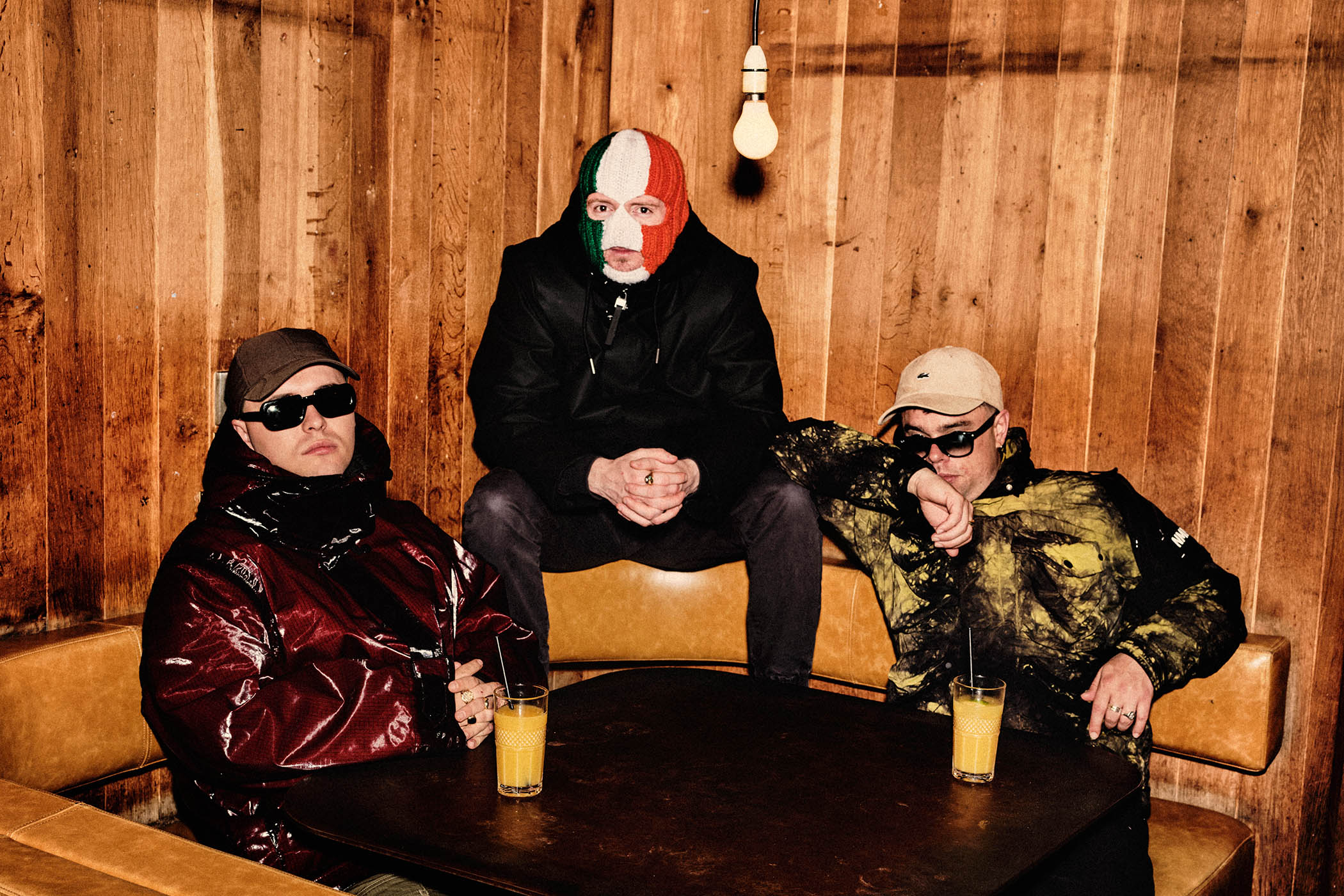
From left, Mo Chara, DJ Próvaí and Móglaí Bap
While we wait, Móglaí Bap takes control of the music behind the bar and Próvaí settles into a booth. So here’s the recap, as one of Kneecap’s singles has it. Móglaí Bap (Naoise Ó Cairealláin, 32) and Mo Chara (Liam Óg Ó hAnnaidh, 28), both from republican Catholic families in west Belfast, formed the band in 2017, via an Irish-language festival that Móglaí Bap was running. Próvaí (JJ Ó Dochartaigh, 36) who’s from Derry, also met them at that festival. They had much in common. “Sharing the words and the youth culture, and taking recreational drugs,” as Móglaí Bap told me when I met the band in 2024. It was natural for them to rap in Irish (Móglaí Bap’s first language), though they had to bring it up to date. They taught me the words they’d made up. “Snaois” for cocaine, “capaillín” for ketamine. The title of their first album, 3CAG, which is tattooed on Móglaí Bap’s chest, stands for “trí chonsan agus guta”, meaning “three consonants and a vowel”, ie MDMA.
When I met them then, they presented a united front, as they do now. But they are quite different people. Mo Chara, chatty and cheeky, is the most naturally outgoing. Móglaí Bap is one step back, with a wild grin that disguises an underlying sensitivity, a slight wariness. Próvaí is calmer, more grown-up; he was a secondary school teacher until his employers found out he was in the band. Someone recognised him when he dropped his trousers onstage to display his buttocks, emblazoned with “Brits Out”.
All three were fun, and they had fun: calling their UK tour Farewell to the Union, making songs about going on the razz with Arlene Foster, the Unionist former first minister of Northern Ireland. They built a fanbase that cut across the usual sectarian divides, their high-energy gigs and witty interviews enhanced for many fans by their outspoken support for Palestinians caught up in the Israel-Palestine conflict. They brushed off naysayers, including then-home secretary Kemi Badenoch, who blocked the band from receiving a £14,250 UK arts grant. (Kneecap took her to court and won: they gave the grant money to youth organisations working with Protestant and Catholic communities in Belfast.) But in April last year things changed. The band had been booked to play Coachella festival in California, both weekends, and the shows went well. But, as they had done at all of their gigs, they used background visuals that included a slide accusing Israel of “committing genocide against the Palestinian people”, and one that read “Fuck Israel, Free Palestine”. After it was aired on TV, several Jewish public figures expressed their outrage. Sharon Osbourne called for the band’s US work visas to be revoked. A letter emerged, signed by 30 prominent music business executives, demanding Kneecap be pulled from festivals. Gigs were cancelled (last July they were banned from Hungary for three years). Most seriously, a video of the band performing in November 2024 was unearthed in which it appeared that Mo Chara was wrapped in a Hezbollah flag and a band member seemed to shout “up Hamas, up Hezbollah”. Both Hamas and Hezbollah are defined in the UK as terrorist organisations. In May 2025, Mo Chara was charged with terror offences.
“I found out that I was being charged through a WhatsApp message,” he tells me, when he finally arrives, whey-faced but still chatty. “My aunt was watching the news and it came up, so she videoed the telly and sent the video to us. The media was given the heads-up before I was.”
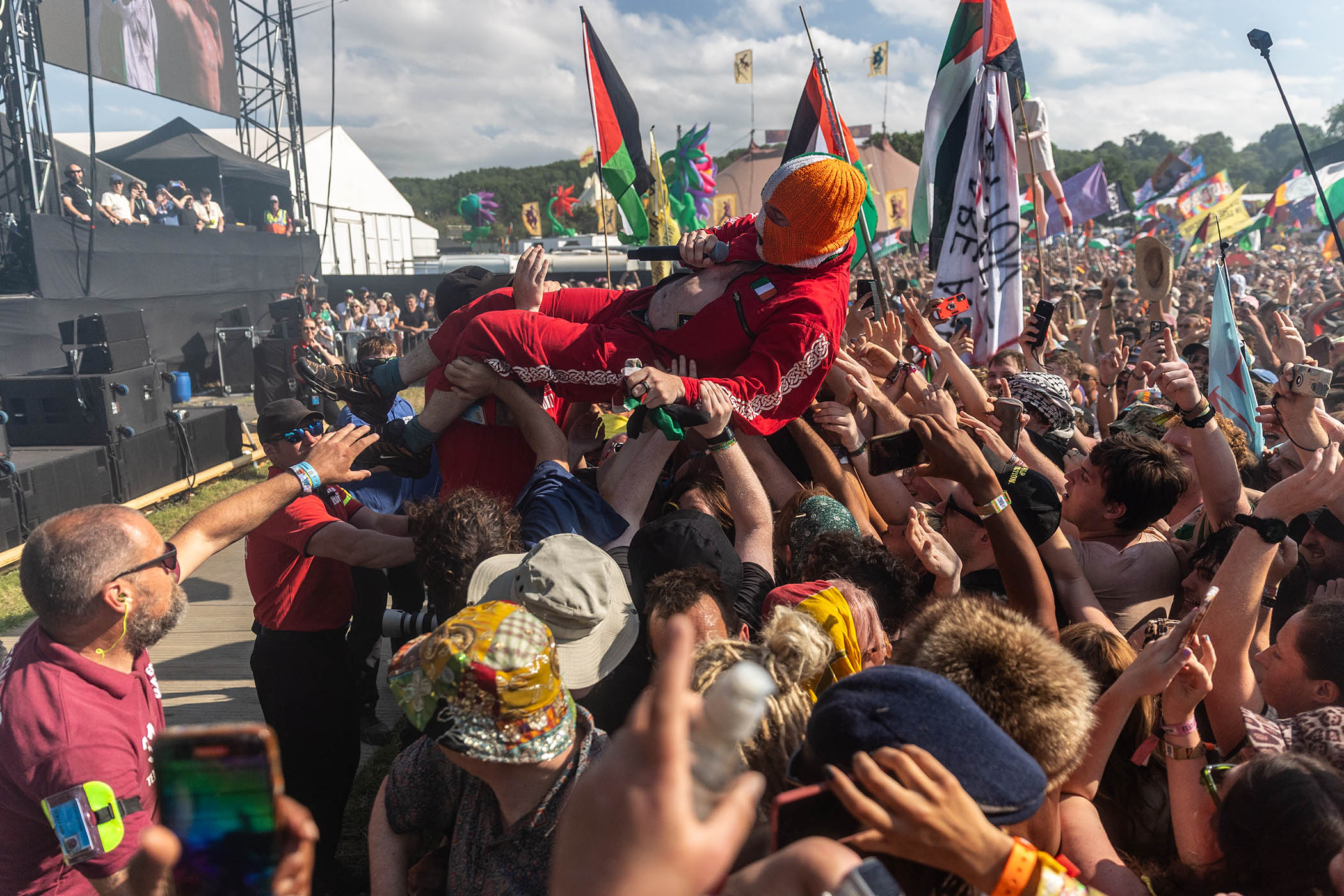
A crowdsurfing DJ Próvaí at Glastonbury
Mo Chara thinks this is because the CPS wanted a headstart on the media war. Certainly the court case caused a lot of hoo-ha. Keir Starmer proclaimed the band’s beliefs “completely intolerable”. Fans turned up at the Old Bailey with “More Irish More Blacks More Dogs Mo Chara” posters. When the case finally began it was immediately dismissed on a technicality. The CPS had filed it one day outside the six-month limit after the alleged offence took place. As the judgment said: “The respondent has not been tried for his alleged conduct on 21 September 2025 and will not be tried. He has not been convicted, and he has not been acquitted.” Somehow the whole palaver trundled on until a couple of weeks ago, when the CPS’s appeal was dismissed.
Kneecap claimed this as a victory: a witch-hunt that failed. But the process wasn’t without its pressures and the band are reluctant to get into some of the details. A few of my questions are answered by an “mmm” and nothing more.
Did the spotlight help them get their point across?
“No,” says Próvaí. “Because when you’re thrust into the limelight, you’re in the news, but at the same time they’re trying to censor what you’re saying; it’s counterproductive.”
“Like we’ve always said,” says Móglaí Bap, “it’s not about us. The Palestinians don’t have their own identity or their own nationality; they have to have Israeli passports. And yet you can’t criticise Israel, even though Netanyahu has [an arrest warrant issued by the international criminal court] that says he is a war criminal. The problem is supremacy.”
The band want to widen the focus out from the case, not just because it takes the pressure off Mo Chara, but also because they’re longtime supporters of the Palestinian cause. It’s part of their lives. Móglaí Bap used to go on pro-Palestine marches with his mum, and to supermarkets “aged around 14”, removing Israeli products. His eldest brother, Aine, is engaged to a Palestinian woman, and in 2020 set up the ACLAÍ (fitness) gym in the Aida refugee camp in the West Bank. Many Irish republicans have long felt an alliance with Palestinians, because they regard the British as occupying Ireland.
Mo Chara says he found the court case difficult, but the charges ludicrous. “It’s hard to know exactly what’s happening onstage 100% of the time,” he says. “It’s dark, everyone’s full of energy.” You notice that these days he wears sunglasses for public appearances in the same way that Próvaí wears his balaclava.
“It wasn’t that bad,” he says. “Everything that happened to me, I’ll get over. Any time you are feeling this tremendous stress, it’s worth remembering that it’s marginal, like, fractional, compared to what people in Gaza and Palestine are going through. And it’s not as though I’m the first Irish person to be called a terrorist. In the courtroom, there was not one person in there that thought I actually am a terrorist. Nobody actually thinks that. It’s this whole big carnival of distraction.”
Our core foundation is the language and the community that surrounds our reclaiming of this and being proud of it
Our core foundation is the language and the community that surrounds our reclaiming of this and being proud of it
Do you worry about the rise of antisemitism?
“Antisemitism is on the rise again, and that’s a real, legit issue that people need to talk about,” he says. “I couldn’t give a flying fuck what religion people are. I’m from Belfast; Jesus Christ, religious difference, I literally could not care less. It means absolutely fucking nothing to me. But what does mean something is people who have endless resources to bomb people who have zero resources. It doesn’t matter what religion people are, I’ll call that out. There’s plenty of things that Muslims have done over the years that isn’t fucking defendable. Same as what Israel is committing in the name of Jews. And it doesn’t look like Jews are any safer because of Israel.”
It’s unusual to spend a good part of an interview talking politics with a band, but Kneecap would rather do that than talk about their personal lives (“That makes me cringe,” says Mo Chara). They are sustained and empowered by their long-term beliefs and aims. Fenian opens with Éire go Deo, a track about the Irish language; An Ra is withering on what the north of Ireland has been given by the British; Palestine features Fawzi, a Palestinian rapper; Carnival describes the circus surrounding the court case. “Obviously, we had to get ‘fuck Keir Starmer’ in there somewhere,” says Mo Chara, “even though we didn’t want to immortalise him. He’ll not be prime minister at some point.”
Even the album’s title, Fenian, is Kneecap reclaiming a word that has long been used as an anti-Catholic slur. Yet the origins of “fenian”, says Próvaí, are heroic. It comes from “fianna”, the clans of Iron Age warriors whose stories are woven through Irish mythology. “Fenian was used as a slur because the whole [British] colonial perception of Irish people, as with any coloniser, is to make them look subhuman or backwards,” he says.
“Like when my dad was growing up and the British army were calling us fenians,” says Móglaí Bap. “As if it’s a bad thing.”
Móglaí Bap’s parents appear on the album’s opening track, which honours people who kept the Irish language alive when it was close to disappearing. You hear the voice of his mum, Aoife Ní Riain, sampled from a radio show she hosted. She and his dad helped to start the Coláiste Feirste school with just nine pupils in 1991; it’s now the biggest Irish-language secondary school in the whole of Ireland. Móglaí Bap and his two older brothers went there, as did Mo Chara.
Both Móglaí Bap’s parents are dead now: his mum died by suicide in 2020; his dad, Gearóid Ó Cairealláin, also revered within the Irish-language movement, at the end of last year after a short illness. His funeral was a big event. (Gerry Adams attended, as did Danny Morrison.) Fenian’s final track, Irish Goodbye, is Móglaí Bap directly addressing his mum.
“When my ma passed away, for a long time, it was hard for me to think of normal, fun memories, positive memories,” he says. “She was sick with depression for a good while. It’s the suffering. Because when you see someone suffering, that sticks in your head. So I wanted to create this happy sad song, looking back at the mundane things, walking round the Botanic Gardens. It’s all the boring, mundane stuff you miss.”
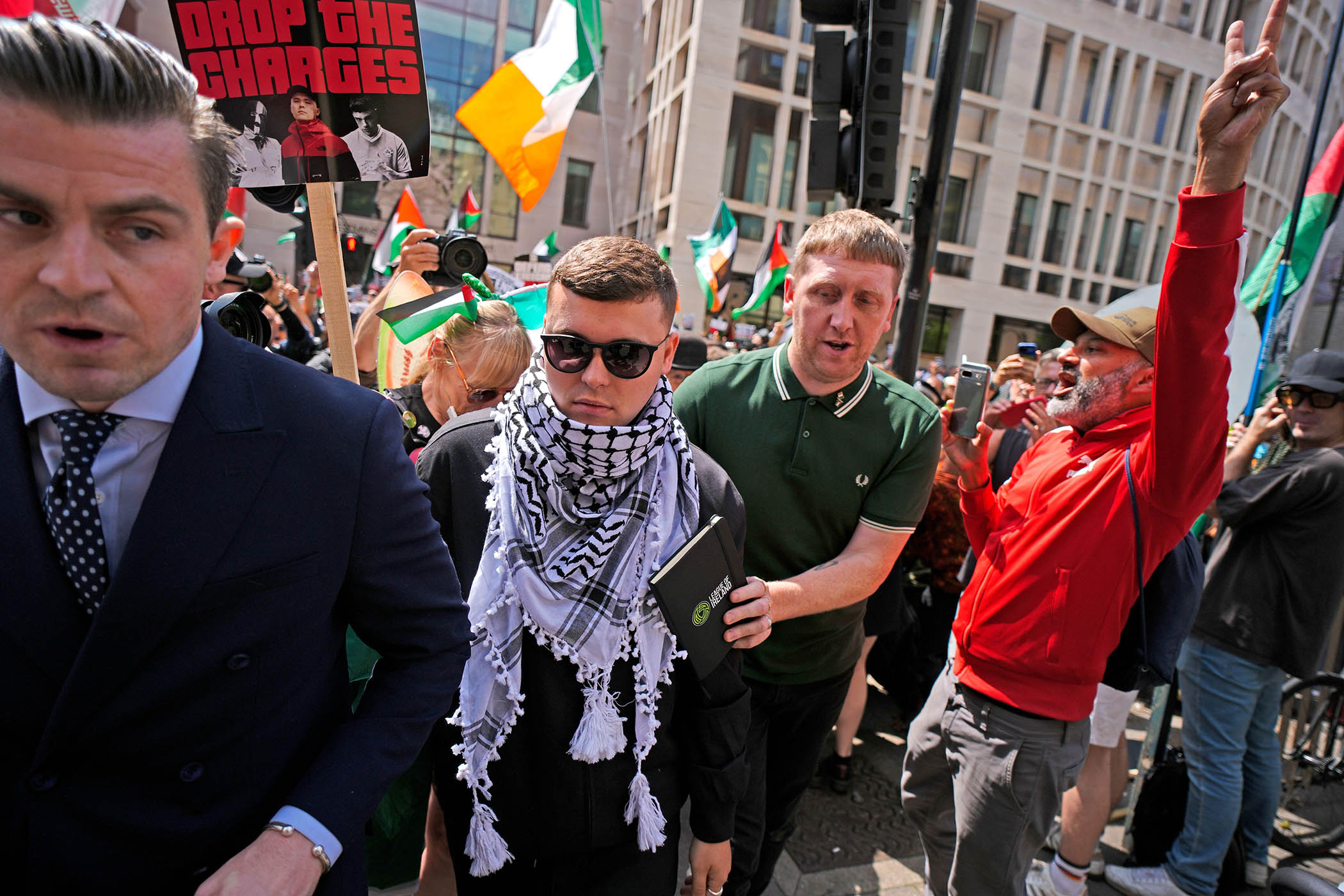
Mo Chara outside court in London last June
Outside their political struggles and mickey-taking exterior, their lives are the usual combination of ups and downs. Móglaí Bap had a gambling addiction when he was younger. Mo Chara can’t sleep – not just because of the cocaine. “I’m just not a great sleeper. At least we got a decent song out of it [on the album]. I had this idea from a John Martyn song [Cocain], the original Cocaine Lil.”
Despite it all, 2025 was a good year. Separately they all enthuse to me about meeting the actor Simon Pegg (“he said he loved our film, that was iconic!”); about their bigger festival gigs (“camping backstage at Glastonbury was class”). Mo Chara’s girlfriend came out on tour and they did some travelling together, to Mexico, Guatemala, Japan. They’ve all enjoyed seeing the world, though they found the few times they were in the US a little weird.
“LA is one of the scariest places I’ve visited,” says Móglaí Bap. “It’s nice in the nice places, yes, but not in the other places.”
“The first time we landed there,” says Próvaí, “they took us to this big record store, and there was a fella lying on the floor outside. So we went over to try to pick him up and this guy from the record company was like, ‘Don’t pick him up, man. If you start picking guys up, you’ll be here all day.’”
They’re happier back home. “Though I’m no fixed abode,” grins Móglaí Bap, who lives between three houses, none of which are his own: they are his brother’s, his grandparents’ and his girlfriend’s, all within 10 minutes of each other. “So if I piss one of them off, I can just move on to another.”
Próvaí, who’s moved to Lurgan in County Armagh, is getting domestic: “I’m a dabbler in cooking and I am a good tidier. And I’ve got a wee bit of a workshop going on.” He’s leaving for the airport straight after our interview: he voiced a part in the Irish-language version of The SpongeBob Movie: The Search for Square Pants, and he’s off to the premiere. Mo Chara, who’s brightened up and is now on the vodkas, wants a proper pint of Guinness.
“The beauty of Kneecap,” says Móglaí Bap, “is that it fuels us through all this madness. Our core foundation is the language and the community that surrounds our reclaiming of this and being proud of it. If it ends tomorrow, that’s what it is. We’re happy that we’ve had a small part to play. And we’ll be passing this legacy on to the next generation, another band coming up. Another Kneecap. Even better than us.”
Fenian is out on Heavenly Recordings on 24 April. Kneecap will be playing Crystal Palace Park on 27 June
Newsletters
Choose the newsletters you want to receive
View more
For information about how The Observer protects your data, read our Privacy Policy
Additional photography by Matt Cardy/Getty Images, PA Images/Alamy