


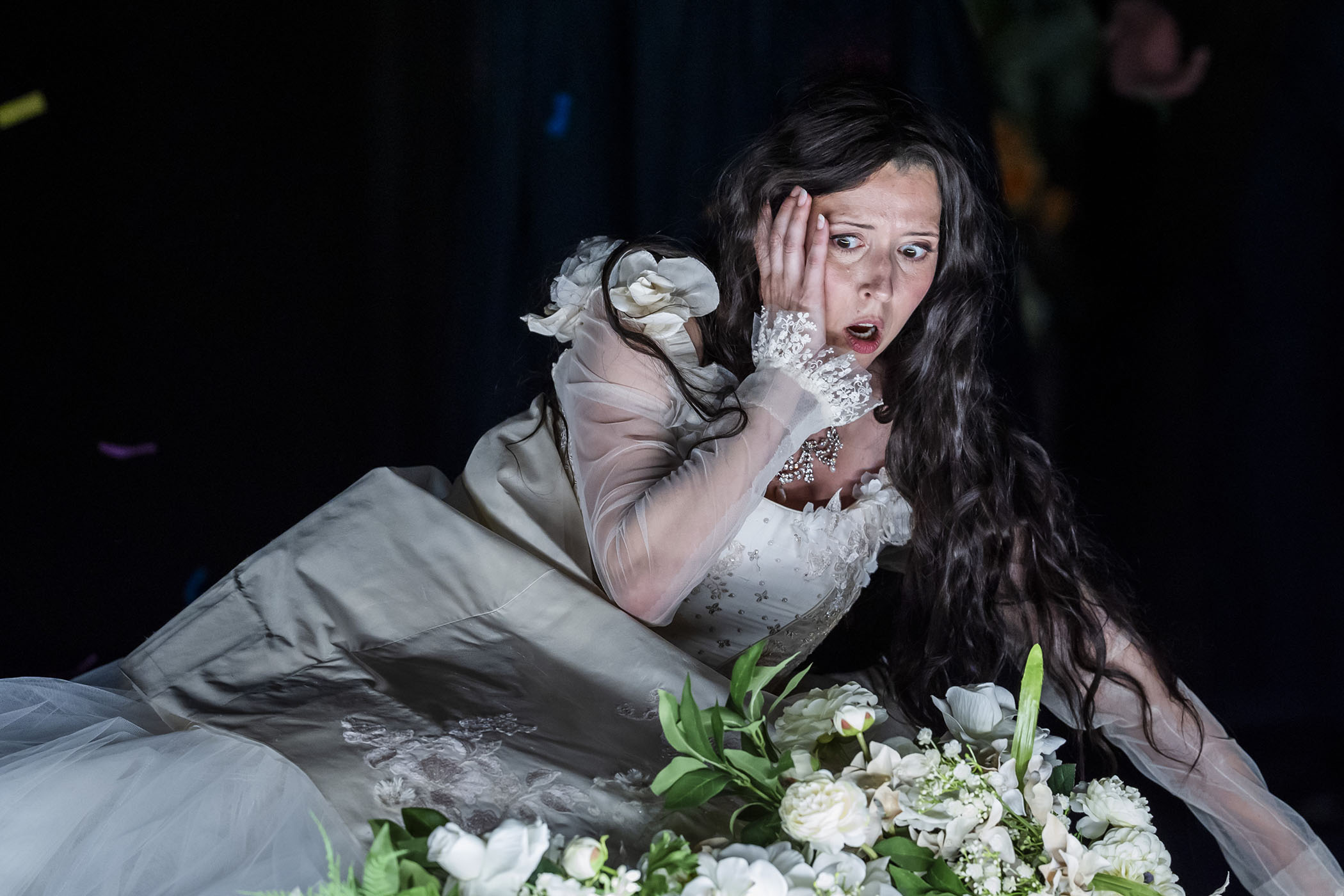
Tamsin Greig, star of a string of popular television sitcoms and dramas, also has an established West End career. She has appeared in Shakespeare and Rattigan, new plays by Yasmina Reza and James Graham, and is now taking on a fresh challenge at the Royal Opera House. Greig, who is 60 on 12 July, will make her Covent Garden debut in the comic role of the Duchesse de Crakentorp, providing a moment of spoken entertainment in the middle of Gaetano Donizetti’s light-hearted 1840 opera La fille du régiment. Greig, who grew up in London, lives with her husband, the actor and writer Richard Leaf. They have three children.
Are you familiar with the grandeur of the Royal Opera House?
I’ve been inside the front of the building a few times, particularly on very hot days because of the air conditioning and the cool marble underfoot. I’ve seen a couple of brilliant productions here too. Last year I went to Madame Butterfly and I’ve just seen Peter Grimes. When I saw the flying sequence in that one, I just thought, that’s how I want to come on as the Duchess. That machinery is in place, so I can suggest it.
How does it feel to follow such an illustrious line of Duchesses?
Ruth Bader Ginsburg [the late supreme court judge] did it in New York, for God’s sake! I’ve watched a video of the 2007 London production with Dawn French to get a sense of the opera and the breathtaking design. And, of course, the exquisite brilliance that French brings with her. She just does this thing with her hands, and you know exactly who this Crakentorp woman is. I will be in a corseted, lilac costume with a fabulous hat and a kind of Mr Whippy wig. In theory you’ve only got six minutes on stage on your own in the second half. I’ve been given carte blanche, which is dangerous. The conductor knows he has to go on playing the waltz underneath, however many times, for as long as I want. It could be six minutes, it could be 60. Who knows?
When fans approach you on the street, can you guess which of your shows is their favourite?
I do try to not make eye contact, but if they’ve got me and are coming over, then within those couple of seconds I’ll do a quick Rolodex flick. Who’s it going to be? I’m mostly right, although sometimes I’m utterly wrong, which I find thrilling. With men of about 50 it is Black Books, probably, or Green Wing. With young men, it will be Friday Night Dinner, though that show was brilliant because it was so true to family life that everyone could relate to a different character. There was a beautiful scene in the kitchen where I’m really stressed and I say to my husband, Paul Ritter, “We have a good marriage, don’t we? And you know I love you and you love me?” And he says, “Yes.” And then I go, “Well, say it then,” and he says, “Likewise”. It is so perfect. So now in our family, we just say, “Likewise”.
People get quite intense about The Archers, especially if there’s a row going on
People get quite intense about The Archers, especially if there’s a row going on
I suspect you’re not recognised quite so often for your part in The Archers, where you’ve played Debbie Aldridge for 35 years?
It was my first proper job and it allowed me to put a deposit down on a flat. So I’m very, very fond of it. It’s surprising, young people do sometimes come up to me about The Archers and I think, “Wow, how did that happen? That’s wonderful.” People get quite intense about it, especially if there’s a row going on. One woman came up to me when I was walking the dog and asked quite angrily why I wasn’t at my mother’s funeral. She said it was ridiculous and I said, “Well, sorry, I wasn’t available.”
Does sitcom experience help the rest of your acting?
Character is about finding the particular rhythm. If you can hear a beat, if you can hear the music of something, then you’ve probably got a sense of it. A lot of it is about how you can stretch something out of what lines you are given; the space between the words and how you modulate that.
What did you watch as a girl?
We weren’t allowed to watch anything after 9 o’clock. But my parents put a horrible old black-and-white television in the bedroom I shared with my sisters. There was a window over the bedroom door, so they could see the light if they came out into the corridor in the flat in Kilburn that we lived in, so we’d have to put a blanket over it. Then I could watch The Good Life and A Fine Romance, with Judi Dench and her real husband Michael Williams, trying not to fall in love with each other and then trying to stay in love. I loved that show.
Is your childhood bond with your sisters still strong?
I’m incredibly attached to them. We were all in it together in Kilburn. And when my mum died, after my dad had died, it was the three of us standing around the bed. I looked at them, and I was so glad we had this three-legged stool. It feels steadier somehow than a ladder. We do talk about our childhood a lot. Like how my dad made beer at home but got distracted. He left a can of malt bubbling away and then heard a bang because it had exploded. The hot malt had splattered over the entire kitchen. Really dangerous. He just painted it over, and we were totally on strict instructions not to tell our mother. We were like, “OK … but she’s going to notice.”
Why did you want to act?
I find psychologising about the thing you end up doing is sometimes reductive and hems you in. You find your own way. Yesterday I saw a full purple clematis flower that had found its way through the wooden fence from next door’s garden. I wonder whether it’s that same energy. Something finding its way and being itself when you don’t expect it to be there.
La fille du régiment runs from 7–24 July
Photograph by Suki Dhanda/Contour via Getty Images