

When I was a young singer, training for what I was sure would be a brilliant career on Broadway, I always wanted to be a belter: to be able to sing Éponine in Les Miserables, or Sally Bowles in Cabaret, or Evita in Evita. Instead, I had a pretty little soprano, which doomed me to play sweet ingenues. Sing high, get the guy, as they say. It was so much more interesting not to get him and then to sing about how sad you were.
The term belt comes from boxing: the idea is that the singer is striking the audience with her voice. The belt I prefer has a slightly different effect: for me it is the sound of ratcheting stakes, of walking a tightrope. I always wanted to be able to do that – to walk that tightrope, to be a belter – but I couldn’t figure out how.
Even as a little kid I couldn’t belt. And that’s what little kids do! Like the orphans in the 1982 film version of Annie, my favourite movie when I was four. I had the soundtrack album and I would sing along with them, but it was as if they had extra room in their sinuses or something, and they could make that little kid belting sound, the one you hear in It’s the Hard Knock Life, and I couldn’t, not really. And I loved it so much, I loved that high shiny sound.
But the place it hit hardest, and had the biggest impact on me, was in a singer who became famous right around the time when I was getting bored with Annie and seeking new creative inspiration. The first singer I most wanted to sound like was Cyndi Lauper. In the mid-1980s, a musical showdown occurred. If you were someone who cared about music, you were given no choice but to take sides in the matter of Cyndi Lauper v Madonna. The two pop stars released their first albums within a few months of each other in 1983, and the result was a polarised playground. Were you a Lauperite or a Madonna fan?
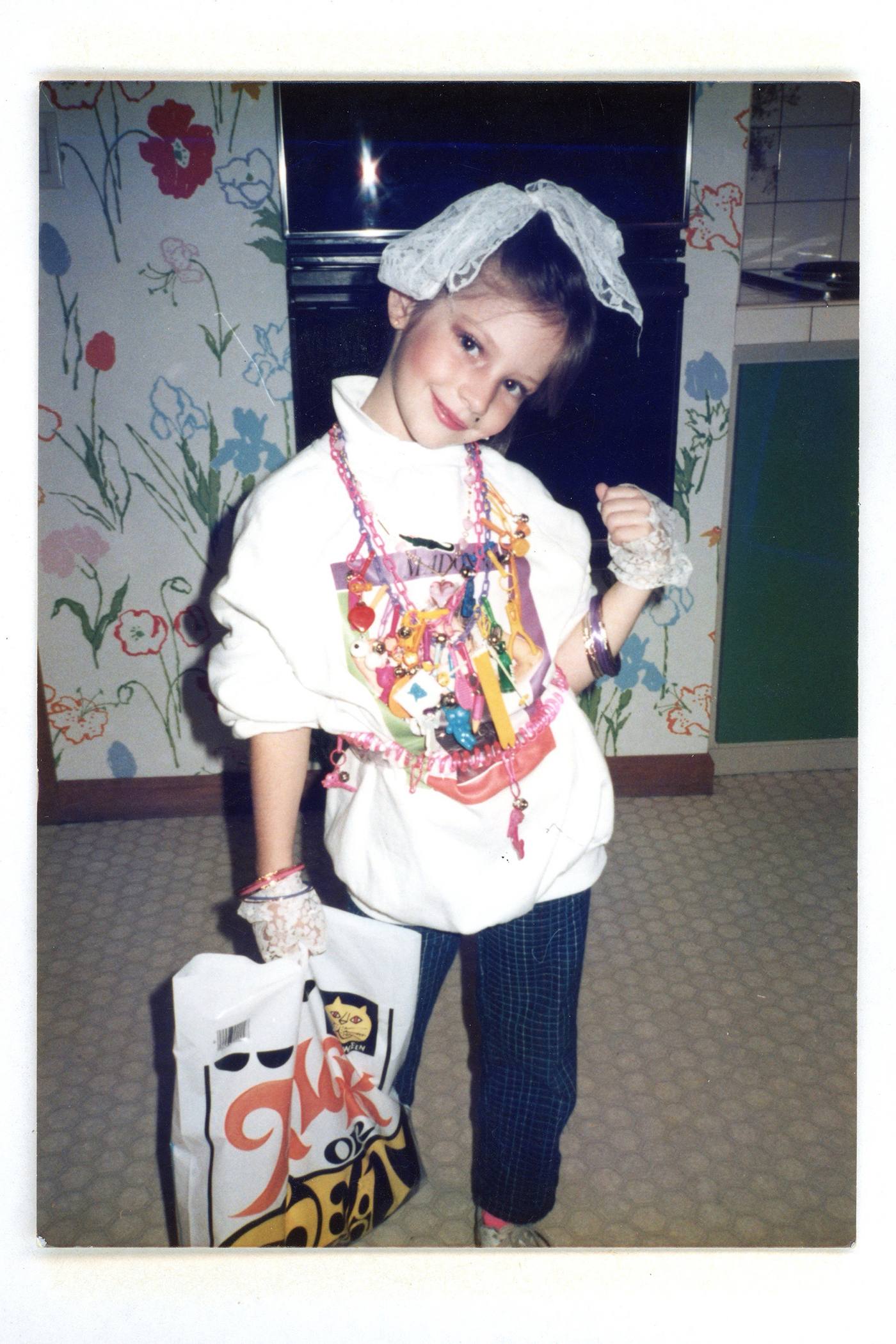
A young Lauren Elkin in full Cyndi Lauper mode
My heart was with Cyndi Lauper; I just instinctively loved her. The pliability and urgency of her voice was thrilling, how she could move from sultry to brassy to cartoony (“like Betty Boop with the hiccups”) in the space of a line, across a four-octave range. Her voice had warmth, texture, interest, personality, integrity. Like most of my family, Lauper grew up in Queens, New York, and she didn’t change her voice to hide it; her accent made her sound like some quirky long-lost cousin. Maybe that’s why I was moved to invite her to my birthday party the following year. I remember sitting around the table in the dining room, watching the door for her, as if this international superstar might take a break from her busy schedule to come to a child’s party on Long Island. Of course she was a no-show, but I wasn’t offended, and two weeks later I dressed as Lauper for Halloween, loaded down with charm necklaces and bangle bracelets, a floppy lace bow in my hair. As I slipped on my fingerless gloves, I remember feeling not only the satisfaction of dressing like my idol but, as if in borrowing from her look, I had become a more interesting version of myself.
Then as now, female pop singers are held up as role models to little girls, no matter how mature their themes or videos. The littler the girl, the less likely that mature content will even mean anything to her; I did not stop to wonder what it meant to be “like a virgin”, and She Bop was, I confidently assumed, about dancing. But Madonna and Cyndi Lauper did not offer the same version of adult femininity. In being asked to choose between them, we were choosing our relationship to our own femininity, our own future bodies; we were already choosing sides. Madonna promised all kinds of rewards for learning to be pleasing to men. For this reason, Madonna was threatening. Cyndi Lauper was kooky and offbeat, and made space for us simply to please ourselves. (She bops, indeed.) The division would linger, between the Madonna girls and the Cyndi Lauper girls, a fault line that would determine our social standing at my school for years to come.
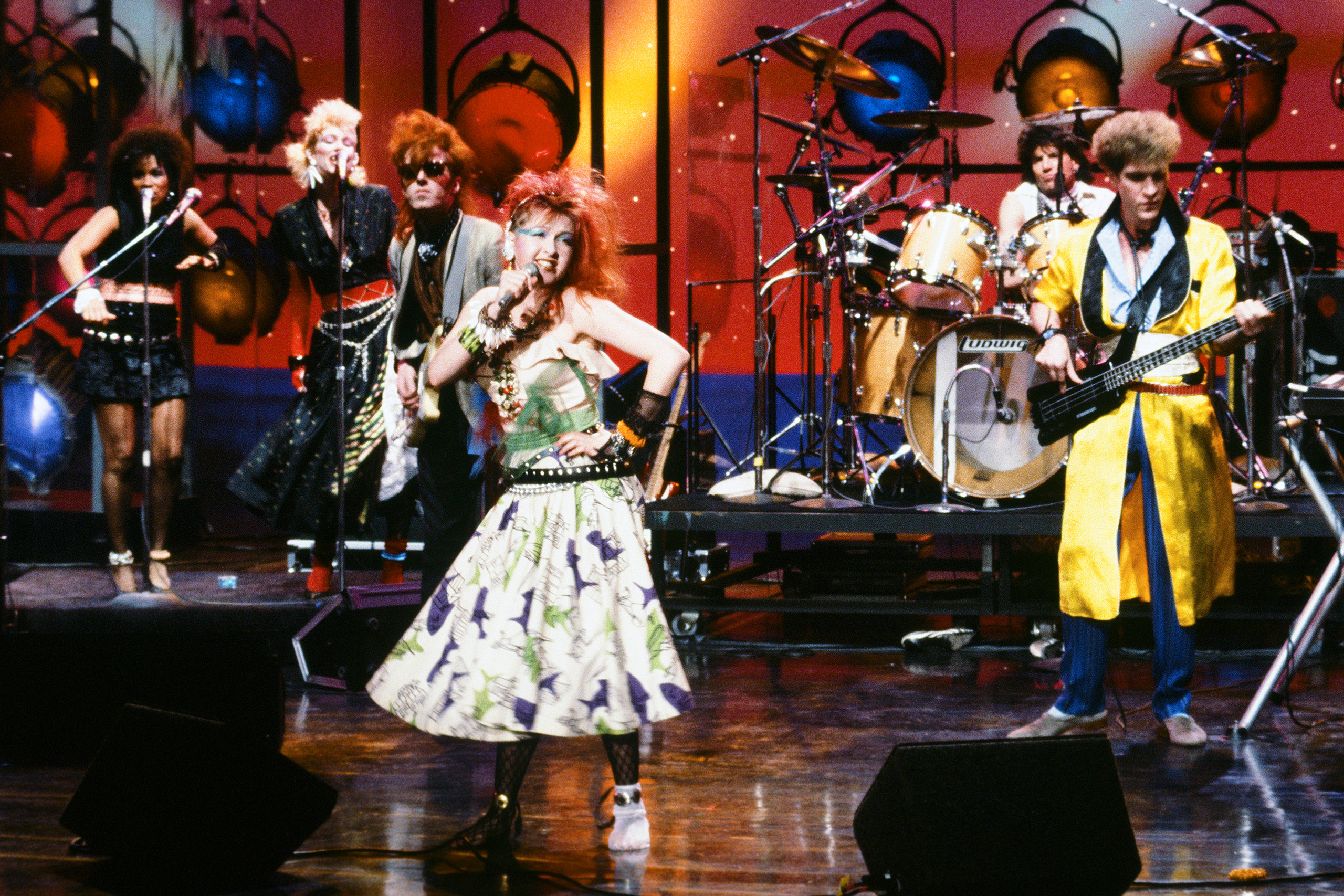
Lauper never trained formally as a musician; she grew up singing along with her mother’s Broadway cast recordings. She didn’t study voice until she was already singing professionally; after she blew out her vocal cords early on singing with a covers band, she had to rebuild her voice from nothing, with the help of a vocal coach. Hugely talented, with flawless instincts, she became a consummate vocalist and musician with a deep understanding of technique and interpretation. Watch her performance of Girls Just Want to Have Fun on The Tonight Show in 1984 and listen to where she lodges the high notes, each one precisely placed, even live. She counts in the band, plays around with them while she sings, dancing in her socks – this is joy and technical accomplishment.
And when she sang about wanting “to walk in the sun”, I knew that she was singing for me. Even as a little kid, I instinctively understood that Lauper’s version of girlhood made more room for the kind of girl I was, or would become.
Though she emerged from the punk and no wave scenes of downtown New York in the late 1970s, Madonna is a creature of the 1980s: a material girl, a businesswoman. She was after mass appeal, but she wasn’t afraid to court controversy; she figured out a way to make it appealing. I don’t think she was a bad feminist; she was doing her part to move the needle for women. But Madonna was more aligned than Lauper with the feminism of that moment, offering a more blatantly individualist narrative to postfeminist women, and a reassuring sexual fantasy to the men who would shy away from anyone who called themselves the F word.
Lauper, on the other hand, strikes me as a continuation of 1970s feminism, punky and spiky, with recognisably progressive politics, which she maintains to this day. She is a performance artist as much as a singer, attuned to visual culture as well as to music. In her book A Memoir, she describes her early training in art and fashion design, and her instinctive understanding of what makes a good painting: framing and content. When she left home aged 17, she packed only the basics – toothbrush, underwear, and a copy of Yoko Ono’s 1964 artist’s book, Grapefruit.
While making She’s So Unusual, Lauper insisted on being deeply involved in the process, leading on the music, the videos, the art direction for the album cover. The result is a gesamtkunstwerk, shaped almost entirely by her own creative vision. It was an uphill battle. Just shy of 30 years old, Lauper was a scrap of a thing with a high squeaky voice, a thick Queens accent, and a specific idea of what kind of work she wanted to make. She had to fight “tooth and nail” to be let into the writing process, but in the end her vision dominated the album.
When Lauper’s producer, Rick Chertoff, first brought her Girls Just Want to Have Fun, she turned it down out of hand. The original song was written by a man, and largely about having casual sex with random women: girls just wanna have fun in bed. Chertoff encouraged her to change it so it suited her purposes. “He kept saying: ‘Think about what it could mean.’ And so I thought about what a woman’s version might say. And that maybe I should try to find a new heart in the song. I started to think: ‘OK, I’m not a guy. How do I feel?’ If I could find the twist in it so that I could use my voice in a unique way, and in a woman’s key, that could change everything.”
Newsletters
Choose the newsletters you want to receive
View more
For information about how The Observer protects your data, read our Privacy Policy
Lauper rewrote the lyrics and rearranged the melody, borrowing a bit from reggae, a bit from Motown, and turning it into a feminist anthem. A scene of bonding between a son and his father became an encounter between a mother and a daughter that acknowledges their working-class status (which, as Lauper has said in interviews and in her memoir, held back too many women from her neighbourhood), while also justifying a woman’s right to enjoy herself, instead of complying with convention, tradition, patriarchy. In her high, girlish voice, Lauper rewrites the script of the good girl, whose obedience or liberation mainly benefits the men she sleeps with. Lauper gives her a different song to sing, light and happy and exuberant.
When it came time to make the video, Lauper said she knew exactly what she did and did not want. “I don’t want to be portrayed as just another sex symbol,” she said. “I can look at all the videos other people have done and see all the things I don’t want to have done to me. I think every artist should have the right to express him or herself visually – and to be able to do it sincerely and not be made into something synthetic.”
The resulting video was an instant classic. There she is, wacky white girl in her asymmetrical orange haircut. She’s not working it for the male gaze, or teaching little girls to trade on their looks for financial gain; she’s jigging down the street, hoicking up her skirts and doffing her hat to passersby. There she is in leopard-print pyjamas getting Lou Albano in a hammerlock. There she is talking the wrong way into a rotary phone receiver to her girlfriends, who are, unusually for videos of the time, mostly women of colour. There she is throwing on winged white sunglasses. There she is leading a conga line down the road and into her parents’ house, right into her pink-painted bedroom where she throws some kind of rave complete with a fire brigade and a pizza delivery guy. Girls’ bedrooms are the places where they dream, sing, write, hide away, emerging reinforced, armed with their secrets. In her memoir, Lauper describes hiding in her bedroom from her abusive stepfather, the door firmly locked. A decade and a half later, Lauper brings together the public zone of the street and the private world of the bedroom in a joyous outpouring of protest against how we’re brought up to be: quiet, pretty, obedient.
It is a completely joyous video, girls taking over the streets of New York with their infectious enthusiasm, dancing on the steps of the Met, in a subway station, by the New York Stock Exchange, by Sheridan Square Park, and, memorably, down Gay Street in the West Village. Not long after the success of Lauper’s 1984 debut album She’s So Unusual, the TV presenter Dick Clark warned her that pop music is a “disposable” art form. “No,” she replied, “I did not work my whole life to make disposable music.”
I can’t help hearing Clark’s comment as a judgment not only of Lauper’s music, but of her gender. Pop stars are coded as female, while the template for being a rock star is a male one. Rock gods are authentic artists; female pop stars are just a flash in the pan. Just look at the musicians who have been inducted into the Rock and Roll Hall of Fame: 91.6% are men. Pop stars are not taken as seriously as rock stars, so pop stars can be women. In fact, in Billboard’s list of the greatest pop stars of the 21st century, women occupy the top three positions (Beyoncé, Taylor Swift and Rihanna, respectively) and all told rank in seven out of the top 10 slots. Pop sounds light and ephemeral, like a balloon that might explode, or super sweet, like soda. Disposable as a can of Coke, processed and forgettable. Rock sounds firm, immutable, or like something you’d hurl in anger, in protest.
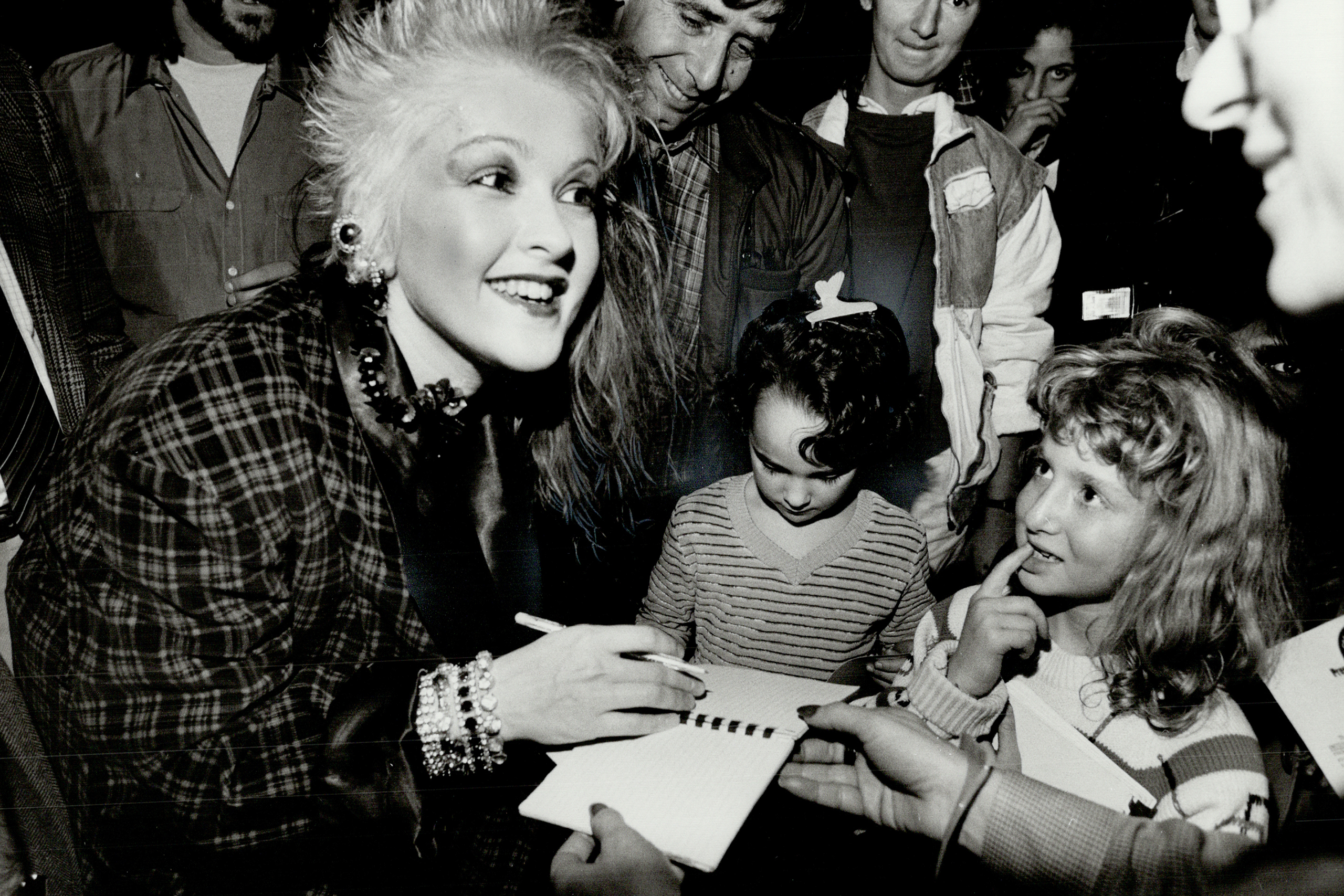
Lauper signing autographs in Toronto during her 1984 Fun Tour
Of course women can rock, but it often seems as if they are having to prove themselves in a game written and defined by men. Somewhere around the 1970s, when 1960s rock’n’roll gave way to the rise of the rock star, rock performance became associated with aggressiveness, loudness and violence, all about banging and thrashing and shredding. Cock rock, as feminists began to call it almost as soon as it was invented: “Mikes and guitars and phallic symbols; the music is loud, rhythmically insistent, built around techniques of arousal and climax; the lyrics are assertive and arrogant, though the exact words are less significant than the vocal styles involved, the shouting and the screaming.” Women’s music has accordingly been stereotyped as sweet and quiet, centering subjects like love and relationships. These assumptions form the foundation for the construction of gender in rock music. Young girls have been more encouraged to play seemingly polite instruments like the piano or the violin; if we did happen to pick up a guitar, we were told we couldn’t play it.
In listening to Cyndi Lauper, I am thinking of the voice as a point, a point of confluence, where influences and timbre come together, culminating in a voice like the tip of a pencil, or a knife. A pointy voice is so instantly recognisable, probably what you’d call shrill or strident, but that’s OK; maybe it’s time to reclaim stridency. It can be thrilling to hear. The voice as a feminist tool, a sharp instrument. It enters you, gets inside your body, and moves you in a way you don’t understand and possibly don’t even want to be moved. In The Queen’s Throat, his ode to opera, Wayne Koestenbaum describes this penetrative voice:
“To hear is metaphorically to be impregnated – with thought, tone, and sensation [ … ] The listener’s inner body is illuminated, opened up: a singer doesn’t expose her own throat, she exposes the listener’s interior. Her voice enters me, makes me a ‘me’, an interior, by virtue of the fact that I have been entered.
“The singer, through osmosis, passes through the self ’s porous membrane, and discredits the fiction that bodies are separate, boundaried packages. The singer destroys the division between her body and our own, for her sound enters our system.”
For a patriarchy anxious about its orifices, a woman’s voice is indeed dangerous. Hence the attempt to control the singer’s voice through lessons and technique – or by brushing it off as light, disposable, unserious. The voice can pierce. This is why, perhaps, women with high voices were defanged into playing the ingenue. And this danger – call it strident, call it shrill – is what offends the men who would stop them singing.
Lauper has never held back about how much she hated being constantly compared to Madonna. (Madonna has not, to my knowledge, offered her thoughts.) “As if you could only have one woman who is successful. What the hell is that about?” she asked. Women were radically under-represented in the commercial music industry of the early to mid 1980s (this is unfortunately still the case today), and would find themselves placed in competition with one another even when they had nothing in common apart from their gender. Country radio had its female singer: Dolly Parton. Aretha Franklin was the anointed soul singer. And so on. Madonna seemed intent on being that one female pop star, and Lauper, constitutionally averse to fame and all it demanded, left her to it. While Lauper has gone on making work over the years, faithful to her own aesthetics and politics, exploring different genres of music (jazz, blues, country, dance) and trying to bring something true to each of them (take a listen to 1993’s Hat Full of Stars), going on to win a Tony award for her musical Kinky Boots, raising money to combat homelessness, opening shelters for LGBTQ+ youth, and lobbying Washington on their behalf, Madonna went supersonic, becoming the biggest pop star in the world, adapting her look and her message to fit her given moment.
What the culture needed from a pop star was something other than great singing: it wanted someone who wanted to be an icon. Lauper just wanted to sing.
Vocal Break: On Women, Music and Power by Lauren Elkin is published by Chatto & Windus on 21 May (£22). Order a copy from The Observer Shop for £19.80. Delivery charges may apply.
Photographs by Gary Null/NBCU Photo Bank/NBCUniversal via Getty Images; courtesy of Lauren Elkin; and Jim Russell/Toronto Star via Getty Images