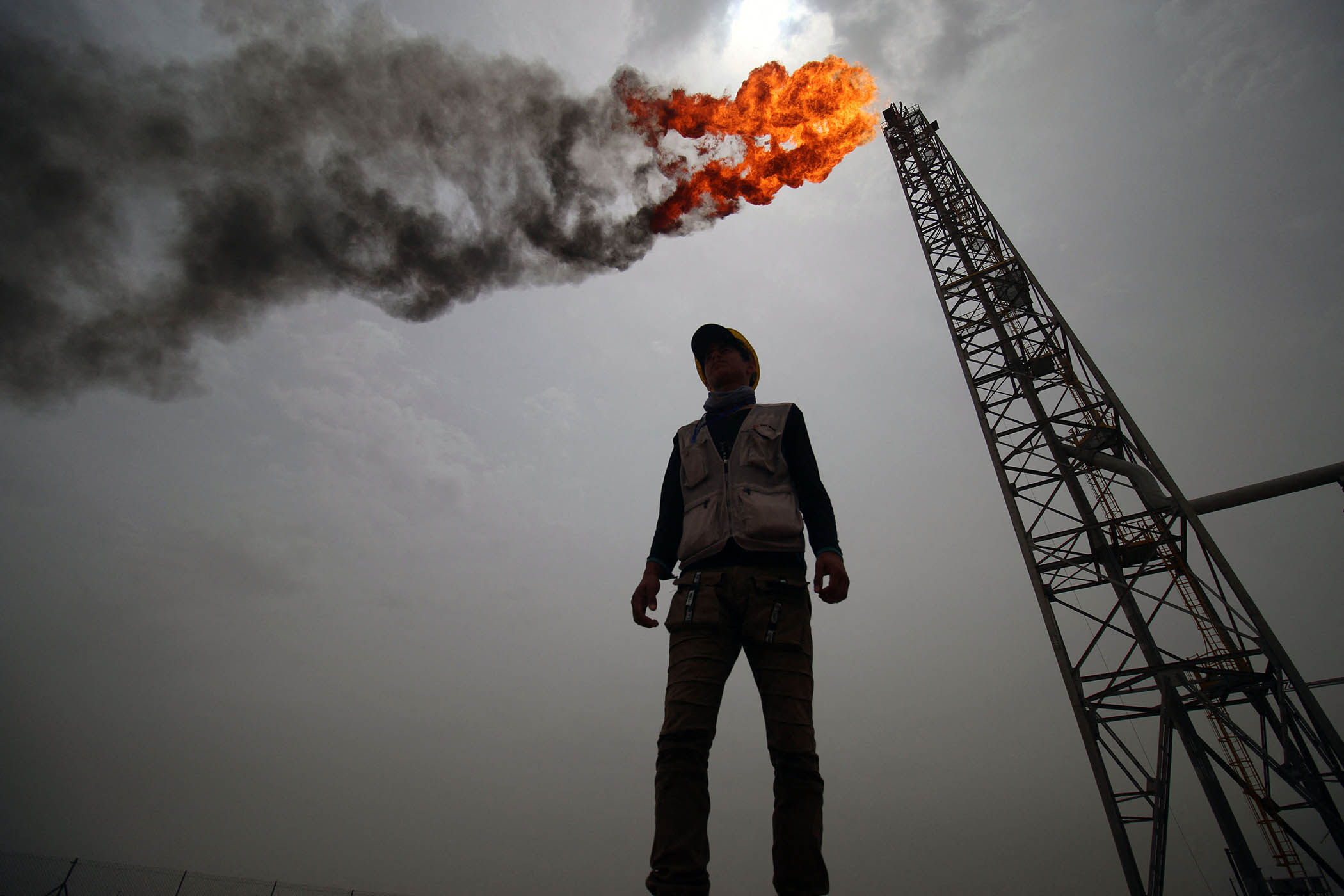

A fireball erupted as an Iranian missile crashed into the oil refinery in Bahrain on 5 March, sending plumes of thick black smoke into the skies above the capital, Manama.
The attack on the state-owned Bapco Energies refinery struck at the heart of the world’s biggest oil-producing region – one of a string of attacks on infrastructure in the Gulf as Iran seeks to impose economic pain on the US, Israel and allies.
The S&P 500 index is now in negative territory for the year. UK gilts sold off sharply on the expectation that the shock will damage public finances and pressure the Treasury to intervene on energy bills.
‘We expect all Gulf exporters to call for force majeure in the next few days’
‘We expect all Gulf exporters to call for force majeure in the next few days’
Saad al-Kaabi
Almost half of the world’s oil reserves and exports come from the Middle East, which has five of the world’s seven biggest reserves of oil.
Even more pressing for gas-dependent Britain is the fact that the Strait of Hormuz, which Iran claims to have effectively shut down, is a key waterway for about one-fifth of the world’s supplies of oil and liquefied natural gas (LNG).
On 4 March, drone strikes on Qatar Energy’s vast Ras Laffan LNG terminal, the world’s largest, forced it to shut down and declare force majeure – a contractual clause that allows it to suspend shipments to customers because of events beyond its control.
The plant supplies about a fifth of the entire world’s LNG, which is a crucial component of the energy mix for many countries, including China, Japan, South Korea, Pakistan and India. Qatar also supplies Europe, albeit in smaller volumes.
The plant is unlikely to be able to restart production for at least two weeks, prompting grim warnings from Qatar’s energy minister, Saad al-Kaabi, who said that war in the Middle East could “bring down the economies of the world”.
Kaabi told the Financial Times that even if the conflict were halted immediately it would take weeks or months to return to regular scheduled deliveries of LNG, a superchilled form of gas which can be transported by ship, much like an oil tanker.
“Everybody that has not called for force majeure we expect will do so in the next few days that this continues. All [Gulf region] exporters will have to call force majeure,” he said, adding a prediction that oil prices could hit $150 a barrel within two to three weeks if the Strait of Hormuz remains impassable to marine traffic.
Newsletters
Choose the newsletters you want to receive
View more
For information about how The Observer protects your data, read our Privacy Policy
“Once these facilities are shut down, restarting them takes time,” said Torbjorn Soltvedt, associate director at Verisk Maplecroft in Edinburgh. “Brent crude is heading to over $100 a barrel. It’s getting critical.”
At least nine oil tankers have also come under attack from Iran. BP has evacuated staff from Iraq’s Rumaila oil field after two drones were spotted landing in the area. Unable to load tankers, Iraq has also been forced to cut its oil production by 1.5m barrels a day after running out of storage. Drones have also been also spotted in Azerbaijan, the UAE and Oman.
The crisis has sent oil and gas prices rocketing. The price of a barrel of benchmark Brent crude has surged by 20% to above $90 since hostilities began. UK wholesale gas prices surged above 165p a therm last week, a level it had not reached since Russia’s invasion of Ukraine.
While the UK imports relatively little oil and gas directly from the Gulf, consumers are still exposed to price spikes because it is a global market, feeding into inflation that could force central banks to consider tightening monetary policy if the crisis continues for an extended period.
Available cargoes of LNG from other suppliers, such as the US, Angola or Mozambique, may find themselves the subject of bidding wars between Asian and European suppliers.
Until recently, the Bank of England had been expected to gradually trim UK interest rates this year, but a spurt in inflation linked to energy prices may shift that assessment. The Bank’s monetary policy committee next meets on 19 March – and markets are currently assigning less than a 5% chance of a rate cut.
Photograph by Haidar Mohammed Ali/AFP via Getty Images