Illustration by David Foldvari
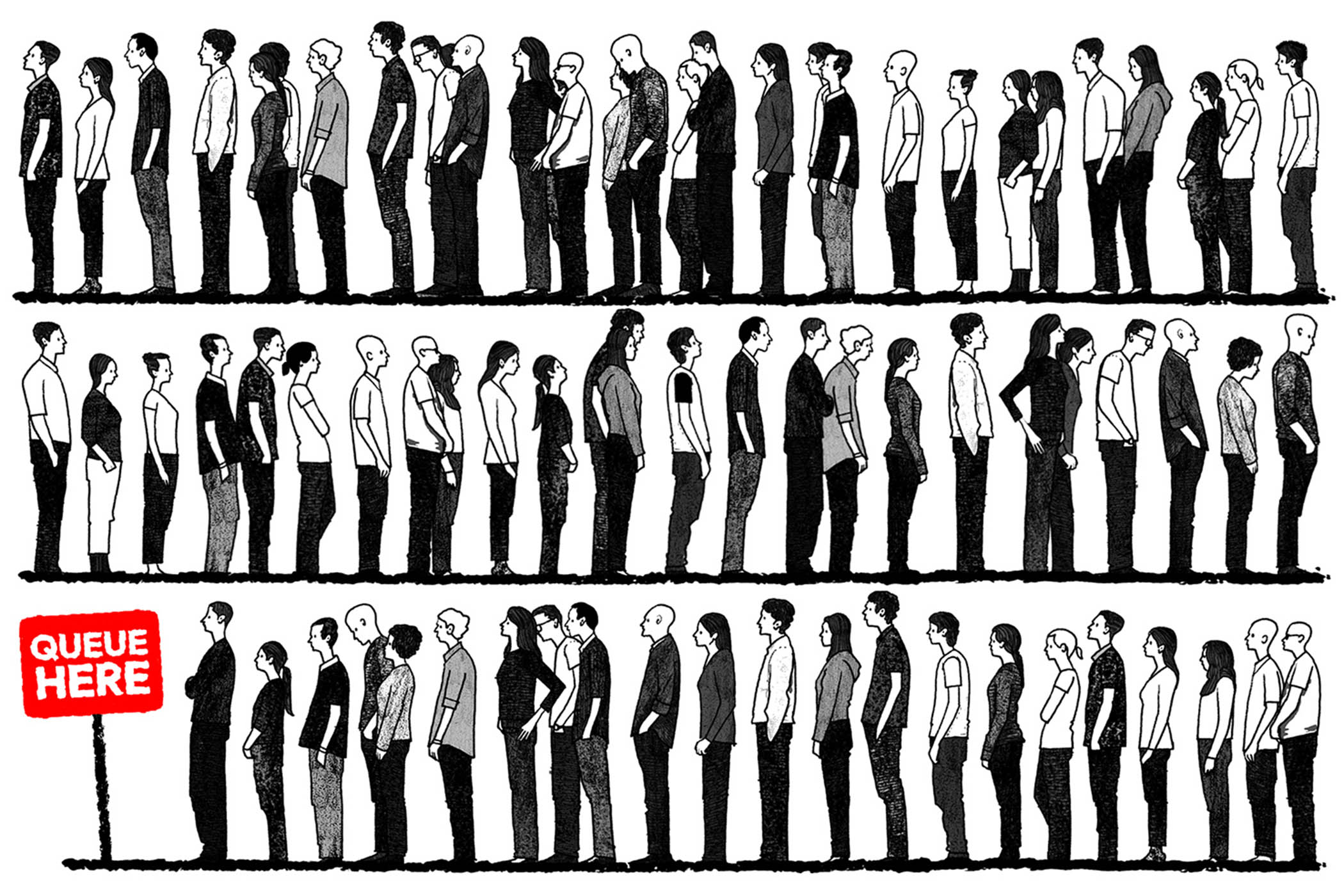
It’s a beautiful sunny afternoon and I am in an oyster shack on the edge of a picturesque forest in Essex. All right, this is not technically true. Technically, I am standing outside an oyster shack, on the edges of a car park in Epping, eating a melted ice-cream I paid more than 99p for. I am in a queue, and the queue, by the looks of it, is more than 90 minutes long. People keep leaving the queue and coming back to it, armed with reinforcements – pints and crisps – from the pub next door. It is the lunchtime rush. We wait 20 minutes and then we give up and drive all the way back to north London in a hangry huff. We didn’t even get close enough to see the menu.
In other words, I rage-quit the queue. Was I wrong to do so? Perhaps. Perhaps I should have been more resilient, more patient. The oyster shack I was trying to eat at had recently been featured in several popular videos on social media. It had recently been referred to as a “hidden gem” on TikTok. It had recently been visited by the food blogger Eating With Tod, which is both the golden ticket to insane profitability for any food establishment, and the kiss of death for any normal person wishing to eat there. I may have been on the border of Essex but what I was seeing was inevitable – the epidemic of London queue culture, an infection that was beginning to spread past its initial containment zone.
For two years I worked directly opposite a jacket potato shop in Soho called SpudBros Express. SpudBros made me feel how I assume pensioners who read the Telegraph feel on a daily basis: frightened and confused by the world around me. It is, for all intents and purposes, a jacket potato shop. And yet people queue for these jacket potatoes, sometimes for more than an hour. People travel into London to queue for these jacket potatoes. They take a train from hours away and they come to another city to stand in the street and then pay more than a tenner for weeknight mum dinner food, made by men wearing T-shirts which read “full of beans”.
Until this week, I had never actually made it inside the SpudBros shop, largely because of the queue. In the interest of journalistic integrity, I finally made the pilgrimage. Initially, I was sceptical about my chances of success. A sign on the front door informs all customers that the potatoes arrive at 11am every day, and that when they’re gone they’re gone. But when I got there at 2.45pm on a weekday afternoon, the spuds were still going strong. And without the added sideshow of the queue itself, for which SpudBros has had to introduce crowd control signs on Archer Street, the whole spectacle was much less appealing than it seemed. Inside, the overall impression was somewhere between MrBeast YouTube video and school dinner hall, with a kind of AI Willy Wonka décor. Suddenly granted the opportunity to do so, I decided that I didn’t want to buy an £11 salt and pepper chicken jacket potato, or a “chewna coleslaw”, and not just because they were displaying the calories for each (up to 590 and 1,000 kcal respectively).
Newsletters
Choose the newsletters you want to receive
View more
For information about how The Observer protects your data, read our Privacy Policy
Could it be that queuing culture is not actually gatekeeping good food, but creating a frenzy over things that are in fact very normal? That the hype of the queue is the extent of the appeal? Admittedly, I am not much of a foodie – my favourite thing to eat is pick n mix – so I decided, also in the interest of journalistic integrity, to ask someone better suited to answer this instead. “I actually refuse to go somewhere if there’s a queue,” Joe Bishop, editor of the food newsletter Freeloader, tells me. “Because it is inherently shameful.”
“To be part of a queue is a tacit admission that you are desperate to do something so much that you’re willing to be a kind of zoo exhibit for passersby who can see you embarrassingly in the thrall of a ramen place or a steak frites place,” he says. “In Japan, if there’s a queue you should join it because there’s almost certainly something very good at the end of it. We do not have that here – it’s actually, I might argue, the opposite.”
Joe thinks that queueing for food “takes the air out of an evening” and I am inclined to agree. It’s hard to be spontaneous when part of your night involves 45 minutes of waiting-in-line small talk. This is why I have never in my life successfully completed a date at Dishoom.
But it is now a truth universally acknowledged – not just in London but in any major city – that to eat popular food you are going to have to queue on the street for it. In New York, much of a visit is defined by queueing, from immigration lines at JFK to hour-long waits outside Katz’s Deli for pastrami sandwiches, but also at non-famous, non-touristy spots. For years now, it hasn’t been uncommon to wait an hour for a pizza slice with artichokes or hot honey prawns on it, or for cheesecake slices purchased from Greek tavernas. New York has always been ground zero for food trends, but in this case what it’s exporting is not a particular dish but the very activity of waiting. The queue is the trend. The queue is the meal. The queue is the experience.
I fear part of my mental block when it comes to endemic culinary queueing culture is that the things being queued for are not necessarily feats of gastronomy or even aesthetically pleasing Instagram fodder, but the experience is a kind of Sisyphean feat of patience. By posting a meal at a queue-ravaged establishment you are communicating something about yourself; a kind of “in the knowness” I find irritating because it’s not warranted.
Once hundreds, if not thousands of people, “discover” a small establishment or a fun event, it destroys the mythos of discovering something good. I am simply too self-conscious to enjoy something that I can see a line of other people waiting to enjoy. I’m too pretentious. This is why I can’t eat £12 jacket potatoes.