
“This is our only country. Can you imagine if we lose this country to foreigners?” “We cannot cater for the whole globe. We don’t have enough.” “People are not working, the jobs are being taken by illegal foreigners.” “We have an obligation to protect our women and children.”
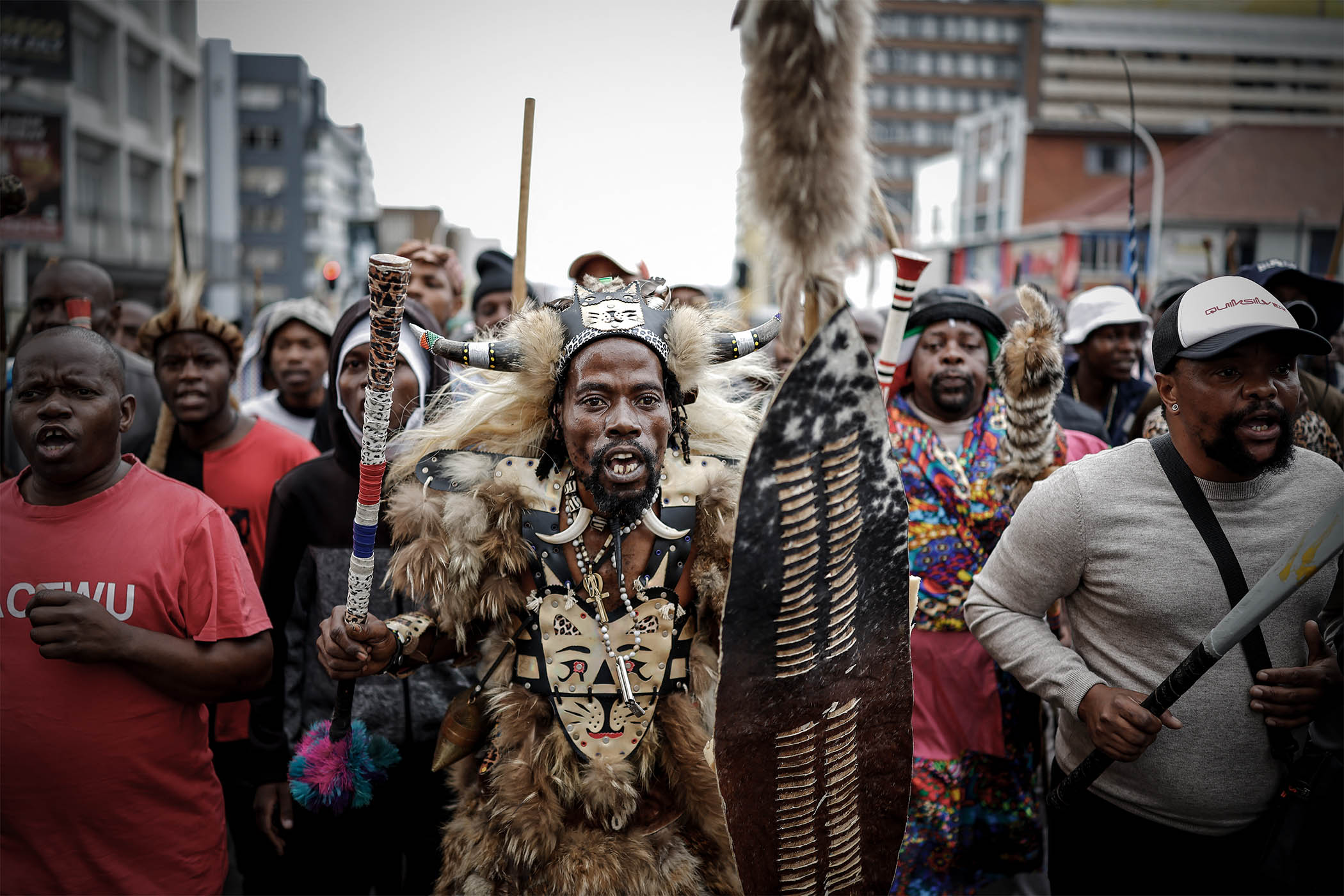
These might have been comments at a Tommy Robinson rally or a protest at an asylum hotel. They are in fact anti-migrant voices from South Africa. Over recent months there has been a brutal campaign against African immigrants in the country with at least four people killed, thousands made homeless and other African governments organising mass evacuations of their citizens. In many places, protesters went door-to-door demanding to see residents’ papers and chased out hundreds of foreigners who were forced to sleep on the streets or in makeshift camps. Protesters have blockaded hospitals and health centres, refusing to allow anyone suspected of not being South African from entering.
Most of the protests and much of the violence have been orchestrated by two main groups. Operation Dudula, whose name means “to remove by force” in isiZulu, emerged in the early 2020s organising attacks on immigrant traders, and is now a registered political party. March and March is a self-described “grassroots” civic organisation that draws heavily on Zulu nationalist imagery. “Abahambe!” (“They must go!” in isiZulu) has become the movement’s rallying cry. Protesters claim to be acting against undocumented migrants but there is little distinguishing between legal and illegal migrants. There have even been calls for South African women married to foreigners to be expelled.
The anti-migrant movement draws support from the poor and the unemployed. South Africa is perhaps the most unequal society in the world, and has become more so since the end of apartheid. The Gini coefficient is a measure of income inequality in which 0 represents perfect equality and 1 maximal inequality. For European countries the coefficient is around 0.25-0.35, for the USA 0.41 and for sub-Saharan Africa as a whole 0.58. For South Africa, it stands at 0.63. The top 10% of the South African population enjoys between 71% and 85% of total wealth, while the bottom half scrabbles for 4% - 7%.
The official unemployment rate stands at 32% while the “expanded” unemployment rate, which includes those who have given up looking for work and so is more accurate, is 43.7%. Of 15- to 24-year-olds, more than 60% are unemployed.
One in eight households still lives in “informal dwellings” – shacks. More than half of households have no running water inside the house, while 14 million have no flush toilets. Studies suggest that “the percentage of the population currently receiving reliable water services is lower than it was in 1994”, when apartheid fell.
The plight of working-class South Africans, and their sense of the betrayal of post-apartheid promises, is desperately real. But it has little to do with migrants. According to one calculation, if every foreigner were expelled, and all their jobs given to locals, unemployment would still stand at 37.6%.
Inequality, the economist Khwezi Mabasa has observed, is the product of policies pursued by the state and by private industry. Deindustrialisation, trade liberalisation and deregulated financial markets have all helped destroy the “sectors that have historically employed large sections of the black working class”. At the same time, while a small number of workers have standard employment rights, the majority “occupy precarious jobs with minimal labor protections”, making it easier to “exploit them through labor market flexibility.”
Austerity policies have exacerbated poverty, while state corruption, often organised through the ANC, has become so endemic, and so intertwined with organised crime - including through “state capture” - that it has undermined democratic processes, incapacitated the delivery of essential services, including water and electricity, and established, in the words of one report, “a self-sustaining, self-protecting and self-expanding criminal economy”.
For 30 years, the writer Duncan Nortier observes, “South Africa has been great at sloganeering” but “fewer and fewer people feel like those slogans meant something”. The moral authority the ANC gained through its role in the overthrow of apartheid has long since drained away. Groups such as Operation Dudula and March on March give “those who feel silent something to say, something to do, a tangible action - and that is a lot more than broken promises.” This, Nortier reflects, is a case of “the marginalized being mobilized against the marginalized” while “those in power sit back and smile as they are left unscathed.”
Newsletters
Choose the newsletters you want to receive
View more
For information about how The Observer protects your data, read our Privacy Policy
And more than simply sitting back and smiling, many within the corruption-soaked political class have helped inflame anti-migrant sentiment. March on March is particularly close to uMkhonto Wesizwe, a new party now run by former president Jacob Zuma, for most of his life a leading ANC figure, and the politician most embroiled in corruption scandals. Through such political agitation, foreignness, in the words of political philosopher Anye-Nkwenti Nyamnjoh, “is made to appear dangerous, disordering, burdensome, or morally suspect”.
Local factors have clearly been important in fuelling the xenophobic violence that now wracks South Africa. But many of the same processes can be seen playing out in Britain, America, India and other countries across the globe. South Africa reveals in the starkest form what happens when the anger created by the betrayal of working-class hopes is exploited by sections of the elite to deflect attention from their own role in that betrayal, and to forestall the political and economic policies necessary for real social change.
Photograph by Marco Longari/AFP/Getty Images