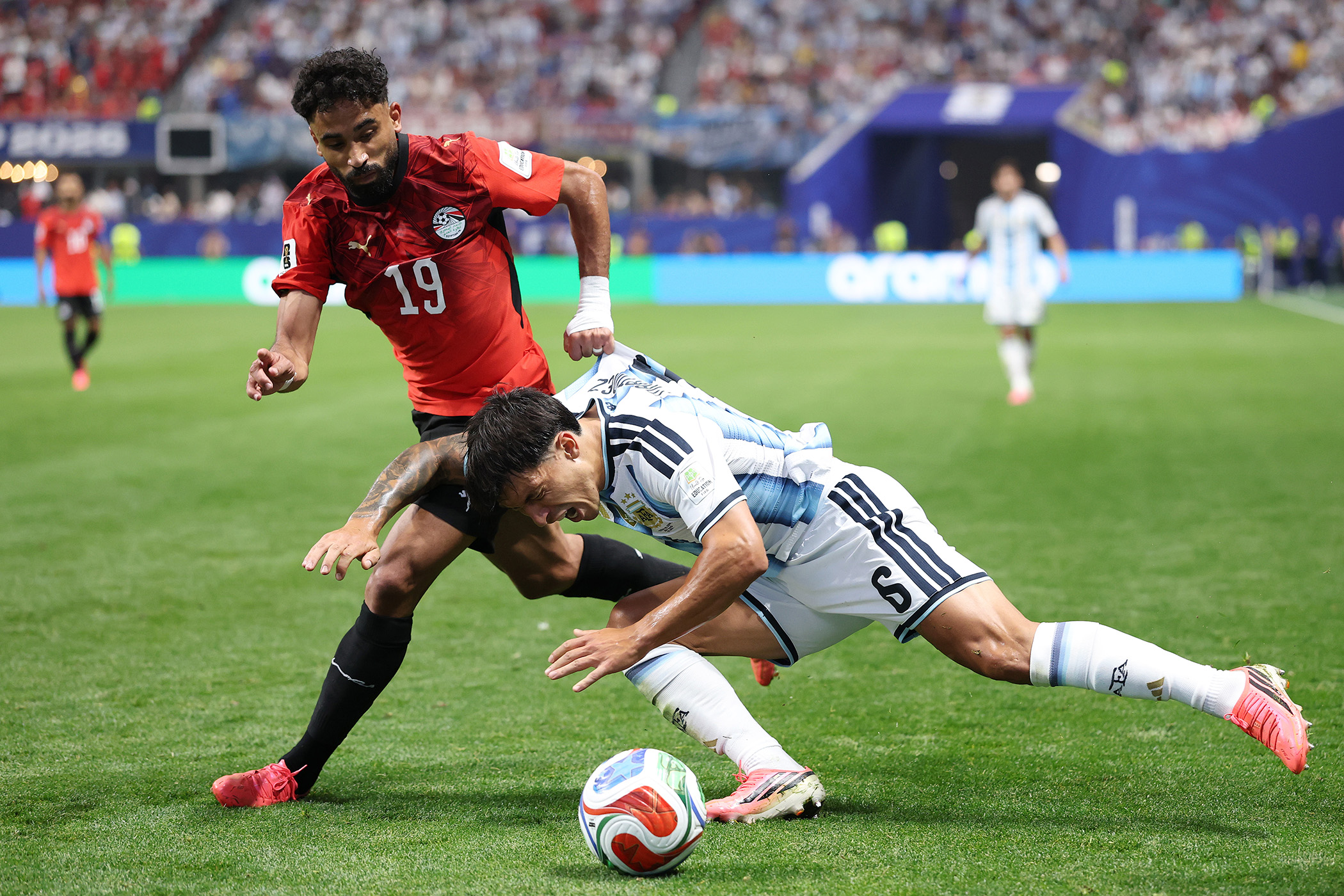

It would have been one of the greatest goals scored in World Cup history. Egypt’s Haissem Hassan tore down the right wing, ghosted past two Argentinian defenders, passed to Mohamed Salah, who in turn played an inch-perfect ball to Mostafa Ziko, who dinked it over goalkeeper Emiliano Martínez and into the net. That made it 2-0 to Egypt after 58 minutes, and on their way to causing one of the biggest shocks to happen in the tournament.
But the whistle went. The referee brought the play back, and after a VAR review, judged that a foul was committed 17 seconds earlier, 100 yards away, by Egypt’s Marwan Attia on Argentina’s Lisandro Martínez. The goal was disallowed.
Despite Egypt scoring a legitimate goal nine minutes later, Argentina pulled off a remarkable comeback to win the game 3-2.
That was far from the end of it. After the game, Ziko said it was “clear that this tournament has been fixed”. “The referee was really not fair. The injustice was clear… a 2-0 lead isn’t enough to beat Argentina.” His manager, Hossam Hassan said he would not watch another minute of the tournament, and accused Fifa of favouring the reigning champions. “It’s all about money. They want Messi to stay in the tournament,” he added.
While pre-tournament arguments centred on ticket prices, USA immigration policies and the heat, the World Cup has been dominated by officiating controversies and conspiracies. Chief among these was Fifa’s decision to suspend for a year the one-match ban handed to the USA’s Folarin Balogun after he was sent off against Bosnia-Herzegovina. The move came after President Donald Trump asked the tournament organisers to review the incident, and called Brazilian referee Raphael Claus’s decision “horrible” and “a little bit suspect”. USA’s tournament top scorer Balogun was reinstated, but was unable to stop his country losing the subsequent last-16 fixture 4-1. Belgium’s players celebrated their final goal by mocking Trump’s fist-pumping dance.
The incident is one of many refereeing controversies. The Croatian Football Federation filed an official complaint to Fifa after their Round of 32 loss to Portugal, claiming there was an “incorrect application of VAR and ball sensor technology.” Ghana coach Carlos Queiroz said VAR had “gone for a coffee” during an incident in which England’s Ezri Konsa tackled – and arguably fouled – Ghana’s Prince Adu in the penalty area.
Conspiracies surrounding World Cups are nothing new. In the podcast series Foul Play, Gabriel Gatehouse explored whether Gordon Banks was the victim of a CIA plot when he fell unwell and was unable to play against West Germany at the 1970 World Cup. In 2002, there were accusations that referees favoured co-hosts South Korea in their run to the semi-finals of the tournament. The quality of refereeing even drew then-Fifa president Sepp Blatter to call it the “only negative aspect of this World Cup”.
In 1998, a conspiracy followed the inclusion of an apparently unwell Ronaldo in Brazil’s 3-0 final loss to France. The striker – a global superstar of that era – was allegedly forced to play either due to collusion between French and Brazilian authorities, or under pressure from sports manufacturer Nike, whose boots Ronaldo wore. The conspiracy went so far that Brazil launched a congressional inquiry into the relationship between Nike and the Brazilian FA. “I only played after medical tests showed I was clinically and physically fit to do so,” Ronaldo said.
The Balogun incident has led to intense scrutiny of Fifa president Giovanni Infantino. He has never been far from criticism in his decade in charge of the governing body, and his relationship with Trump became so close he awarded the US president Fifa’s inaugural “Peace Prize” last December – 85 days before USA launched “Operation Epic Fury” on Iran.
On Wednesday, 72 members of the European parliament called for an investigation into Fifa over its political neutrality and the process that led to Balogun being allowed to play. Fifa appointed an independent judicial body to oversee the case. Infantino said it will “operate autonomously, apply the Fifa disciplinary code, and decide cases based on the applicable regulations and the specific facts before them”.
Newsletters
Choose the newsletters you want to receive
View more
For information about how The Observer protects your data, read our Privacy Policy
Whether the pile-up of controversies at this World Cup will overshadow the spectacle of the football itself will probably depend on how this week’s semi-finals and final goes. Pass without incident and the tournament will be remembered as an all-time great. Further controversies, and the conspiracies will only intensify.
What are your thoughts on this? Send us a letter to letters@observer.co.uk
Photograph by Justin Setterfield/Getty Images