About 3,000 miles (4,800km) from Tehran, a mansion said to have been bought for the supreme leader of Iran sits mouldering. Nearby there is another – and another – uninhabited and overgrown, all on one of the most expensive streets in London.
The British property portfolio allegedly amassed by the family of the late Ayatollah Ali Khamenei – and worth at least £100m – serves as a powerful metaphor for the regime he left behind: in disrepair, illiquid, built on corruption and yet apparently immovable.
As far as anyone knows, the new supreme leader, Mojtaba Khamenei, has never been to London. Nor has he been seen in public since being named as his father’s successor a week ago. On Friday’s annual al-Quds day march through Tehran, he was nowhere to be seen among the crowds.
The younger Khamenei has been described by Iranian state television as “a wounded veteran”, and even, by US officials, “disfigured”. Some Iranians have taken to joking about his absence by mocking up videos of him made of cardboard. Speculation about his wellbeing swirled, prompting questions about whether he really survived the attack that killed his father along with much of his family – and who is in day-to-day control in Iran.
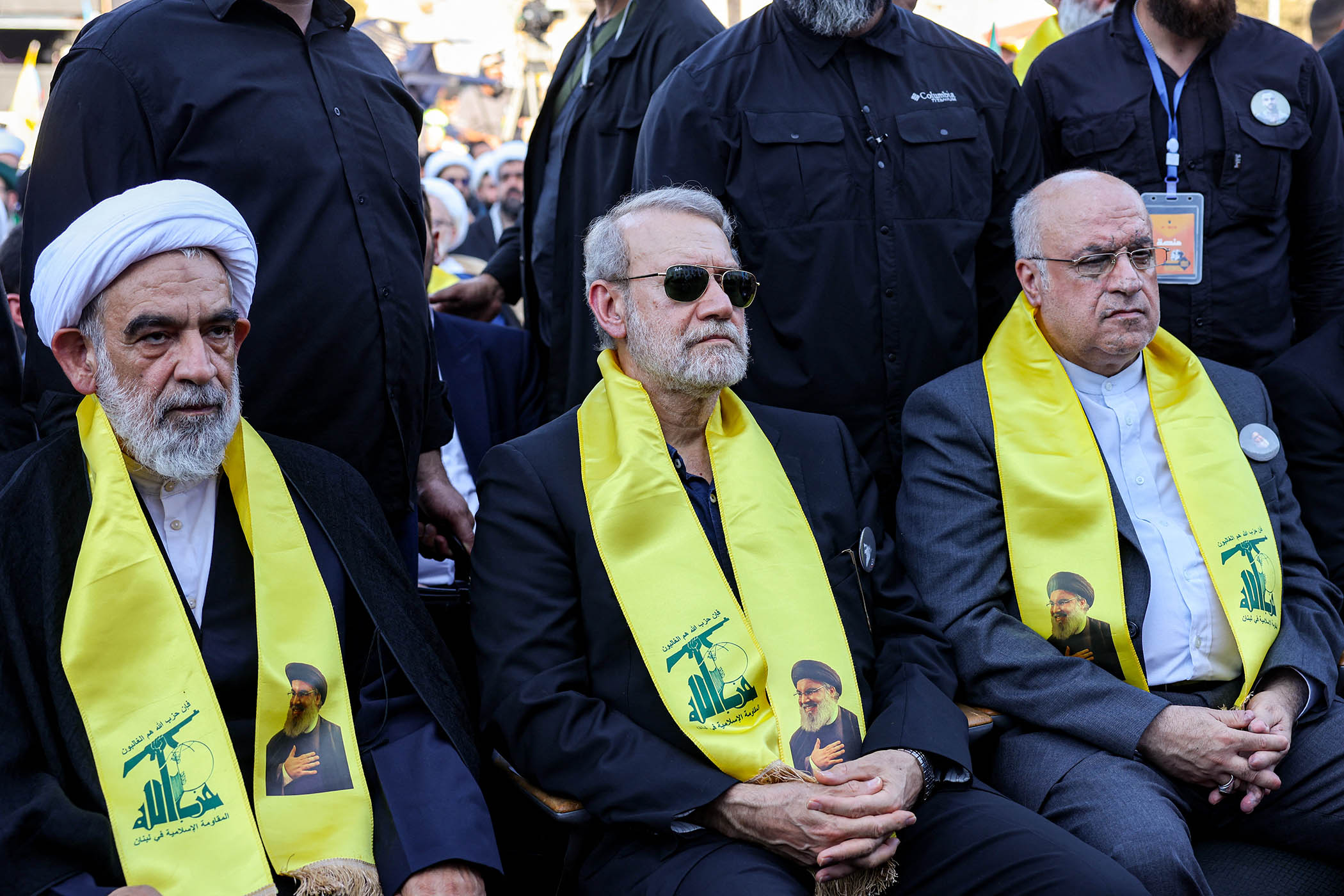
As Tehran suffered under hundreds of tons of Israeli and US ordnance, some of the many faces of the regime did surface for the march on al-Quds day: the security chief, Ali Larijani, strode defiantly through the streets of Tehran. Iran’s president, Masoud Pezeshkian, took selfies with passersby in the drizzle, and the judicial chief, Gholam-Hossein Mohseni-Eje’i, prayed in the middle of sitting crowds before speaking to state TV as a strike hit close by.
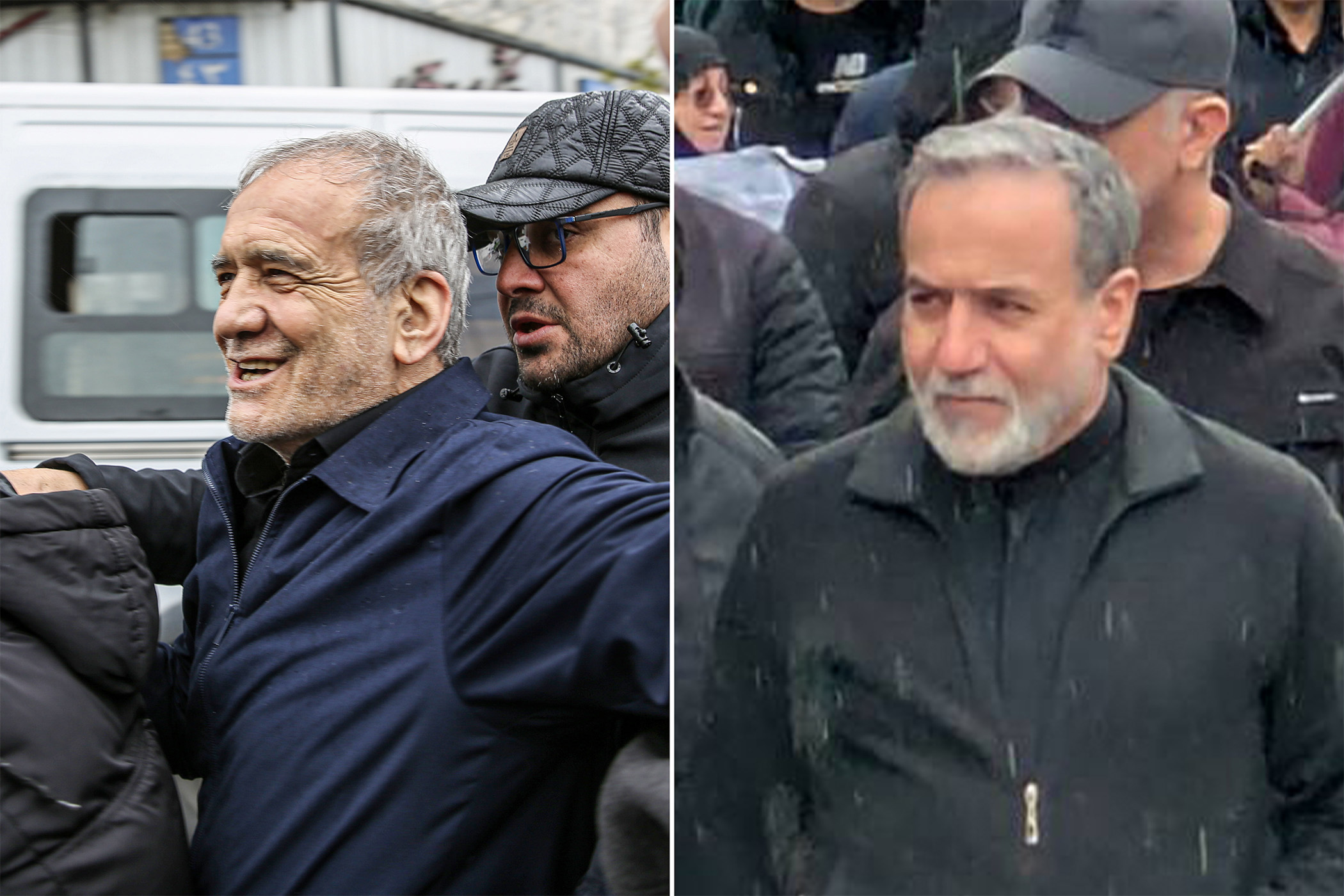
Iranian president Masoud Pezeshkian, left, and foreign minister Abbas Araghchi participate in al-Quds day rallies
Two weeks into the war, one supreme leader is dead and another invisible, but the regime is proving resilient. Hardliners are firmly to the fore, pledging vengeance and giving no hint of concessions.
Since the death of Ali Khamenei, Larijani and Mohammad Bagher Ghalibaf, the parliamentary speaker, have expanded their influence at the top of the regime, but true power remains with two institutions: the Islamic Revolutionary Guard Corps (IRGC) and the sprawling office of the supreme leader – regardless of who sits at the helm.
“These are the two pre-eminent institutions in Iran,” said Alan Eyre, a former Iran policymaker and Persian-language spokesperson at the US state department. “They are the ones that railroaded through Mojtaba Khamenei’s selection as supreme leader. Even if he was in the pink of health, he has no power above and beyond them. This may change over time if he amasses enough individual power to separate himself from the IRGC but for now, he’s just a frontman.”
Larijani's prominence grew in the aftermath of the 12-day war with Israel last year. Born into a prominent clerical family and with a decades-long political career, the head of Iran’s supreme national security council emerged as the face of continuity the morning after Ali Khamenei’s assassination, when he appeared on state TV vowing revenge.
This cultivated a sense that he is the power behind the throne – the key liaison between the IRGC and civilian elements within the regime – but Larijani's power has been limited by his reported inability to get his brother Sadiq appointed as supreme leader. “This is elite politics – it’s about institutions,” said Eyre. “None of these people’s power derives from popularity.”
Newsletters
Choose the newsletters you want to receive
View more
For information about how The Observer protects your data, read our Privacy Policy
Still, hopes persist in Washington that the security chief could be among those willing to negotiate, as Venezuela’s former vice-president Delcy Rodríguez did after Nicolás Maduro’s abduction from Caracas two months ago. Donald Trump has said he likes the idea of an “internal... and eternal” candidate in Iran, “because it works well – I think we’ve proven that so far in Venezuela”.
Larijani has hit back at Trump and the suggestion that anyone within the regime is willing to talk, and Ghalibaf took to social media to throw barbs at Washington. “The war will continue until the enemy’s calculus is altered and they are driven to regret,” he said on X, writing in English.
‘Mojtaba Khamenei is likely to be much more aggressive, even with the economy. He does not see any barrier’
‘Mojtaba Khamenei is likely to be much more aggressive, even with the economy. He does not see any barrier’
Saeid Golkar, Iran expert
One certainty in the chaos of war is the growing power of IRGC, within Iran’s “de facto collective leadership”, said Ali Alfoneh of the Arab Gulf States Institute. This group includes figures such as Ghalibaf but also Eje’i, who showed his ability to rule over Iranian citizens’ lives with an iron fist when he toured prisons filled with demonstrators in January, after the regime gunned down tens of thousands who rose up against it. Figures such as Eje’i and members of the IRGC’s Basij paramilitary militiakeep a tight grip over Iran’s streets and ensure no dissent is allowed to emerge.
Rule by a tight-knit circle of hardliners will continue regardless of Ayatollah Mojtaba Khamenei’s health, Alfoneh said, although the IRGC is likely to wield outsized influence in the circumstances. “As was the case with his late father, it may take him years to consolidate his position, and he may never fully succeed if the current power holders are unwilling to concede authority voluntarily."The IRGC is a behemoth inside the Iranian regime, whose influence extends far beyond the realm of the military and deep into Iran’s economy and social fabric – and is now also led by a hardliner, Ahmad Vahidi.
Nominally, civilian politicians such as Ghalibaf and Larijani – both former IRGC members – remain formally in charge. But Vahidi and others within the IRGC demonstrated their power by ensuring their chosen candidate became supreme leader.
“This shows the emergence of a militarised regime with a clerical figurehead struggling to ensure its survival,” Alfoneh said. Its future appears grim, he added – “isolated, nationalist, impoverished and revanchist; this is what Israel and the United States have achieved in this war”.
Ensuring victory for this emerging version of the regime means survival – which may explain why Mojtaba Khamenei is yet to show his face in public. His first message to the nation was not a public speech or even a video, but a diatribe read out on state TV in which he vowed to continue the fight. “We will exact reparations from the enemy,” Khamenei declared, adding that the strait of Hormuz would remain closed – and Iran would keep up missile and drone strikes aimed at US military bases.
Pete Hegseth, the US defence secretary, claimed the disembodied statement emerging from a wounded new leader in a bunker symbolised the Iranian regime’s retreat below ground. Khamenei, he said, was “likely disfigured" from his wounds, and “on the run”.
Without any video or new images to show his current state, rumours about the 56-year-old have swirled: his injuries may be more severe than the state admits, or the security forces wrote his vengeful statement for him.
That a younger, even more hardline leader has taken the helm has struck fear into some Iranians, while others try to make light of it. “Good that at least we don’t need to change our chants: we can stick to ‘Death to Khamenei,’” said Vida, a longtime protester from Bushehr, a coastal city in southern Iran.
But protesters holding out hope for the end of the regime that rules over them face a mammoth task. An authoritative report issued last month suggested that, while Khamenei’s father was branded a mouse for retreating into a bunker, the office of Iran's supreme leader had grown “into a political giant”, designed to safeguard his rule even when he is not seen in public.
Khamenei Jr has inherited control over a structure that functions in parallel to Iran’s three branches of power and state bureaucracy, with 4,000 employees in its core office and more than 40,000 at affiliated organisations. This includes a vast patronage network, such as the Setad organisation, estimated to be worth more than $90bn, and the Islamic Revolution Mostazafan Foundation, known as Bonyad Mostazafan – an economic giant the US treasury said had revenue in the multibillions of dollars by expropriating assets and setting up subsidiaries in the mining, energy, logistics, financial services and IT sectors. When the foundation was sanctioned in 2020, the US treasury mentioned that Mojtaba Khamenei’s father-in-law, a confidant of Ali Khamenei, was living in a property owned by Bonyad Mostazafan “worth some $100m, paying rent far below market rates”.
The new supreme leader can now tap into the wealth of such foundations, even with the regime isolated by sanctions. Saeid Golkar, the report’s author, predicts this will require a growing reliance on illegal means to keep wealth flowing towards the top of the regime, similar to North Korea: the IRGC has been mining bitcoin as a means to dodge sanctions.
“Mojtaba Khamenei is likely to be much more aggressive, even in his control of the economy,” Golkar said. “He doesn’t see any barrier any more – no domestic opposition has been able to stop him in recent decades, and if he survives the war, there is no real opposition to his rule from outside the country either.”
Growing up in the shadow of the Iran-Iraq war, Ali Khamenei’s second eldest son is understood to have served in the Iranian military and then spent several years studying under a known ultra-hardline cleric in the seminary city of Qom. Whether this shifted or simply enhanced his views is not known, and one of his former classmates has told multiple interviewers that he was obsessed with the apocalypse and called him “more dangerous than 50 nuclear bombs”. His views did not mellow with age and he seemingly did not care to develop interests beyond obsessions with security and power.
From early on during his father’s time in power there were signs that Mojtaba Khamenei backed hardline elements, notably former president Mahmoud Ahmadinejad. The younger Khamenei also cultivated ties to the powerful IRGC and reportedly instructed the Basij to crush mass protests that marked the 2009 Green movement – sparked by Ahmadinejad’s election victory amid claims of vote-rigging.
Now at the helm of a vast security apparatus, in addition to his accumulated wealth, Khamenei will seek to consolidate power, reshaping his father’s office in his image by purging the IRGC to promote a radical younger generation.
The houses in north London’s Bishops Avenue – known as “Billionaires’ Row” – linked to Khamenei are listed as owned by Birch Ventures, an Isle of Man-based company whose active beneficial owner is Ali Ansari. The businessman, who has held a Cypriot passport since 2016, is considered to be one of Iran’s richest men. He founded Ayandeh, a large private bank that collapsed last year and triggered the January protests.Last October, Ansari was sanctioned by the UK for his alleged role in helping to finance the IRGC. He denies the allegations.
Birch Ventures bought 11 plots in Bishops Avenue in 2013 for £73m. A year later, Ansari, under his own name, spent more than £33m on an eight-bedroom property in the street, complete with sauna, basement swimming pool, staff accommodation and an acre of landscaped gardens.But many of the Birch properties lie derelict and are in visible disrepair. One of them is the Towers, a cavernous mansion built by the Saudi royal family in the 1990s. Once the most expensive new house in Britain, it was never inhabited and became overgrown with mould and ferns. When Birch Ventures bought the property in 2013, it applied for planning permission with Barnet council to demolish it and replace it with a block of 65 flats A fire destroyed the roof in July 2023, but two months later the council approved the plans for a rebuild. An amendment to them was approved as recently as last July. Other plots believed to have been bought by Birch include three adjacent houses known as the Collection, which have since been demolished.
An agent who had tried to sell the freehold sites queries whether mandatory compliance checks were carried out thoroughly when they were bought by Birch Ventures. “You’ve got to know who the ultimate beneficial owner is. So whoever handled these transactions should have asked the question: who is the ultimate beneficial owner?”
Whether that question can ever be answered confidently may depend on a faraway war.
Photograph by Anwar Amro/AFP via Getty Images, ZUMAPRESS.com/Avalon