

Photographs by Valeria Mongelli for The Observer
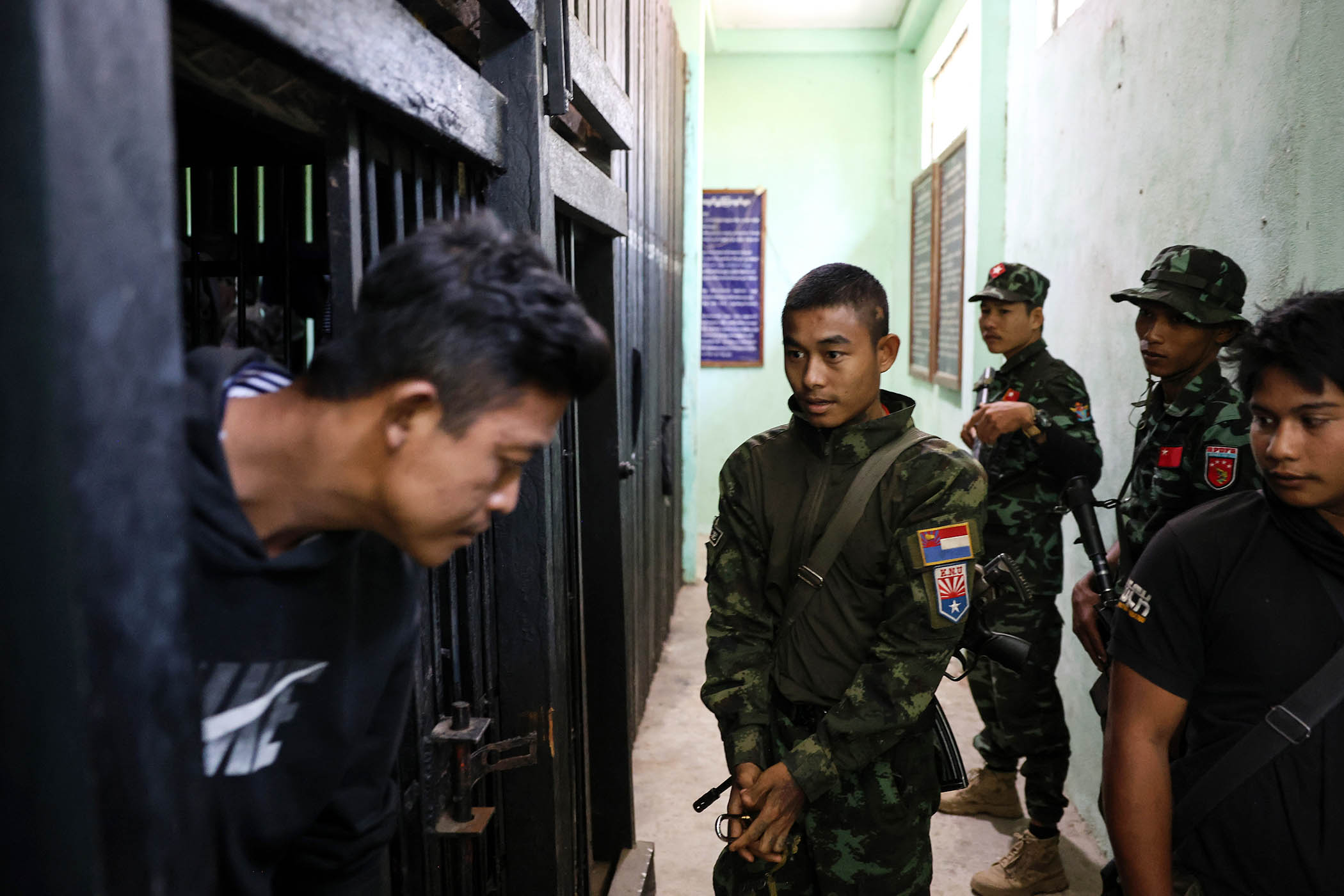
‘I was forced to join,” says Htet. Moving closer to the iron bars of his crowded cell, the 37-year-old soldier seems unbothered by dozens of captured comrades boring their eyes into his back. “I didn’t want to be in the military.”
In this former police station, a jail since the southern Myanmar town of Mawdaung fell last November, young revolutionaries chat beneath a “May I Help You?” sign nearby. A tired and dishevelled Htet, not his real name, reflects on how he became a prisoner of war.
The capture of Mawdaung, a town close to the Thai border, is a moment to celebrate for the Karen National Union (KNU), one of dozens of rebel groups that have been fighting the junta in Myanmar since the 2021 coup that overthrew the democratically elected government. For the first three years of the war the rebels were on the up, but since the start of 2024 the regime – aided by China and Russia – has regained the upper hand. Htet’s journey from drinking tea with his friends to being held in a makeshift prison helps to tell the story of how they did it.
A year ago, he says, security forces “grabbed” him from a teashop in south-central Myanmar. Taken to a station, he was told to enlist and promised a salary. He became one of an estimated 70,000 men conscripted since February 2024. The junta was bleeding troops. Suffering unprecedented defeats on multiple fronts, it threw fresh recruits at seasoned fighters in what the defector-led research group Myanmar Defense & Security Institute describes as “human wave” and “human shield” tactics.
Helping the regime mount a partial resurgence, Beijing pressured ethnic armies to abandon resistance and strike deals with generals, while drones made in China and Russia tilted the battlefield back in its favour.
This clawing back of territory preceded a junta-orchestrated election, widely seen as a means to entrench authoritarian rule. Only junta-approved candidates appeared on ballots, with the military-backed Union Solidarity and Development Party claiming victory.
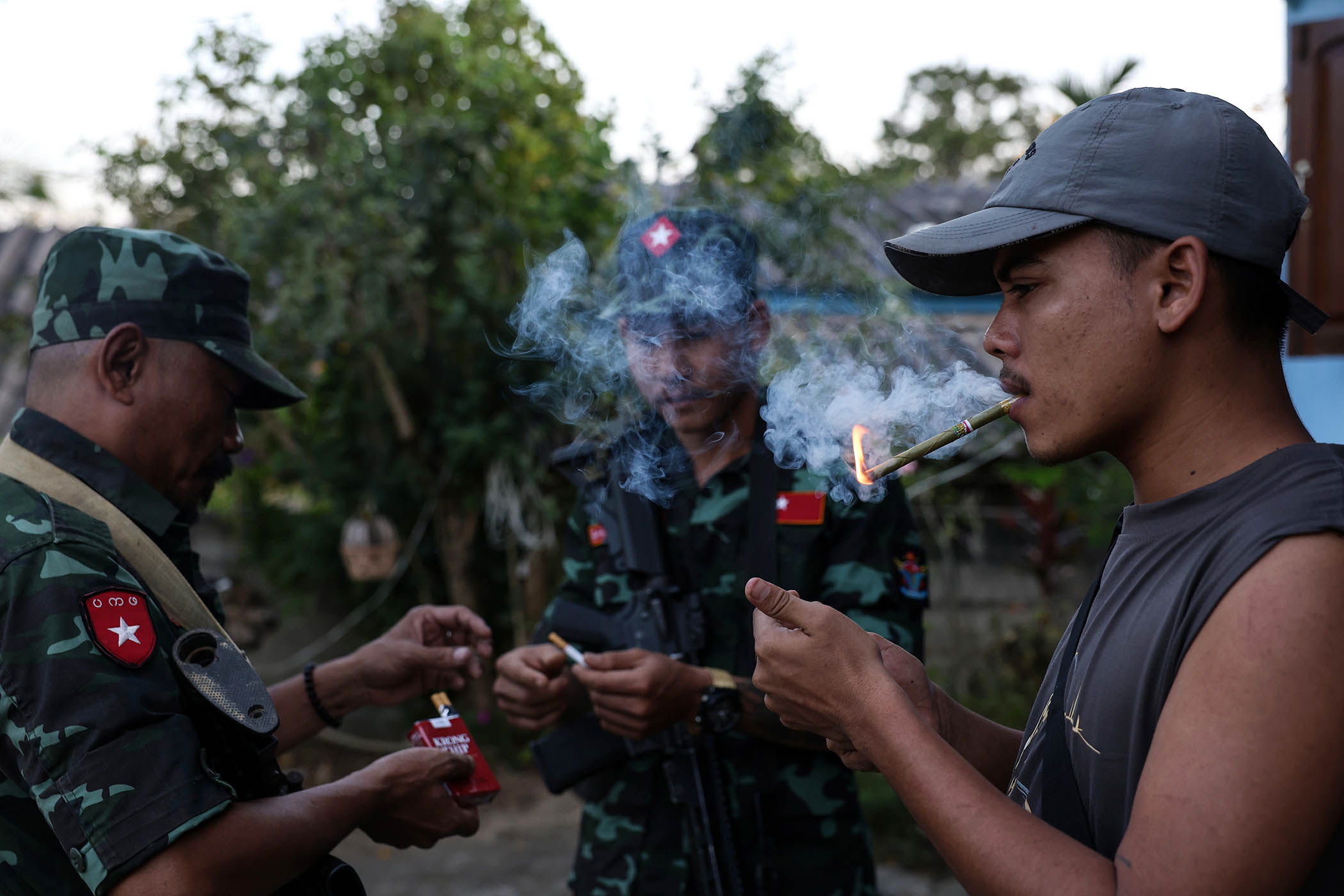
Rebel fighters light cigars in Mawdaung
Staggered over three phases because of fighting, voting concluded on January 25 . The United Nations, many western governments and human rights groups say the election was neither free nor fair.
A USDP source told Agence France-Presse on Monday: “We’ve already won a majority.” Official results are due later this week but there is little doubt that they will simply repackage military rule.
General Min Aung Hlaing, the junta chief, toured polling stations in Mandalay Region on Sunday and told state media he did not understand why foreign governments refuse to recognise the vote. “We recognise that the people are voting,” he said. “That’s the way it should be.”
Newsletters
Choose the newsletters you want to receive
View more
For information about how The Observer protects your data, read our Privacy Policy
For the millions living outside regime control, the election means little. Control is fractured between established ethnic armies, newer resistance forces, and the regime with its militias. The picture is uneven: the military has lost much of the west, while regaining ground in parts of the centre, north and east.
The KNU, Myanmar’s oldest ethnic armed group, held nearly a third of the 1,500-mile border with Thailand as of July 2025, said the Institute for Strategy and Policy – Myanmar, a Thailand-based thinktank. The KNU has since captured two more crossings, including Mawdaung, a milestone in its bid to control the frontier. KNU-led resistance forces seized the town – just a 30-minute drive from Thailand’s coast – on 14 November. Embedded with the KNU-allied People’s Defence Force (PDF), The Observer visited the border town this month. Tucked among hills beyond a mountain pass, Mawdaung no longer hums with commerce. The trucks have stopped coming. Shuttered businesses line empty streets, where a few teashops and restaurants now serve armed fighters. Residents idle outside low concrete shops and timber houses. When electricity cuts plunge the town into darkness, some of the only lights illuminate a statue of a Buddhist monk on the hillside, watching over the waters between the Gulf of Thailand and Myanmar’s Andaman coast.
The police station remains fortified with bunkers and trenches, littered with plastic bongs and foil. Troops used them to smoke methamphetamine-caffeine pills called yaba for chemically induced courage, said resistance fighters.
Inside two large cells, 48 soldiers, police and pro-military militiamen sit playing checkers, reading and smoking. Under watch, a local captive police officer cradles his child and speaks to his wife during a visit. Htet’s family are unaware of his whereabouts. “No one knows I’m here,” he says.
Htet’s plight is unlikely to win much sympathy in Myanmar. Regime forces are accused of extrajudicial killings, rape, arson and torture. A video that surfaced three years ago typified the brutality: three soldiers bragging about slitting throats and kill counts. The International Criminal Court is investigating their leader, Min Aung Hlaing, for crimes against the Muslim Rohingya.
His coup on 1 February 2021 triggered nationwide unrest, which according to Armed Conflict Location & Event Data has killed up to 92,000 people on all sides, and displaced more than 3.5 million. The most popular party, the National League for Democracy, has been dissolved, and its leader, Aung San Suu Kyi, is held in an undisclosed prison.
In the aftermath of the coup, many peaceful protesters who survived a bloody crackdown sought combat training from ethnic armies, fusing long-running struggles for autonomy with a revived democracy movement. They have spent their formative years at war.
What was seen as one of southeast Asia’s promising economies has collapsed. By 2023, 43% of Yangon’s population lived in poverty – an increase from 10% in 2017, said the UN. Regular power outages cripple businesses.
But an immensely lucrative industry has emerged: cyber-scamming. Sprawling compounds run by Chinese gangs and regime-aligned armed groups carry out online fraud, human trafficking and money laundering in Myanmar’s borderlands, generating billions annually. Yaba production has exploded in the east too, flooding the region with meth. Thailand seized one billion tablets in 2024.
Amid the turmoil, Htet was unemployed before conscription. He admits military service had perks: a 300,000-kyat salary (about £100). “I could send money back to my family,” he says.
For the first time, he travelled to other parts of the country – the rolling hills of southern Shan, the palm-flanked rivers near Mawdaung – though, surrounded by enemy forces, he was banned from leaving the base or returning home. “There was no freedom,” he says. “The living and food were whatever. No proper comfort.”
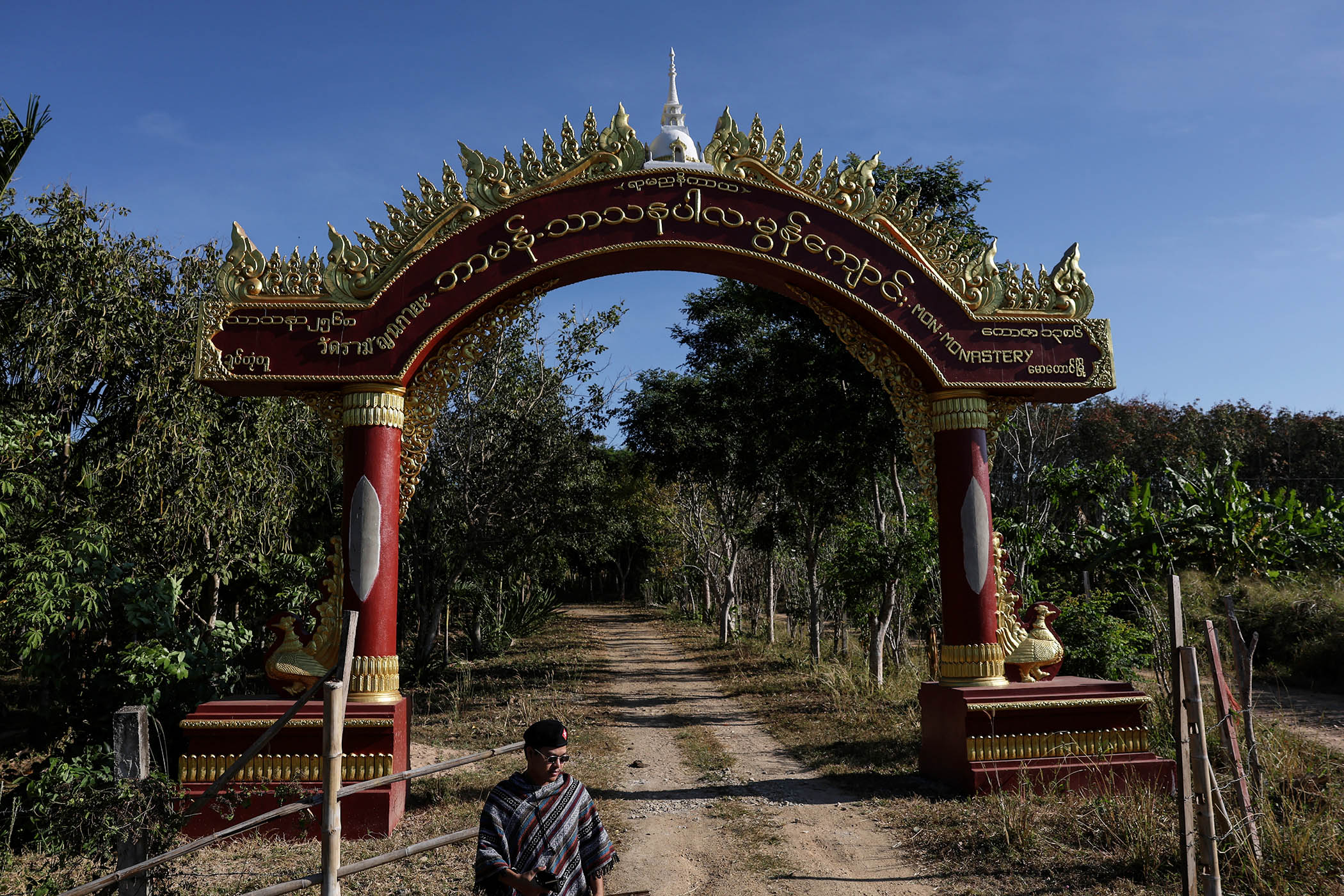
Ko Sea, a major in the People’s Defence Force, at a Mawdaung monastery hit by air strikes
Then came “the first time I had a proper fight”. As rebels entered Mawdaung, about 60 soldiers fled through town, some changing into casual clothes and slipping into Thailand. Their uniforms remain in the debris of destroyed outposts and abandoned homes.
After defending the police station throughout the night, Htet’s officer told them to surrender – they were happy to oblige. “I fired five or six bullets, but I didn’t want to fight any more,” he says. “There were so many of them.”
Only a third of Mawdaung’s 3,000 residents have stayed, said a KNU official. They weigh relief at the regime’s defeat against daily struggles of life in areas wrested from junta rule.
“We worry about airstrikes,” says Lwan Po, 43. Mortar damaged several homes in the battle, while an evacuated Buddhist monastery struck twice by regime bombs was destroyed, leaving charred alms bowls and sandals among the ruins.
Lwan Po, who abandoned a Mawdaung furniture business after the military takeover, returned on hearing the town had changed hands. If the regime returns, she will flee again. “I only help the resistance groups,” she says. “We have our beliefs, and my goal is to support them until we win the revolution.”
Thailand, which does not officially recognise the KNU, has closed the crossing. Border trade, the lifeblood of the town, has stopped, and a regime blockade has further stymied the flow of food and medicine. At least 600 residents, fearful of drone and air strikes, shelter in the jungle. Schools and hospitals are shut in Mawdaung amid military aerial attacks on civilian buildings. The KNU has opened a small clinic and rural schools outside the town, but governing under siege is proving difficult.
“We’re trying to survive in very bad conditions,” says Lwan Po. “There’s more freedom now the KNU has taken control. But the movement of goods is very limited.”
A local businessman, who asked for anonymity, was blunter. “Nothing can be brought in,” he says. “Everything has stopped. It’s not just me – everyone is struggling.”
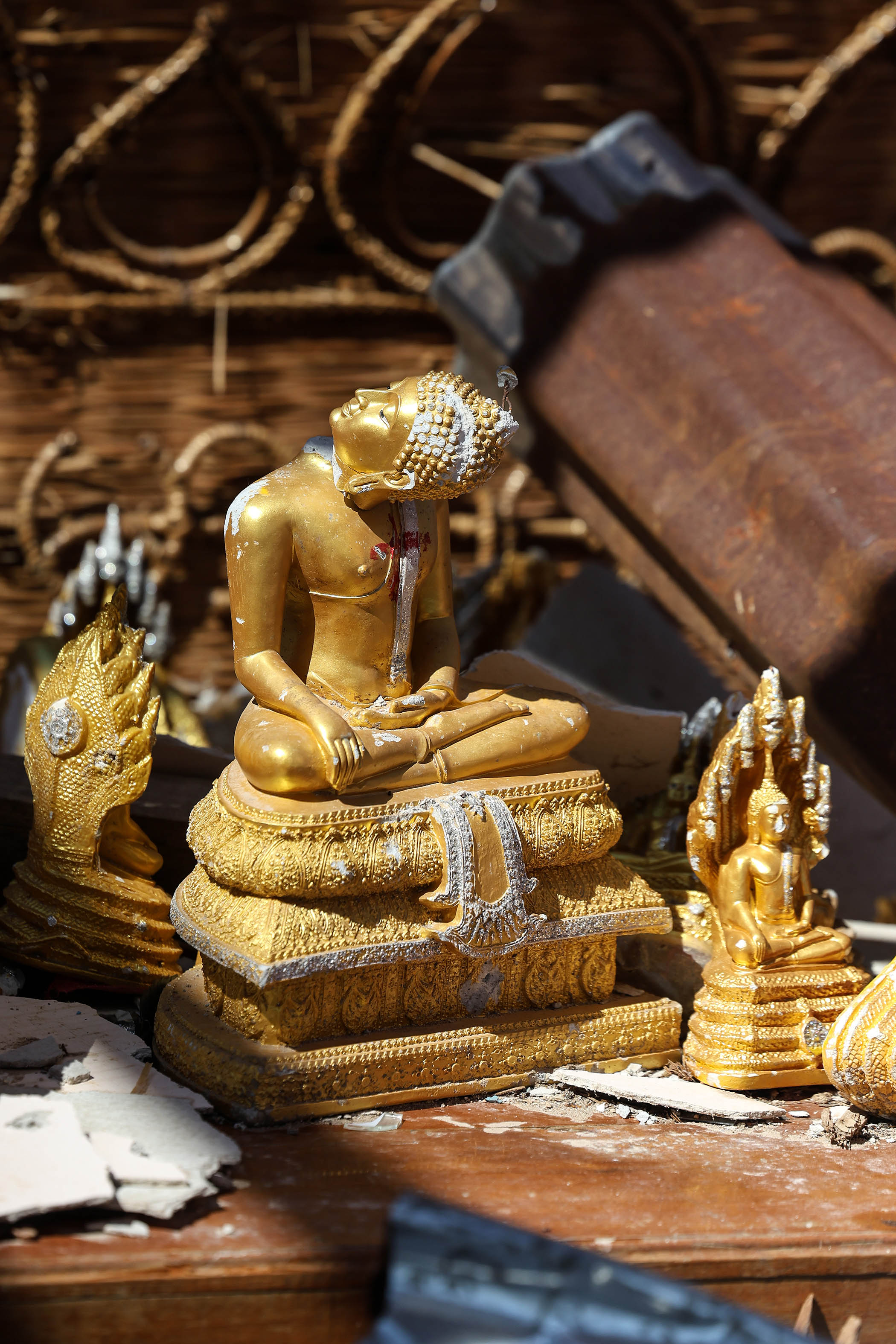
A Buddha statue at a temple damaged during clashes between the Myanmar military and resistance fighters in Mawdaung
The election was far from their minds. Local media reported just three polling stations open in Tanintharyi township, where Mawdaung is located: two in a regime-held town and one at a village with a military base. Voting was cancelled in the surrounding 219 villages, reported local media.
Under the junta’s election law, a single polling station per constituency – including one on a military base – is sufficient for authorities to declare a result. Anyone deemed "attempting to sabotage" the vote risks from three years’ imprisonment to the death penalty for cases involving violence. Some have been jailed just for liking a Facebook post.
Even as few governments recognise the election’s legitimacy, Myanmar’s generals are capitalising on a shifting global landscape. Under President Trump, the US state department has been told to stay silent on foreign election integrity.
Homeland security secretary Kristi Noem cited the junta’s vote as evidence of progress, using it to justify ending temporary protected status for some 4,000 Myanmar nationals in the US. The junta welcomed the move, echoing Min Aung Hlaing’s public thanks to Trump last July for defunding Voice of America and Radio Free Asia, whose Burmese-language broadcasts had bypassed regime censorship.
Ko Sea, the nom de guerre of a PDF major, dismissed the vote, saying the regime could not enter 80% of the township. Air strikes echo from the front line about 12 miles away, where the military has heli-dropped 180 soldiers. “The primary difficulty we face is simply not having enough ammunition to meet the challenge,” says the 26-year-old. But, he says, they have progressed from comrades dying on days-long jungle hikes of treatable wounds. Now they have established clinics and have “proper uniforms, proper rifles … [and can move] openly through villages and along roads”.
“That’s success,” he says. “Many comrades became discouraged and left over these five years. But for us, this is the final battle.”
Richard Horsey, the International Crisis Group’s Myanmar adviser, said that despite recent battlefield gains, the generals still face determined nationwide resistance. For rebel forces, conditions are worse, he says: weapons and ammunition are harder and costlier to obtain, air strikes are relentless, and counter-offensives loom.
“The hope of two years ago, that political change could be achieved through the battlefield defeat of the military, now looks unlikely,” he says.
Behind bars in Mawdaung, regime soldier Htet is unsure what his future holds. When asked if he would have tried harder to escape the military, knowing this would be his fate, he pauses. “I would not fight. Not for the military, not for any side,” he says. “I just want to live peacefully.”
Five years of conflict
8 November 2020
Aung San Suu Kyi’s National League for Democracy wins a sweeping election victory - a result the military later claims, without evidence, was fraudulent.
1 February 2021
Hours before parliament is due to sit, the armed forces seize power and detain civilian leaders, triggering the largest protests in Myanmar’s modern history.
March–May 2021
After security forces kill hundreds of demonstrators, peaceful resistance collapses and young activists become fighters, many trained by long-established armed ethnic groups.
27 October 2023
An alliance of ethnic armies launches a coordinated offensive in northern Shan State, seizing towns and border crossings and inflicting the junta’s most serious losses since the coup.
10 February 2024
Facing mounting casualties and desertions, the junta announces mandatory conscription, prompting panic and an exodus of young people.
28 December 2025
After clawing back territory with Chinese backing, the military moves ahead with an election widely seen as neither free nor fair, but a means of legitimising military rule.