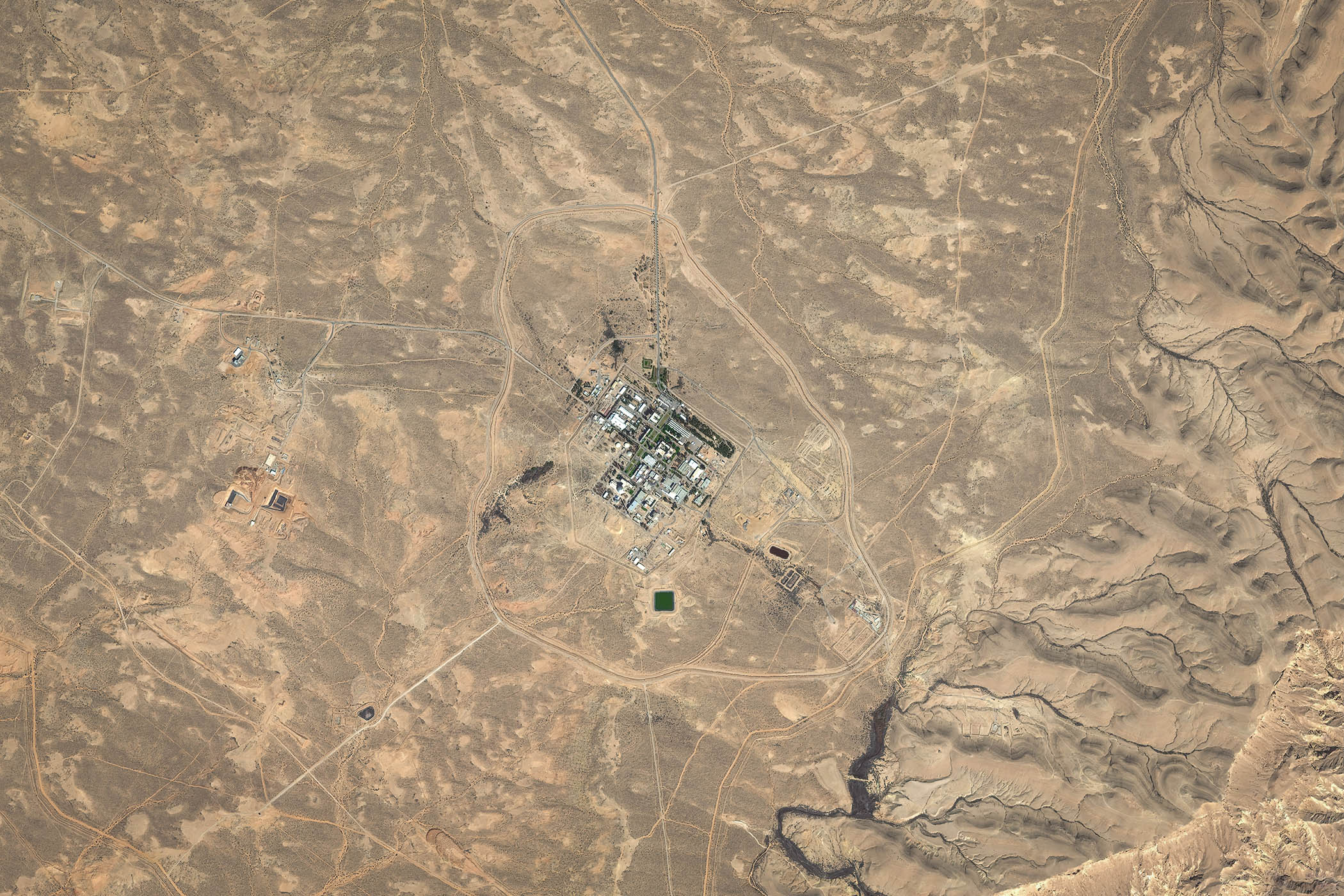



The road through the Negev desert cuts across a lunar landscape, past giant erosion craters, date groves, a crocodile farm – and Israel’s worst-kept secret.
The Dimona nuclear site is not visible from the road, but it appears clearly in satellite images. The nuclear weapons programme looms quietly in the background as Iran, facing an existential threat from Israel and the US, lashes out across the region. An Iranian military official last week threatened to target the Dimona nuclear site if Israel and the US sought regime change.
Israel has never confirmed or denied having nuclear weapons. But the Stockholm International Peace Research Institute last year assessed it has more than 80 nuclear warheads, and Israeli officials occasionally allude to them. “We have weapons that we haven't used yet, and we will use them if we feel threatened to the point of an existential threat,” said the deputy speaker of Israel’s Knesset, Nissim Vaturi in an interview with the ’News Arena’ channel last month as the country was gearing up for war. “They have Persian carpets, we have the textile factory.”
Officially known as the Shimon Peres Negev Nuclear Research Center, Israel is believed to have begun building the site soon after its birth in 1948 against the backdrop of the Holocaust. After wars against Arab countries, the nascent state’s leaders concluded that conventional military strength alone wasn’t enough. To insure Israel’s survival in a hostile region, it would need a deterrent so potent that no adversary would risk confrontation.
Israel took it further: under the Begin doctrine, no other country in the region would be allowed to develop nuclear weapons for itself. Before bombing Iran’s nuclear facilities last year, Israel had struck the Osirak reactor in Iraq in the 1980s and the Al Kibar nuclear site in Syria in 2007.
As efforts to thwart Iran’s nuclear ambitions intensified in recent years, construction work on the Dimona site gathered pace. Experts say the large black box that appears in recent satellite images is likely a new reactor. “It’s huge, so it’s not a gymnasium,” said Jeffrey Lewis, a nonproliferation expert at the James Martin Center for Nonproliferation Studies at the Middlebury Institute of International Studies.
That the US and Israel are conducting attacks to prevent Iran from developing a capability reveals a “lack of a certain strategic empathy”, Lewis said. It also highlights a paradox: “On the one hand Israel quite likes having nuclear weapons and believes in deterrence, but it doesn't believe that deterrence would function in the face of an Iranian nuclear weapon”.
Officially presented as a research facility, the CIA assessed in the late 1960s that Israel had assembled its first nuclear devices at Dimona, according to documents declassified decades later. The extent of the programme first emerged when a former technician at the site leaked photographs of plutonium components and a full-scale model of a thermonuclear bomb to the Sunday Times in 1986. Five days before the article was published, Moredechai Vanunu was drugged and abducted in Rome by the Mossad intelligence agency. Back in Israel, he was tried, and sentenced to 18 years in prison on charges of espionage and treason. Vanunu was released in April 2004, but is banned from leaving the country or contacting foreigners, though the now 71-year-old insists he has no secrets left to reveal.
Of the nine countries confirmed or believed to have atomic weapons, Israel is one of four that have never joined the Nuclear Nonproliferation Treaty, a landmark international accord meant to stop the spread of nuclear arms. That means the International Atomic Energy Agency, the United Nations’ nuclear watchdog, has no right to conduct inspections of Dimona.
While Israel’s nuclear doctrine is deliberately opaque, it is seen as a last resort in the event of invasion or existential threat. Dubbed the Samson Option, it refers to the biblical figure of Samson, a Hebrew judge of ancient Israel renowned for his superhuman strength. According to ancient scriptures, when Samson was captured and blinded by the Philistines, he responded by bringing down the pillars of the temple, killing his captors – and himself.
Photograph by DigitalGlobe / Getty Images
More from The Observer
Newsletters
Choose the newsletters you want to receive
View more
For information about how The Observer protects your data, read our Privacy Policy