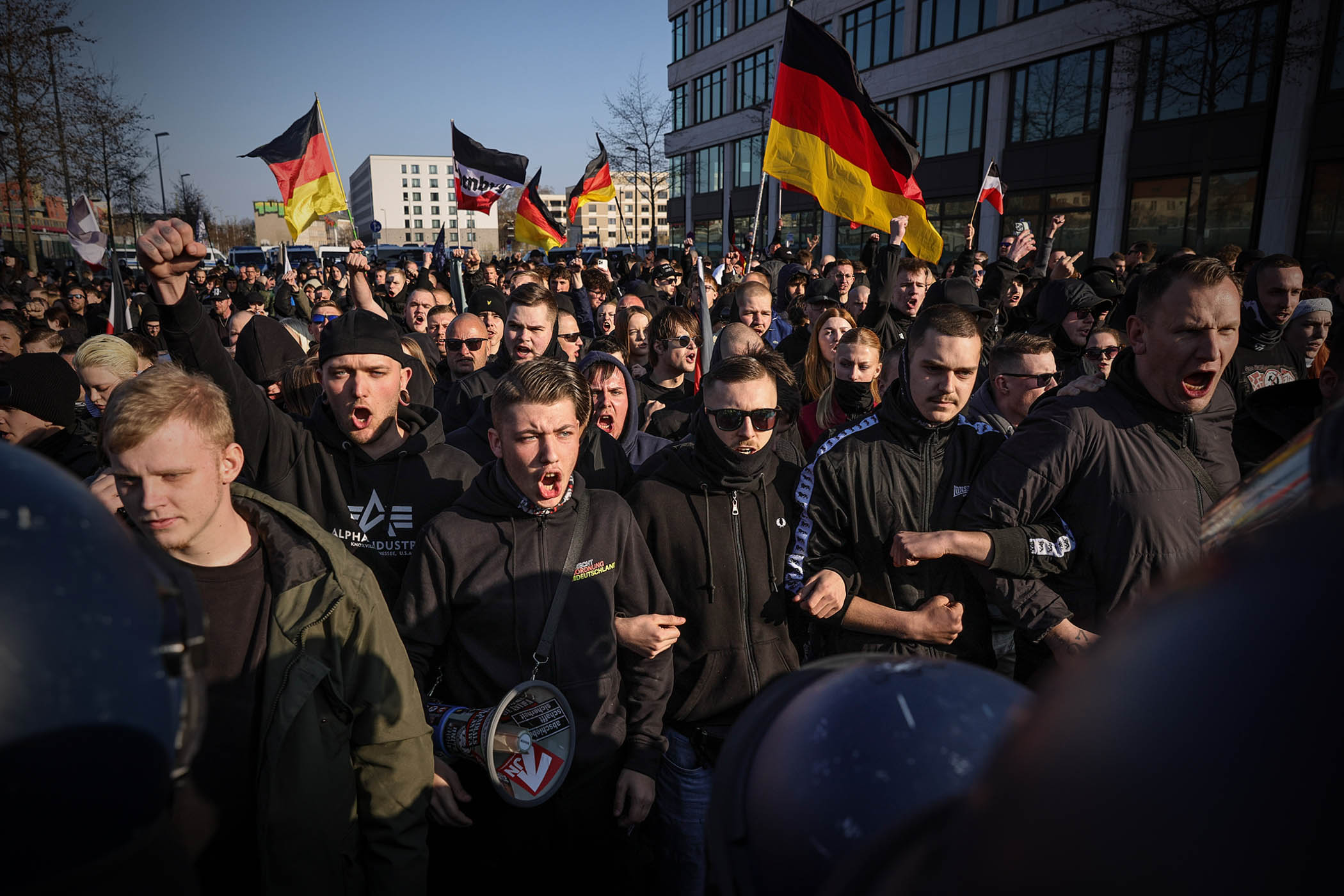
The signs, if you want to acknowledge them, are everywhere in Germany. It’s the far-right graffiti that appears faster than authorities can scrub it off. It’s the group of men heard the other day singing Nazi songs near a main train station. It’s the men on the tram wearing a clothing brand associated with neo-Nazis. It’s the skinhead who eyeballed a father and his daughter, the five young men who spat on a teenager and his friend, the Whatsapp messages about the bars to avoid, neighbourhoods to be careful in.
And while not everyone feels the same way, it’s in the conversations now being held between people of colour in Germany about whether it’s time to leave.
The rise of the far-right Alternative für Deutschland (AfD) has been well-documented. Founded as an anti-euro party in 2013, it swiftly became a far-right outfit that was openly Islamophobic and hostile not only to immigrants but to Germans born to immigrant parents. It became the official opposition in 2017 and the latest polls suggest it is now Germany’s most popular political party.
Less commented upon is the rise in far-right political violence that has tracked the AfD’s surge. More than 42,000 “rightwing motivated crimes” were recorded in 2024, according to the Amadeu Antonio Foundation – a rise of 48% from the year before.
Last year German police arrested five teenagers accused of being part of a far-right terrorist cell that had allegedly attacked asylum seekers. Dozens of chat groups were discovered linked to a group called Last Defence Wave that was actively recruiting teenagers on social media. Earlier this month more than 600 police officers raided around 50 homes targeting young people accused of involvement in far-right groups.
“I can’t express how dangerous it is right now,” said one person who, for entirely understandable reasons, did not wish to be identified. “It’s an atmosphere of broiling chaos.”
“There is a constant reminder that someone can spit at you or say, ‘Go back to where you came from’,” said Jennifer Kamau, a Kenyan-born activist who is the co-founder of International Women* Space, a feminist anti-racist political group in Berlin.
The group has come under fire from the AfD, named in parliament as an organisation that should have its funding cut. In the months after that, the group’s offices were broken into three times. On one occasion, files were pulled out of cabinets and human faeces was smeared over them. “It felt very personal,” Kamau said.
The populist right has been on the rise across Europe for the past two decades, but the AfD is more extreme than Marine Le Pen in France and Italy’s prime minister Giorgia Meloni. Its support for “remigration”, promotion of the Islamophobic “great replacement theory” and its authoritarian attitude towards journalists, judges and other pillars of democratic society mark it out as unashamedly far-right and extremist.
“The idea that this party can get close to power should frighten anybody,” said Gerald Knaus, a migration expert who has advised several German governments, “particularly people with a migration background.”
Newsletters
Choose the newsletters you want to receive
View more
For information about how The Observer protects your data, read our Privacy Policy
A key test will come in regional elections in September when the AfD seems set to win control of Saxony-Anhalt, a state in the former East Germany. “The police will be controlled by the AfD,” said Knaus. “That’s terrifying.”
Part of the reason for the AfD’s success is the failed response of mainstream parties. Since the retirement of Angela Merkel, who famously welcomed an influx of Syrian refugees in 2015 with the words ‘wir schaffen das’ (‘we can manage this’), both the rightwing CDU and centre-left social democrats SPD have been unwilling to challenge the AfD’s narrative that German identity and culture has been diminished.
The rightwing chancellor Friedrich Merz, while refusing to work with the AfD, has nonetheless echoed its language. Last year he said his government would “carry out expulsions on a very large scale”, doubling down when challenged by a journalist, suggesting that migrants posed a threat to young women and girls. “Ask your daughters, I suspect you’ll get a pretty loud and clear answer. I have nothing to take back; to the contrary I stress: we have to change something.”
The centre-left SPD, meanwhile, has had little to say on the issue – neither defending its migration and asylum policies nor attacking the AfD’s language.
“Something needs to be done,” said Knaus, “instead of this paralysis. You need people who believe in something.”
For Kamau there is at least the option of leaving. “I am an African, I have my sense of belonging. But for an Afro-German who was born here and has no connection to the country people are saying they should go back to… that hits differently. This is their country, this is where they were born. They do not know anywhere else other than Germany.”
Photograph by Omer Messinger/Getty Images