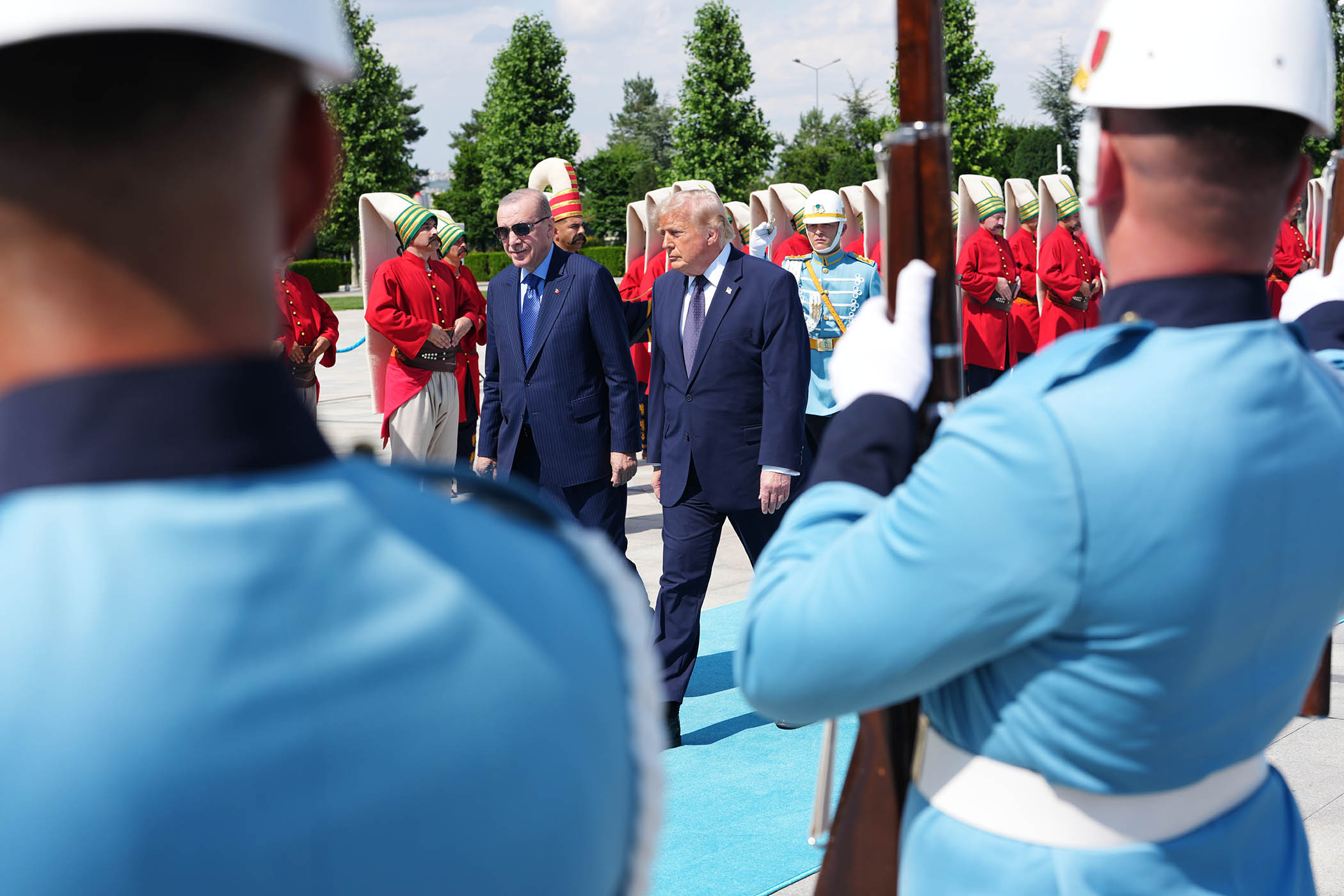
Before the Nato summit had even begun, Donald Trump made it plain: he was only flying to Ankara because of the Turkish president, Recep Tayyip Erdoğan, this year’s host.
While he lambasted other Nato leaders, reviving his attempt to acquire Greenland and threatening to pull US troops out of Europe, Trump heaped praise on Erdoğan, hailing him as a “friend” and a “strong leader”.
“Militarily, he’s very powerful. People leave him alone,” Trump added, noting with approval the $120m (£90m) upgrade to an Ankara airport to make the runways wide enough for his new presidential plane, a hulking $400m Boeing 747 that was a gift from Qatar.
Erdoğan soaked up his moment in the sun as host, flaunting the military muscle and diplomatic leverage that has cemented Turkey’s place as an indispensable Nato member at a time of deep uncertainty for the alliance.
He gifted all 32 world leaders in attendance an engraved revolver and a round of bullets; Keir Starmer left his in Ankara, citing British gun laws, while Canada’s prime minister, Mark Carney, joked that his present of maple syrup was “kind of undermatched” by Erdoğan’s largesse.
The Silver Moon handguns – the first of their kind to be manufactured in Turkey – are a nod to Ankara’s $30bn in defence spending last year. Turkey now meets 80% of its military needs through domestic production, and arms exports are growing fast, including Turkish-made drones deployed in Ukraine. Erdoğan pledged additional arms for Kyiv during the summit.
Once regarded as a spoiler within Nato, and viewed with caution by other members, Turkey, via its role as host and coveted approval from Trump, has forced visiting heads of state to acknowledge its growing presence in the alliance. Its support for Ukraine and strategic importance as an anchor on Nato’s southern flank comes as the organisation confronts an escalating threat from Russia and the existential crisis posed by its uncertain relationship with Trump.
Turkey boasts the second-largest military in Nato after the US, and has fought on the opposing side to Moscow in proxy wars in Libya and Syria in recent years. Ankara has also deployed troops to Nato missions in Iraq and Afghanistan, but it is Erdoğan’s forceful diplomacy that has cemented his country’s power across the Middle East.
Turkey is the most powerful regional backer of Syria’s new government, and a key interlocutor with Iran. Istanbul also hosted early rounds of peace talks between Russia and Ukraine, boosting Erdoğan’s reputation as the only Nato leader other than Trump who can talk to Vladimir Putin.
Trump’s demand that Europe shoulder the cost of its own defence has rocked the alliance. But in Ankara, the brinkmanship from the White House was seen as an opportunity rather than a setback.
Newsletters
Choose the newsletters you want to receive
View more
For information about how The Observer protects your data, read our Privacy Policy
“We were more ready for that, I think, than a lot of other European allies,” said Timur Söylemez, a former Turkish diplomat. “They have to catch up, and in that catching-up process, manage their relationship with the White House.”
Trump’s love for a strongman was again on full display in Ankara. In a landmark move, the US president said he would overturn American sanctions on Turkey and consider readmitting it to the F-35 fighter jet programme, an action that potentially sets up a fight with regional US allies, as well as within Trump’s own Republican party.
Turkey was barred from buying F-35s in 2019 after previously securing a deal for the S-400 Russian air defence system in 2017, sparking fears in Washington that Ankara was drifting towards Moscow. But Trump said his friendship with Erdoğan had tipped the balance.
“I haven’t totally made up my mind. But my inclination is to say: ‘Look, he’s done everything. He’s helped us in so many different ways,’” he said. “We don’t want to sanction friends,” Trump added, noting that the Turkish president “has been a very good ally”.
He went on: “Why wouldn’t we do that?”, adding a swipe at other Nato partners. “We have a better relationship with Turkey, and Turkey has been in many ways much more loyal than other countries.”
Trump’s warm words for Erdoğan contrasted with his indifference to other Nato leaders. Its secretary general, Mark Rutte, opened the conference with a splashy presentation, called the “Trump trillion”, that highlighted Europe and Canada’s $1.2tn surge in defence spending since the president first took office in 2017, including deals with US arms manufacturers.
Trump himself appeared unimpressed, repeating his complaint that Nato allies had refused to join his war with Iran. “We don’t need their money,” he said. “I just want loyalty.”
With Ankara now essential to the battle in Ukraine, criticism of Turkey’s worsening human rights record was quietly shelved by European allies.
“That’s their own business,” said the rightwing populist Finnish MP Tomi Immonen, admitting that Trump and Erdoğan share “the same style of leadership”.
Latvian diplomat Jānis Mažeiks also rebuffed questions about Erdoğan’s human rights record, including hundreds of arrests across the Turkish capital in the weeks before the summit. The mounting threat from Moscow was the focus, Mažeiks said, stressing that Nato was “existential” for Riga. Turkey hosting the summit showed how Ankara is needed in the fight against Russia, he added.
“There is a palpable crisis of confidence in US leadership right now within the alliance,” said Torrey Taussig, head of the transatlantic security initiative at the Atlantic Council. Erdoğan’s skilful handling of Trump had helped ease concerns among other European leaders that the US may ignore Nato’s founding principle of an attack on one member state being an attack on all, she said.
In return, Erdoğan has stepped up his campaign for Turkish membership of the European Union, despite complaints that Ankara’s human rights record makes it ineligible. The president’s most prominent challenger, the mayor of Istanbul, Ekrem İmamoğlu, is currently imprisoned while on trial.
Turkish officials insist that, with the country now pivotal to Europe’s push to rearm and reduce its dependence on US support, Ankara needed access to EU funding to boost supply.
“Bilateral arrangements only go so far,” said Söylemez. “You need to scale up, and that requires coalitions within Europe to include Turkey… We need to be a part of those structures to be able to contribute meaningfully.”
Erdoğan used his opening address in Ankara to urge the EU to “avoid duplicating Nato structures” and shutting non-EU allies out of Europe’s defence architecture, warning that this would “weaken transatlantic security”.
Erdoğan’s influence with Trump has alarmed other US allies. The Israeli prime minister, Benjamin Netanyahu, has already lobbied against the F-35 deal, claiming it would “destroy the balance of power in the Middle East”.
Erdoğan, who has pushed Nato to take a tougher line on Israel, brushed off Netanyahu’s concerns as he basked in Trump’s good favour. “Hopefully, when the F-35s are delivered to Turkey,” he said, “the whole world will say: ‘America kept its promise.’”
What are your thoughts on this? Send us a letter to letters@observer.co.uk
Photograph by Doug Mills/The New York Times via AP