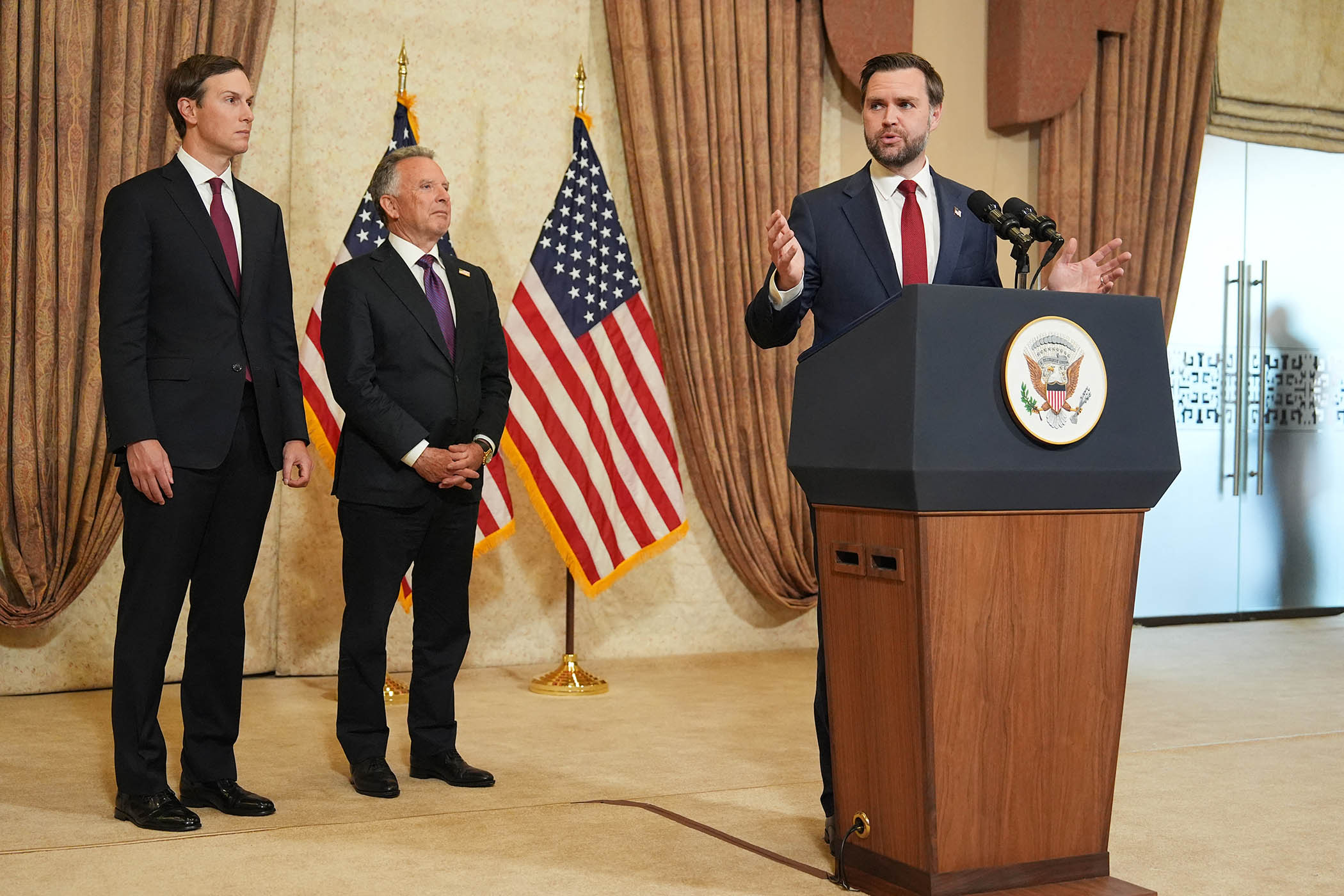


American vice-president JD Vance sitting opposite Iran's hardline parliamentary speaker Mohammad-Bagher Ghalibaf and the Iranian foreign minister Abbas Araghchi marked the highest level engagement between the two nations since 1979 – but still failed to bring a deal to end six weeks of war and reopen the Strait of Hormuz.
It was a high-stakes defeat for the White House whose negotiators emerged after 21 hours of talks in Islamabad, appearing baffled that Iran had refused their demands. “We've made very clear what our red lines are...they've chosen not to accept our terms,” JD Vance told reporters in the early hours of the morning.
Avoiding mention of the Strait of Hormuz, Vance added: “We need to see affirmative commitment that they will not seek a nuclear weapon…we just could not get to a situation where the Iranians were willing to accept our terms. We leave here with a very simple proposal: a method of understanding that is our final and best offer. We'll see if the Iranians accept it.”
Vance, the White House Middle East envoy Steve Witkoff and Donald Trump's son-in-law Jared Kushner had landed in Islamabad to fanfare, amid hopes of an agreement to reopen the strait and heal a wounded global economy. Facing them were a 16-member strong delegation from Tehran that included multiple experienced diplomats, members of Iran's national defence council and the central bank governor, as Tehran looked to enshrine potential sources of revenue including tolls to cross the strait and sanctions relief.
“We reached understandings on some issues, but due to US overreach the talks ultimately failed,” said Iran’s foreign ministry spokesman Esmail Baghaei.
Iran's grip on the Strait of Hormuz and the regime's ability to survive six weeks of American and Israeli attacks meant Iranian negotiators arrived ready to defy Trump's boasts that the US could call the shots at the talks. Trump meanwhile was attending an Ultimate Fighting Championship event in Miami alongside Secretary of State Marco Rubio: the pair watched mix martial artists hurl blows at one another as talks in Islamabad sputtered on into the early hours.
"For Iran the attacks they dreaded have already happened, that threat is done with," said Alan Eyre, formerly with the US State department as its only Farsi-speaking spokesperson. "The US used the big stick it was brandishing and Iran survived it – and by keeping the strait closed for 40 days they also built up this accumulated economic pressure."
Daniel Levy, a former Israeli negotiator, said America's ability to menace Iran into ceding to their demands had already proven empty before either side touched down in Islamabad– both on the issue of Iran's nuclear programme and demands to reopen the strait. "If the Americans could have achieved this militarily they would have – it's clear they can't," he said. Still, in a show of defiance two US warships crossed the strait during the talks: the Pentagon said two US Navy destroyer ships began mine clearance operations. Iran denied this occurred and threatened to attack any ships that transited the strait unannounced. Iranian state television claimed a US ship had been forced to turn back after this warning.
Trump declared a blockade of the strait the following day - without clarifying how this could be achieved when another government had already closed the waterway, or acknowledging that shuttering the strait was already considered a breach of international maritime law.
“Effective immediately, the United States Navy, the Finest in the World, will begin the process of BLOCKADING any and all Ships trying to enter, or leave, the Strait of Hormuz,” he said, adding that he has “instructed our Navy to seek and interdict every vessel in International Waters that has paid a toll to Iran. No one who pays an illegal toll will have safe passage on the high seas [sic].”
Newsletters
Choose the newsletters you want to receive
View more
For information about how The Observer protects your data, read our Privacy Policy
Many experienced diplomats saw the talks in Islamabad as doomed from the start. "This administration has proven itself unwilling or unable to negotiate. They don't have that skill: they decimated the state department, and messers Witkoff, Kushner and Vance are tubes to receive information and say yes or no, but with no real flexibility regarding what the Iranians are seeking," said Eyre. "This is a far more militarised hardline government than the ones we killed, less likely to be flexible in terms of giving the US what it is seeking," he said.
Many cast doubt on what could be achieved in such rapid negotiations, even if talks resume in the coming weeks: the 2015 deal to curb Iran’s nuclear enrichment took years of intricate diplomacy. Eyre feared that the Trump administration has sought a quick, if vague, agreement that resolves few of the finer points of disagreement between the two sides, particularly on thorny issues like nuclear. “They're not going to roll up their sleeves and do the serious sustained negotiations over weeks and months, to get a detailed agreement with Iran on all points of difference,” he said. Meanwhile Iran is not under the same time pressure as the US, with the status quo allowing them to exert control over the strait and by extension a sputtering global economy.
Iran’s former foreign minister Javad Zarif, who spearheaded Iran’s team during the nuclear talks in 2015, responded to JD Vance’s assessment that the talks failed as Iran refused to accept US negotiators’ terms. “No negotiations – at least with Iran – will succeed based on "our/your terms. The US must learn: you can't dictate terms to Iran. It's not too late to learn. Yet,” he said on X.
Even as negotiators sat in the gilded conference rooms in Islamabad, Israeli missiles continued to rain down on southern Lebanon as the question of a ceasefire there persisted: the health ministry in Beirut said over 2,000 people have been killed in Israeli airstrikes since early March. Israel appeared unwilling to cease its attacks regardless of negotiations elsewhere: Israel’s prime minister Benjamin Netanyahu pledged to “continue to fight Iran’s terror regime and its proxies.” The Israeli ambassador to Washington told reporters that Israel is seeking to continue the onslaught despite unprecedented talks with the Lebanese government in Washington later this week.
Levy said American pressure on Israel to stop its widely condemned attacks was unlikely to materialise – even if the US and Iran eventually ensure the ceasefire extends to Lebanon. "If America wants to stop Israel in Lebanon there could be a deal – but Benjamin Netanyahu doesn't want it and Trump still seems extremely susceptible to the spell that Netanyahu can cast over him," he said.
Photograph by Jacquelyn Martin/AFP via Getty Images
More from The Observer