
The US could deploy special forces for targeted missions inside Iran, under a plan that has divided Trump administration officials, as the White House steps up its attack on the Islamic Republic.
With the massive US and Israeli bombing campaign entering its second week, the US defence secretary, Pete Hegseth, is weighing a proposal to use elite troops to kill or capture surviving figures from Iran’s regime and military. US forces could also secure key targets including the country’s stockpile of enriched uranium, according to security sources in Washington.
The move would mark a dramatic escalation in the US offensive, though Donald Trump has not made any decision on deploying ground troops. Some on the national security team, thought to be led by the secretary of state, Marco Rubio, have cautioned against putting boots on the ground, wary of expanding the operation and the risk to American lives. Six US personnel were killed in an Iranian drone strike on Kuwait last weekend as the conflict widened to engulf the region.
“There has been vigorous debate among a few senior officials about the size and scope of the operation,” said one security source. “So far, it’s been almost perfect from a military operations point of view. So what options does that give you? What are you trying to achieve? Is this regime change or not?”
The US and Israeli onslaught has already killed scores of senior Iranian clerics, officials and generals, including the country’s supreme leader, Ayatollah Ali Khamenei. But military experts warn that an aerial bombardment alone will not topple the regime.
With Trump demanding Tehran’s “unconditional surrender”, some in the administration are eager to hunt down surviving Iranian leaders. The White House has been emboldened by the raid on Caracas that saw Delta Force troops seize Venezuelan despot Nicolás Maduro in January.
“The operation with Maduro was so good they feel highly confident that they could snatch someone, or something,” a security source said.
Trump and Hegseth have not ruled out putting boots on the ground in Iran, despite the president’s campaign pledge to end US involvement in costly foreign wars. Trump himself has voiced interest in deploying US ground troops for targeted operations, according to a NBC News report on Friday.
“I don’t have the yips with respect to boots on the ground,” Trump told the New York Post last week. “Like every president says: ‘There will be no boots on the ground.’ I don’t say it.”
The White House press secretary, Karoline Leavitt, dismissed The Observer and NBC reports as “assumptions from anonymous sources who are not part of the president’s national security team and are clearly not read into these discussions”.
Newsletters
Choose the newsletters you want to receive
View more
For information about how The Observer protects your data, read our Privacy Policy
Leavitt added: “President Trump always, wisely, keeps all options open, but anyone trying to insinuate he is in favour of one option or another proves they have no real seat at the table.” The Pentagon denied any friction between senior administration officials.
Senior Democrats have warned that Trump risks dragging the US back into a quagmire in the Middle East without approval from Congress or making the case for war to the American people.
“I would not put it past this government to send US soldiers into Iran,” said Alan Eyre, a former Iran policymaker and Persian-language spokesperson at the state department. “Every day, if not every hour, different reasons come out of the White House as to why they’re doing this. It’s becoming increasingly clear that not only does the United States have no plan B – they don’t even have a plan A.”
The attack on Iran has reopened cracks within Trump’s own Maga – Make America Great Again – movement. Prominent conservative media figures have openly criticised the president’s decision, accusing him of betraying the “America first” doctrine that underpinned his 2024 election campaign.
The Trump administration’s shifting justifications for the conflict, the first American casualties and claims that the US was coerced into bombing Iran by Israel have infuriated many Maga loyalists. Conservative podcast host Megyn Kelly said of the US casualties last week that “no one should have to die for a foreign country”.
Critics seized on Rubio’s suggestion that Trump had authorised the attack because Israel was ready to strike first and he feared Iranian retaliation against US bases in the region.
Rubio walked back the comment the following day, but rightwing podcast host Matt Walsh wrote on X that the secretary of state was “flat out telling us that we’re in a war with Iran because Israel forced our hand”. Walsh added: “This is basically the worst possible thing he could have said.”
Republicans in Congress have lined up in support of Trump, voting down two resolutions to rein in the president’s war powers last week. Privately, however, Grand Old Party (GOP) lawmakers who already face tough re-election battles in November’s midterms are nervous.
Opinion polls show that a majority of Americans opposed the war from the outset. A prolonged conflict, further US deaths and mounting economic fallout would likely provoke a fierce backlash from voters.
One GOP election strategist said that most Republican voters “still have faith” in the Trump administration’s foreign policy strategy “because they’ve earned the right to be trusted”.
“The strikes [on Iran’s nuclear facilities last summer] were successful. The Venezuela operation was successful. The use of force is more credible now,” he said.
“If it wraps up in a couple of weeks and the results are positive, comparable to the Venezuela outcome, the polling will improve significantly among independent voters.”
But if the war drags on, he conceded, the prospects for Republicans seeking re-election grow “more challenging”.
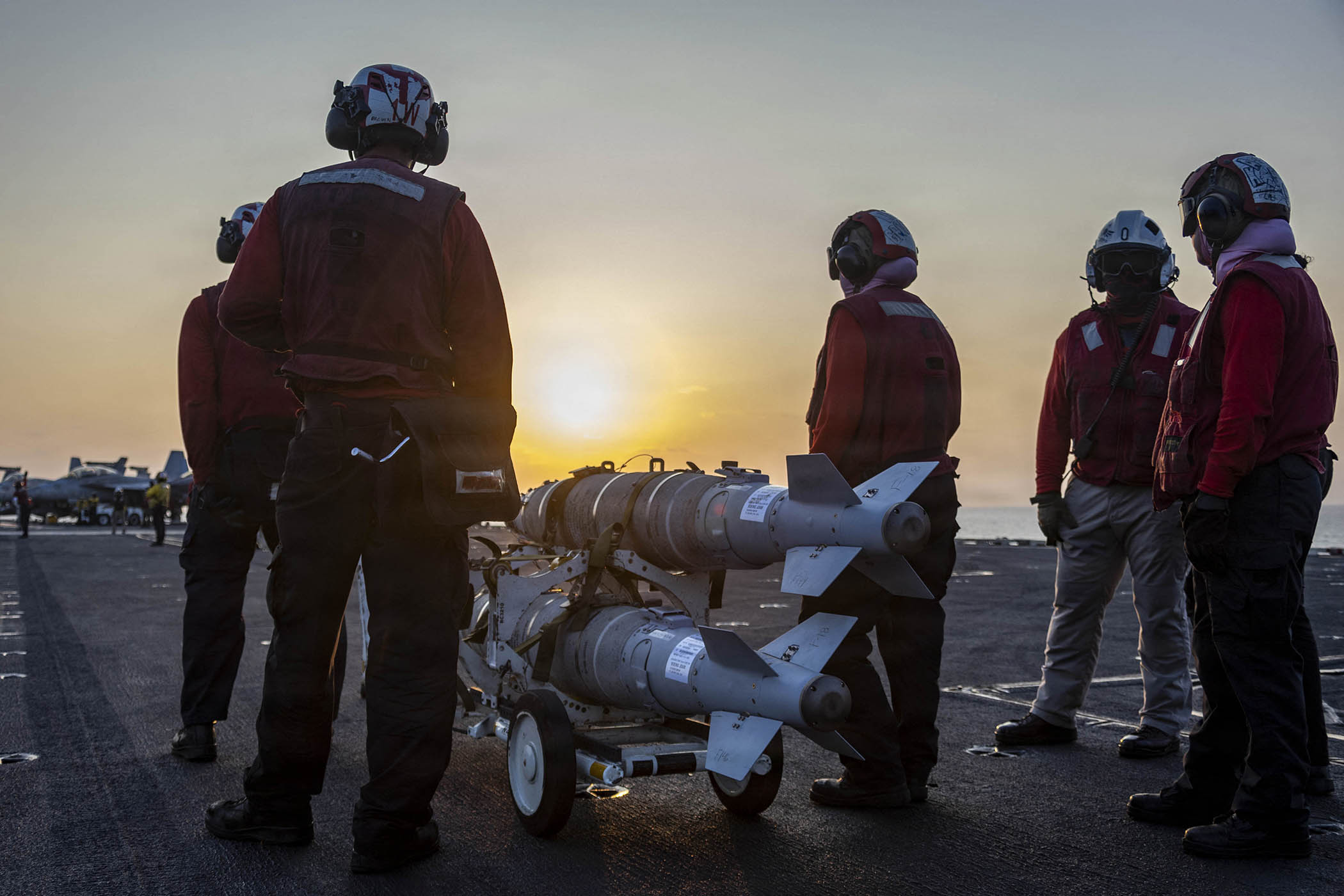
Photograph by US Navy/ AFP Photo