Photograph by Christian Sinibaldi
Ed Davey has a reputation as a political stuntman. If he is not falling off a paddleboard, or bungee jumping from a bridge, he is calling for the king’s state visit to the US to be cancelled to punish Donald Trump.
Yet the truth is that the Liberal Democrat leader who likes to present himself as a bit of a joker has a life woven through with almost unbelievable tragedy.
When he was four, his father died of Hodgkin lymphoma, then when he was nine his mother was diagnosed with breast cancer. He nursed her for four years, administering morphine to relieve her pain, until she too died when he was 15. He then relied on his grandparents, but three years later his grandfather died suddenly of a heart attack.
Davey says he was forced to grow up at an early age. He remembers sitting in the kitchen one day after his mother died and wondering why he was bothering about his O-levels. He had no one to please, but then he decided he had to make his own priorities. “I thought, ‘It’s up to you. Do you want to do well?’” He became head boy, got top marks in his exams and won a place at Oxford. He got a first in philosophy, politics and economics and became a cabinet minister in the coalition government, but as an adult he has faced a series of setbacks. His son John, who is now 18, is severely disabled; his wife, Emily, has multiple sclerosis and walks with a stick. Davey has spent most of his life as a carer, which he says is “way harder than being a political leader”.
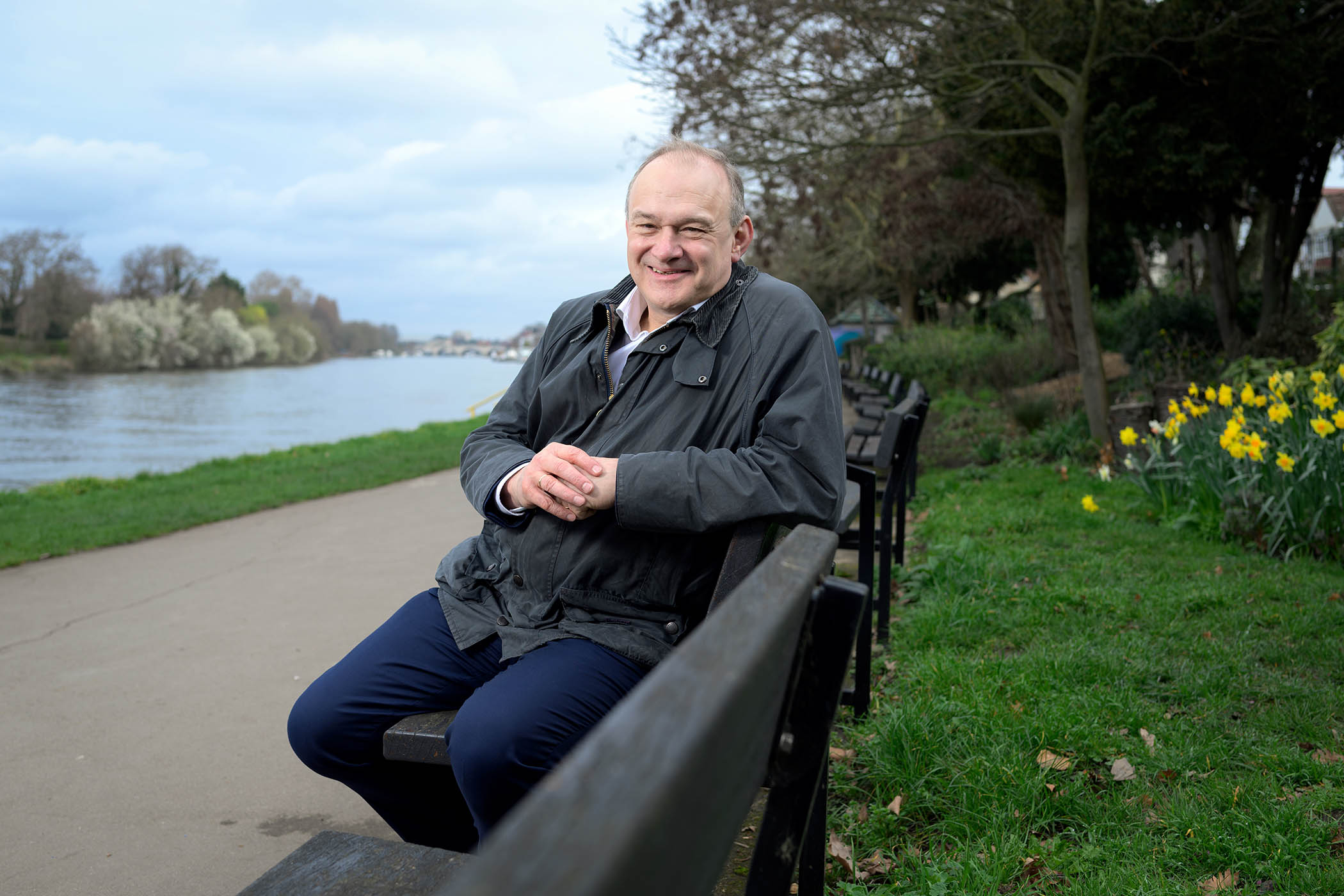
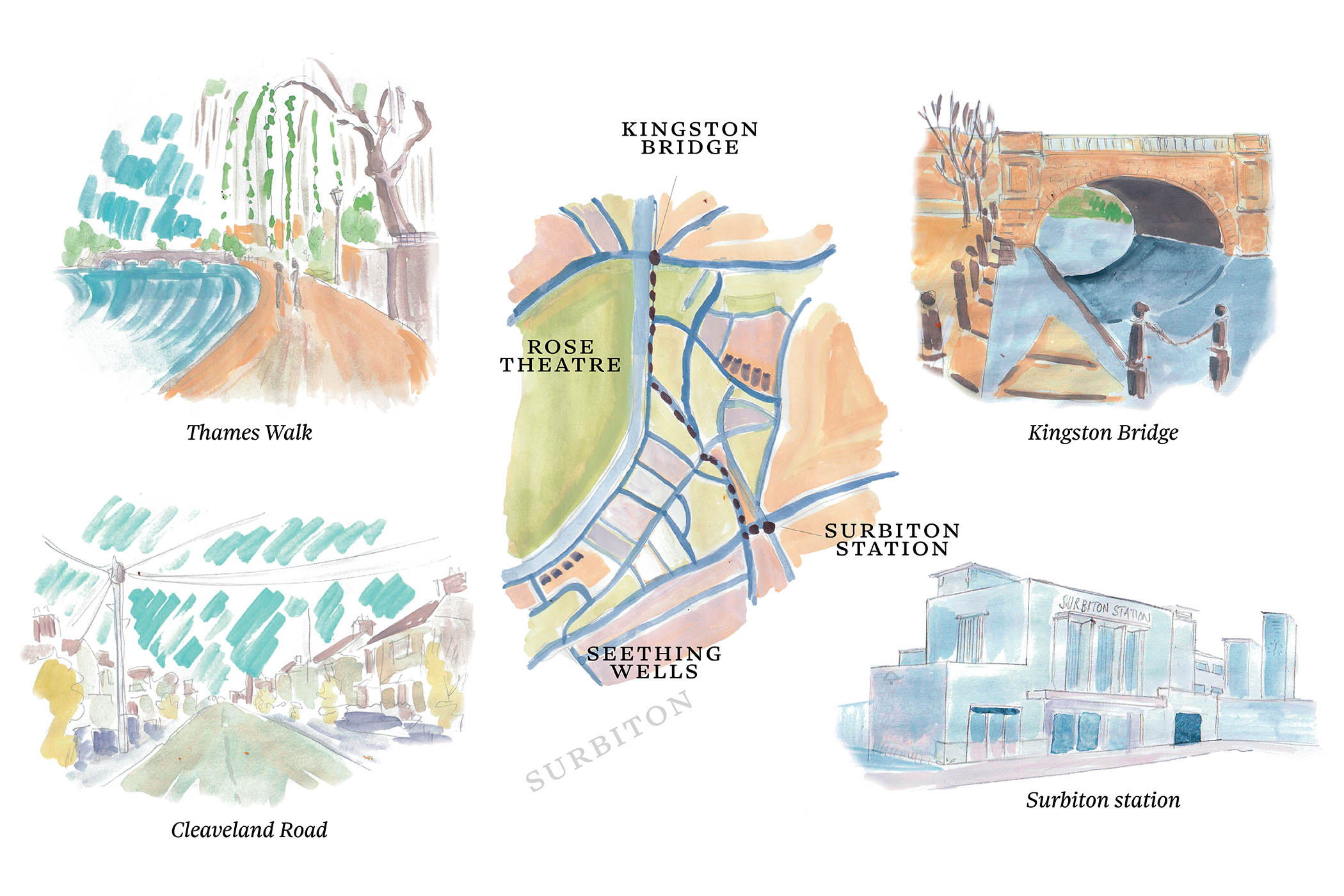
Our walk will take us along the river in his constituency in south-west London, from Surbiton to Kingston upon Thames. It is a route he follows often with his family, all on different vehicles to help them overcome their various mobility issues. “John’s on his tricyle, Emily has a little electric bike, my daughter Ellie is on her normal bike and I’m always on Shank’s pony – that means walking, but they don’t go that fast so I can usually keep up.”
We meet by Surbiton station, opposite Gail’s bakery, and stroll through the leafy enclave that is known by estate agents as Maple Village. “There’s a farmer’s market and some lovely wine bars,” Davey says. “Our church, St Andrew’s, is just down here and there’s a wonderful pub called the Antelope where they brew their own beer.” As we walk along Cleaveland Road, he points out the small terraced house where he and Emily lived when they were first married. A former neighbour out walking her dog remembers him and asks after John. “It was a lovely community, we had a Facebook group and held jubilee parties,” Davey says. “It’s been a bit gentrified over the last three decades but it still retains a lot of that character.”
I ask how his character has been affected by the extraordinary number of traumas he has faced in his life. “I think I do have a sense of perspective,” he says. “I’d go to school at 13 or 14, having helped my mum in the morning, and then see other people my age doing things that 13- or 14-year-old boys do – talking about music or whatever was on TV the night before, having their own little arguments – and I was seeing things through a different lens. I guess as a young carer, you begin to learn things even if you don’t realise it. One is empathy. Another is resilience and the third is good time management.”
He admits his staff might not always recognise the last of those as one of his greatest strengths. “But when you’re working with Emily to make sure that John will get the carers he needs, being able to plan your time out matters. It does mean that you can’t always do the things that you’d like. I don’t see my friends as much as I’d like to.”
We turn down towards the Thames. One of Davey’s cousins jogs past and greets him with a sweaty hug. There are yacht and rowing clubs along the river. Davey points out the paddleboard centre where he did a training session before his pre-election photo call.
Newsletters
Choose the newsletters you want to receive
View more
For information about how The Observer protects your data, read our Privacy Policy
“My mum had a great sense of fun, and despite all she went through, she would always try to see the funny side of things. People who know me will tell you that’s a trait I’ve inherited. If you’re dealing with really tough things there are different ways you can react.
“Mum prepared us for her passing, we would talk about it openly and we would talk about taking every day as it comes.” He never resented the time he spent caring for her. “Feeling angry doesn’t really help anybody,” he says.
‘Being a carer is way harder than being a political leader’
‘Being a carer is way harder than being a political leader’
A relentless optimist, he has no self-pity. “I only got called an orphan once, by the headteacher when I went back to school after mum died,” he says. “That did actually hit me quite hard. It was the shock of someone using that word. I didn’t really feel like an orphan. Orphan conjures up Oliver Twist and work houses and I had a very loving family. I was fortunate. We weren’t rich, but we were comfortable financially. I didn’t feel like a victim. Mum and I had become really close, because I spent so many hours on her bed, chatting to her, and she prepared me. She gave me strength and determination.”
Davey, who is now 60, says caring for his son is completely different to looking after his mother. “It’s partly the relationship, but it’s also the circumstances. Mum was dying and that was tough, whereas my wonderful son is going to hopefully live a proper life, and I get a lot of joy from him.”
John has a neurological condition that means he struggles to walk or talk. “He can walk aided but you have to be there with him or he’d fall over. He’s got no real balance,” Davey says. “We have one live-in carer who helps in the evenings and the mornings. I do that at weekends.” Having struggled with the noise and chaos of school, John is now educated at home. “He has two amazing teachers who bring words out of him, both verbally and also in writing.” He goes sailing – “the wetter and windier the better,” his father says – and loves swimming, rock climbing and horse-riding with support. “He has toys. He plays with a train set.”
There is a lot of joy in caring for him but Davey admits it is not always easy. He has scratches all over his hands. “I get pinched – it’s 80% affection and 20% frustration,” he says. “You can sometimes see it in his eyes, particularly when he’s looking at his sister, who is running around and chatting.”
We walk along the Queen’s Promenade, past the daffodils and tulips in the gardens that have been created by volunteers. Davey admits that he and Emily worry about the future for their son. “It’s our room 101 – you both need to think about it, but don’t really want to think about it. Say he has 30 or 40 years after we’ve gone, who is going to be doing the caring? Will they care for him like we do? And will the carers be supervised and monitored? It’s terrifying and Emily gets very upset when we occasionally talk about it.” Ellie, who is now 12, is beginning to ask questions. “Being a sibling carer is a lifelong caring thing. We’re trying to plan things to make sure she can have a life of her own.”
When Angela Rayner resigned over a failure to pay the stamp duty on a property transaction, which involved a trust set up for her disabled son, Davey’s aides prepared a “classic political attack” press release. “I read her statement and I said, ‘I can’t put that out,’” he says. “I do feel sympathy for her.”
Did he feel unlucky when Emily got her diagnosis? “Life deals you these cards, and it’s how you play them,” he replies. “Some people might think, ‘Oh, well, why is he bothering with politics?’ Well, it actually makes me even more motivated because I think I have some genuine life experience of caring and views about how things could be improved.”
The paperback of Davey’s memoir, Why I Care: And Why Care Matters, out last week, includes an excoriating epilogue about the cross-party failure to deal with social care. “Politicians don’t want to talk about it. It’s always in the all-too-difficult box, and that’s what’s disappointed me most about the government,” he says. “Keir Starmer is a serious man but I don’t think his government’s serious, because there are these problems which they know and they’re not tackling them.”
He “cautiously” welcomes the government’s plan to reform the special educational needs and disability system, although he says: “I'm not sure it’s radical enough. If you really want to transform Send there’s only really one way and that’s much earlier intervention, which means early assessment.”
We walk on towards Kingston, where residents last year celebrated the anniversary of Athelstan’s coronation there as the first king of England. Now Davey is trying to drag King Charles into the tension between the UK and the US over the war in Iran by calling for the state visit to be cancelled. Trump would be furious if the government followed his advice but Davey thinks Britain has to signal its “serious disapproval” of the president’s behaviour.
“He’s reckless and dangerous. I don’t think we should give him honours and prizes that he doesn’t deserve.” He also wants “tax exiles” in Dubai to pay their way if the government is going to rescue them, but insists he is not going after all expats. “This isn’t about ordinary people who are working in Dubai as teachers or lawyers or the people who have retired to France or Spain. It is very much focused on those people who are extremely wealthy and are mocking us, then in the next breath want our help.”
We are nearly at the grand stone Kingston Bridge, made up of five elegant arches. This was solid Tory territory until 1997 when Davey won the seat by 56 votes after three recounts. Now, though, the Liberal Democrats are fifth in the polls and risk seeming irrelevant. Having won a record 72 MPs at the last election, Davey insists he is “bullish” about his party’s prospects. “The polls are a national average. They don’t catch things like tactical voting.”
He says he feels a “moral responsibility to win to stop Nigel Farage”. Does that mean he would tell people to vote for Labour or the Greens if they had a better chance of beating Reform? “Voters should be given a choice and make up their own minds,” he replies. “The way I would operationalise that is by making sure our resources go into the areas where we can win.”
He is sceptical about the idea of a “progressive alliance” between parties of the centre left, insisting: “I just don’t think you can move voters across the chessboard like that.” He is “not focused” on whether or not he would go into a coalition with Labour but is “proud” of what the Conservative-Lib Dem alliance achieved. “Politics is so breathless at the moment. The coalition managed to be a stable government. It wasn’t nirvana but there was an attempt to think things through and work collaboratively.”
Davey is not ashamed of his idealism. “I tend to see the best in human beings, not the worst,” he says. “My values drive my optimism. I was taught them by my mother, who was determined, despite all the hardship she’d suffered personally, to soldier on and fight. My mother fought cancer like no one’s ever fought cancer and I will fight the threat to our country like no one’s ever fought it.”
Why I Care: And Why Care Matters by Ed Davey is out now