


Gurnell Grove is an unremarkable mid-century council estate on the fringes of suburban west London. One first-floor maisonette stood out on a sodden morning last week. The living room window had recently been replaced by a plywood board, its immediate surroundings burnt to blackness after a fire gutted the property at the end of last month.
At the ground floor flat below, a young woman, no older than 18, shyly answered the front door. Yes, she knew about the blaze. It was her brother whose bike had gone up in flames. He had lived upstairs and was still in hospital with what had been life-threatening burns. “He was in a coma for a week. [It’s his] hands and feet now. He’ll have to learn how to use them again.”
The fire broke out just after 7am on 23 May. Four fire engines arrived at the estate, with two dozen firefighters working to bring the blaze under control. The bike responsible had recently been converted from an ordinary pushbike into a powerful electric model through the installation of a lithium battery.
“It just wasn’t worth it,” said the woman at the door, who did not want to give her name. “[I] said that a normal bike [was] enough.” It was scary, she added, how quickly things deteriorated; how high the flames grew in such a short time. Though relieved that her brother pulled through, she knew how fortunate he was to still be alive.
Such stories are becoming common across the UK. Lithium-ion batteries are the lifeblood of all manner of commonly used rechargeable devices, from electric toothbrushes and mobile phones to vapes, smartwatches and electric cars. They also power the ever rising number of ebikes and e-scooters on Britain’s roads. For some, their growing ubiquity is a cause for celebration: a convenient means of modern urban transportation, both affordable and environmentally friendly.
This is not the whole of it. According to new research by the insurer QBE, fire brigades across the UK are tackling lithium-ion battery fires at a rate of one every five hours.
In March, Glasgow Central station, Scotland’s busiest rail terminus, didn’t fully reopen for two weeks after a blaze decimated a nearby building – an incident thought to have begun in a vape shop. In 2025. firefighters attended 1,760 fires in the UK at a rate of 4.8 fires a day. This represents an almost 150% rise in just three years. Ebikes were responsible for 520 callouts – almost a third of all lithium-ion battery fires nationally.
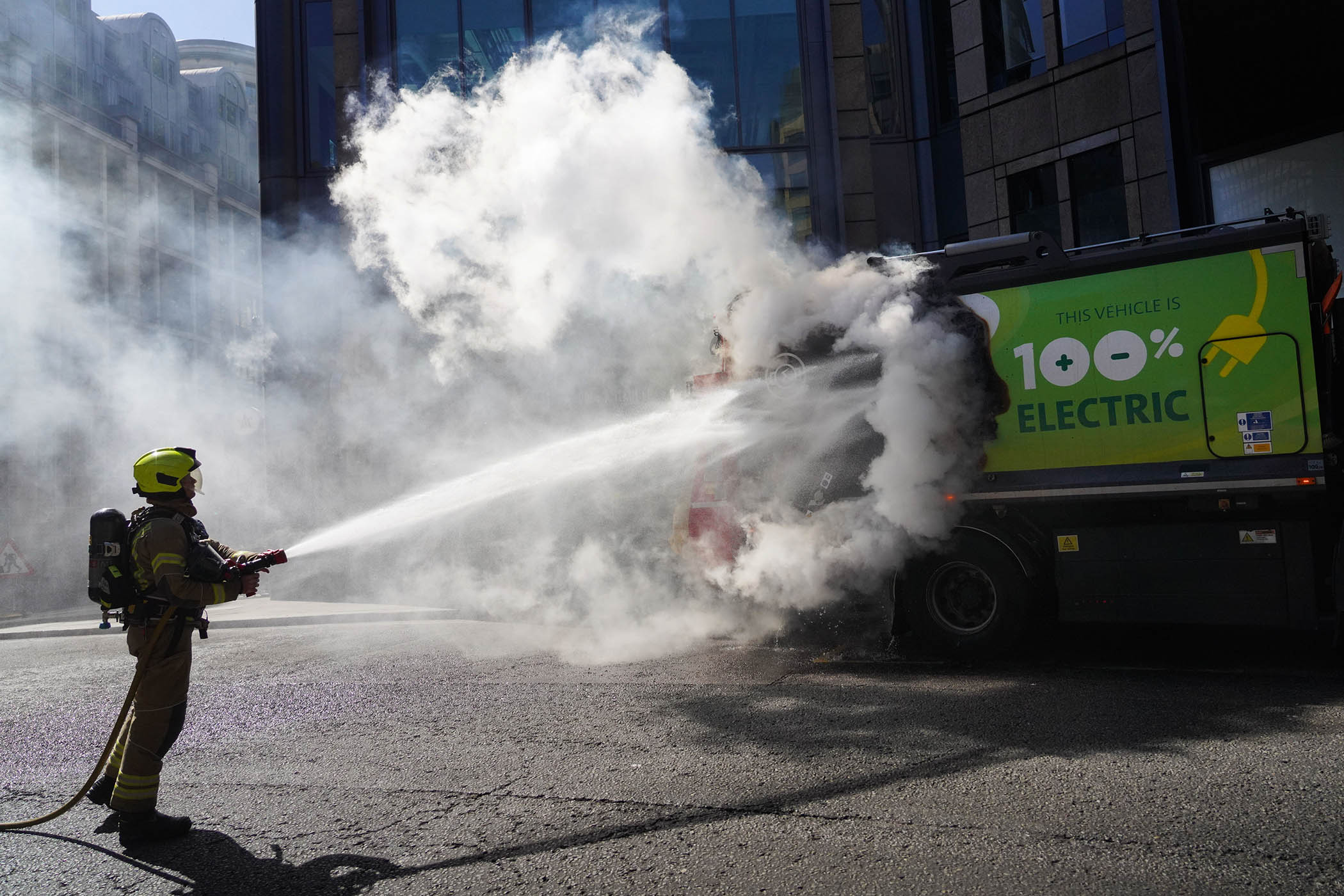
The London fire brigade tackles a fire that started in a rubbish truck
Understanding the headline figures demands some nuance. The majority of ebike fires involve shoddily retrofitted or converted bikes, like the one that torched the west London maisonette. Conversion kits are readily available online, often for a few hundred pounds. Their dangers are manifold, with poor wiring and installation leaving batteries prone to overheating.
Lithium-ion batteries are deceptively powerful, reaching temperatures of 700C. The fires they cause begin without warning, spread rapidly and are fiendishly difficult to put out; they release poisonous vapours and are liable to cause explosions.
Imagine, say frontline workers and experts, something with the power of a small bomb strapped to your bike. In 2017, London fire brigade (LFB) recorded seven ebike and e-scooter incidents. That number had soared to 206 in 2025. This year, 79 such fires have already been recorded.
Newsletters
Choose the newsletters you want to receive
View more
For information about how The Observer protects your data, read our Privacy Policy
This is not a London issue. Nottinghamshire, Greater Manchester and Avon have all registered significant numbers. In 2024, a young couple died in Coventry after an ebike at their home spontaneously caught fire. An attending firefighter said it was one of the worst fires he had seen in a 21-year career. In March, the coroner for Cambridgeshire confirmed that a modified ebike caused a fire that killed a mother and her two young children at a property in Cambridge. In London, ebike and e-scooter fires have killed five people since 2023, with hundreds more injured.
Of these, Sofia Duarte was the first to lose her life. The 21-year-old had been celebrating New Year’s Eve 2023 at her boyfriend’s flat on the Old Kent Road when an ebike charging by the building’s front door caught fire. In the aftermath of her death, Duarte’s family campaigned for an urgent review of regulations around ebike sales. Transport for London announced last March that it would ban them from the London Underground, in part due to a petition launched by the Duarte family.
Alda Simoes is a close friend who has been instrumental in the campaign. Though proud of its achievements, she stressed that there was much work still to be done. “It [isn’t] about product safety but storage as well,” she said.

Fire investigation officer Lisa Wincott
The pace of technological advances has outstripped efforts at regulation. There are signs this may soon change. The Product Regulation and Metrology Act 2025 became law last year. It is, among other things, the most ambitious attempt yet to clamp down on the online market places selling knock-off bikes and conversion kits. Simoes is positive about its potential impact but worried about the already entrenched culture of impunity and carelessness. “People think it won’t happen to them, but it is no joke… enforcement will be the big thing. You can make a rule but how do you enforce it?”
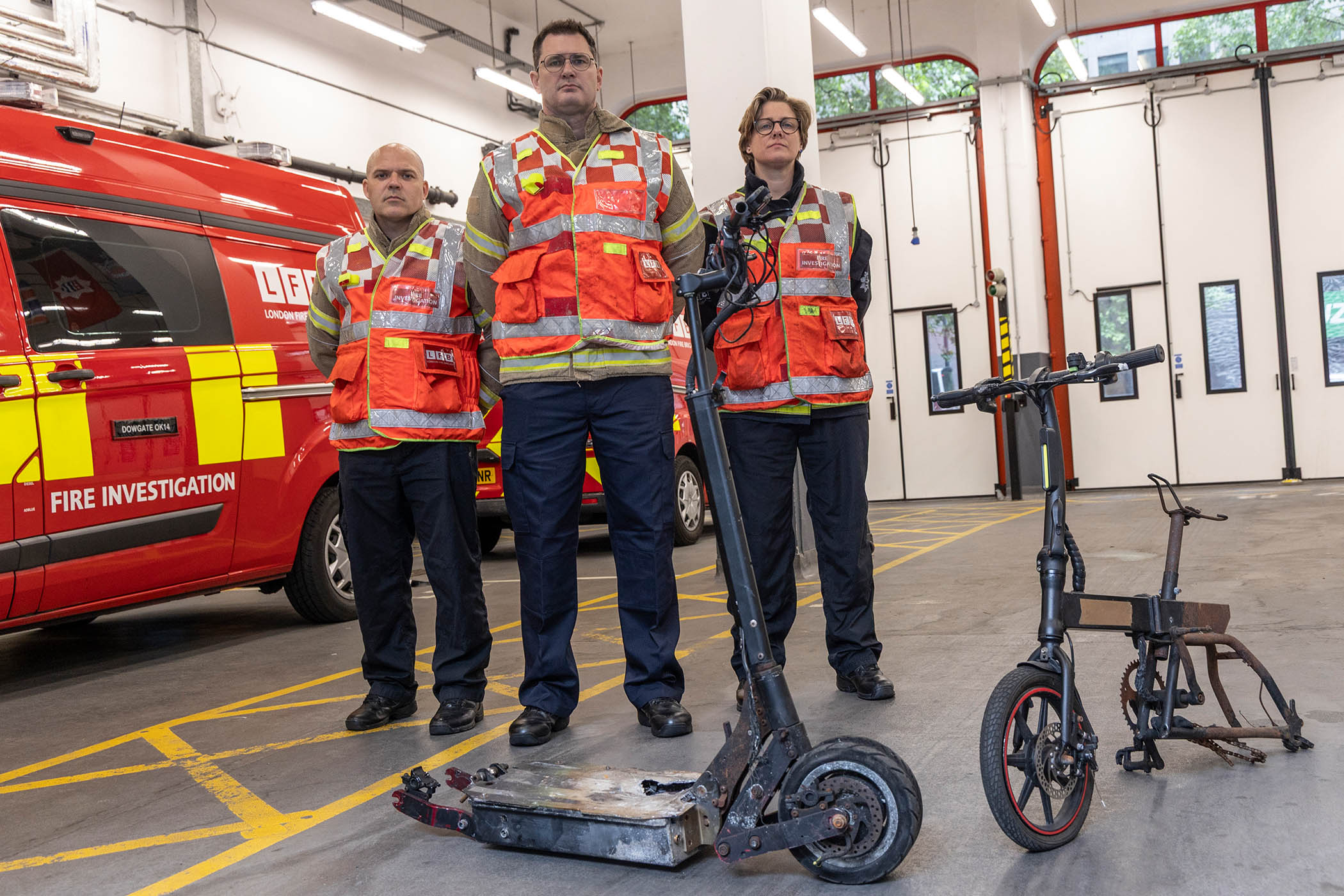
Dowgate fire station is a squat mid-century brutalist block tucked between modern glass offices a few hundred yards from Cannon Street. Dowgate is unusual in several respects. It is the only operational fire station in the historic City of London, as well as home to the LFB’s fire investigation team. They fulfil a unique role in the brigade’s ecosystem. When a serious incident is reported, their expertise is required at the scene to establish how it began, as well as assisting with the frontline response.
“If we notice a trend, we’ll look into what’s causing it,” said Lisa Wincott, a cold scene investigator and former forensic scientist. Over the past decade, the team’s picture of the ebike phenomenon has become increasingly refined. It was, she said, about asking the right questions: “Are they conversions? What property type are they occurring in? What borough? Was it an original charger? You don’t always get the information but you can get some of it.”
The fact was, explained Rob Hill, station commander and a long-serving member of the investigation team, that there was a readily apparent “socio-economic scale” at work. “Maybe uptown you’ll see people on really expensive bikes. But they aren’t the ones that we’re seeing [in] the fires…” Lewisham and Southwark posted the highest number of incidents in 2025, closely followed by Tower Hamlets.
Gig economy delivery drivers were particularly susceptible. “There’s a drive to complete as many deliveries as possible,” said Hill. “And if that means strapping one, two, three batteries to a bike in an unsafe manner, then they’ll do that.”
Last year, the investigation team arrived at an HMO (house in multiple occupation) property in east London where 16 people were living in a one-bedroom flat. “All using different bikes, different batteries, different chargers,” Hill said.
The morning I visited the station was deceptively quiet, though there had been a callout the previous day. Three people were in hospital after a charging e-scooter caught fire at a property in Sutton, south London. “It was charging in a communal hallway. All the doors were open and battery cells [were] expelled into every single room.”
LFB launched its ChargeSafe campaign three years ago. In March, it announced a new partnership with Uber Eats, offering guidance to delivery drivers on safe charging methods. Such efforts have been welcomed, but Hill and his colleagues know it is not a substitute for regulation, which they have consulted closely on. Awareness was a laudable goal, one that would save lives, even if it was only one part of the broader picture.
“Regulation takes time, but we have to act in the meantime. That means educating people, telling them how to use their products so they can stay safe,” concluded Hill.
Photographs by Andy Hall for The Observer, Kristian Buus/In Pictures via Getty Images