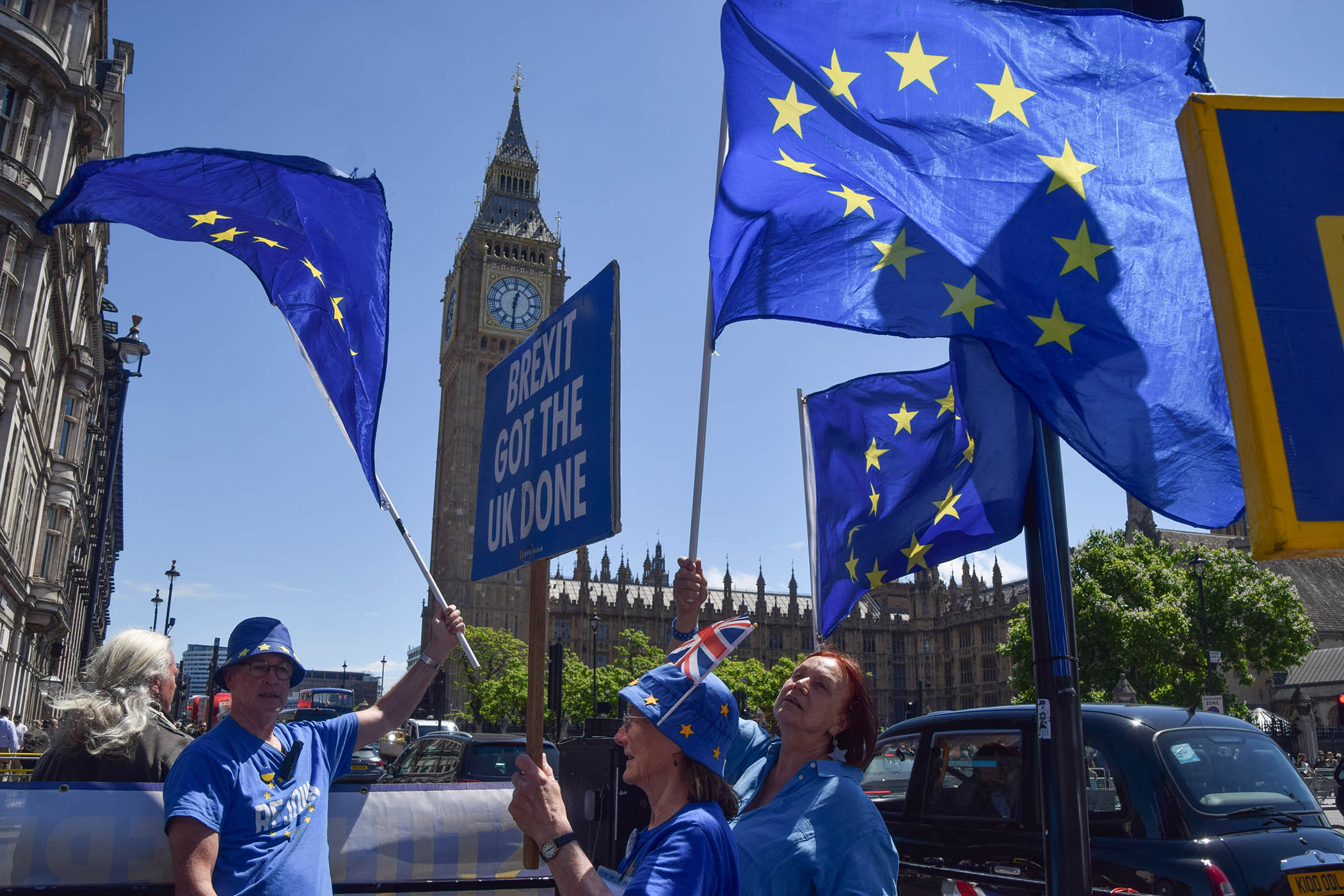



Three-quarters of British voters want to get closer to the EU. Two-thirds are relaxed about freedom of movement. Seven in 10 young people want to rejoin the bloc and more than twice as many overall see the EU as an ally compared with the US.
Ten years in, it’s as good as official: Brexit has made Britain more keen on the EU, not less. And on key questions, from trade ties to nuclear deterrence, voters appear to be more enthusiastic than politicians about EU-UK relations.
While politicians tiptoe around the issue for fear of reopening Brexit wounds, a majority of the public has moved on. These and other findings from a series of four polls conducted in May for the European Council on Foreign Relations show how far sentiment on Brexit has shifted, reflecting huge upheaval in the UK and abroad in the decade since the referendum.
When the Brexit vote was held, Barack Obama was still president of the United States. Russia had annexed part of Ukraine but Europe was largely at peace. A transatlantic consensus favoured more free trade, and David Cameron had just proclaimed a “golden era” of UK-China relations.
Today the postwar order is creaking. Donald Trump has threatened to annex the territory of Nato allies and pull troops out of Europe. Tariffs and protectionism have replaced free trade. China looms large and Russia is testing Europe’s boundaries.
The EU, too, has changed. The turmoil of recent years has forced the bloc to reinvent itself. European leaders today talk of rearming, while open borders have been replaced by much stricter migration policies.
Britain, meanwhile, has had six prime ministers, a pandemic and two energy price spikes driving the cost of living. If Brexit was once a rejection of mainstream politics, it is now an unpopular pillar of the status quo.
Cost of leaving
Brexit did not immediately plunge the UK into a recession, as some had warned. But 10 years on, most voters think the economic impact has been bad for them personally and for the country at large.
About two-thirds say Brexit raised the cost of living – including 43% of Reform supporters. Experts agree the economy is significantly smaller than it would be if the UK had not raised barriers to business with its biggest trading partner. Business investment and productivity growth have stagnated and families are thousands of pounds a year worse off on average. Against that backdrop, only 13% of people polled opposed a closer trade relationship with the EU. Even leavers split favourably, with 49% of Reform voters in favour.
Newsletters
Choose the newsletters you want to receive
View more
For information about how The Observer protects your data, read our Privacy Policy
Politicians lag behind the public
The Labour government pledged to reset relations with the EU while ruling out a return to the single market, customs union or freedom of movement, let alone full membership. Yet when asked to pick a single preferred future relationship, the biggest share opted for full EU membership, followed by Norway-style membership of the single market and a new broad treaty in third. Only 6% backed the status quo.
The red lines drawn by politicians reflect fear of alienating voters fed up with years of wrangling over Brexit. The polling suggests these concerns are overblown. The most-cited responses when people were asked how they felt about closer ties with the EU were “optimistic”, “pleased”, “relieved” and “excited”. Anger, annoyance and uncertainty scored far worse.
The Trump effect
Those in favour of rapprochement with the EU have a lot to thank Trump for. When the UK broke with Europe it could count on a stable relationship with the US, but Trump’s return to the White House has undermined that partnership at a moment of global instability.
Astonishingly, less than a fifth of respondents (18%) view the US as an ally while 63% see relations with Europe as a priority. Even Conservatives lean towards more cooperation with the EU (50%) rather than less (28%).
Common threats
The war in Ukraine has pushed the UK and Europe closer together on defence.
While Trump has slashed support for Kyiv and engaged with Vladimir Putin, Europe and the UK have rallied behind Ukraine and view Russia as a growing threat. If the UK were under attack, only 35% think the US would help; 72% believe at least some European countries would do so.
Common threats have made the UK more willing to work with Europe on security. Sixty-five percent of respondents, including a majority of leave voters, back sharing military resources and intelligence with the EU. Half said they would support creating a European army including a British contingent. And nearly two-thirds favour developing an alternative European nuclear deterrent independent of the US.
“Taking back control”
The promise to “take back control” of the UK’s borders was a rallying cry for Leave. A decade on, more than half of respondents – including 58% of those who voted to leave the EU – believe it has made illegal immigration worse.
The numbers have gone up: small boat crossings have surged in recent years, according to Oxford University’s Migration Observatory. Net migration also rose sharply after Brexit, driven by an increase in non-EU citizens coming to the UK.
Post-Brexit realities have reshaped the politics around freedom of movement: 66% of British voters are now prepared to accept it. Even among leave voters, 57% support restoring freedom of movement, allowing EU citizens to live, work and study in the UK without a visa – and vice versa. Only 18% oppose it.
Europe’s view
A year into Trump’s second term, most European citizens (66%) would welcome Britain rejoining the EU. Danes are especially keen. Voters for several new-right parties, including a majority of Alternative for Germany backers and National Rally supporters in France, are also in favour of taking Britain back.
Leaders are less convinced. Some are open to the UK rejoining, but there is a strong sense that the UK should not be given special treatment, says Heather Grabbe, a senior fellow at the Brussels-based thinktank Bruegel. “The UK has slid very far down the list of priorities in terms of relationships,” she says. “People in Brussels and national capitals spend much more time thinking about the relationship with China, with the US, and even with India. A British minister used to be in the top five of visitors you would definitely welcome into your office. Now he’s lucky to be in the top 20.”
Splitting the right (again)
Brexit emerged from an internal struggle in the Conservative party, but the 2016 referendum split the Labour vote. A decade on, support for a closer relationship with Europe unites Labour voters as well as those who have left the party – and the left more broadly. Overall, 90% of Greens and 76% of Liberal Democrat supporters say they would vote to join the EU.
But divisions over Europe are again dividing the right. One in three Tories say they would support joining the EU. Conservative defectors to other parties are also divided. Only Reform supporters come out decisively against joining the EU.
Demographic churn
In the decade since Brexit, 6 million voters have died. Another 6 million people have become eligible to vote and they are overwhelmingly in favour of joining the EU. If a referendum were held now, 70% of voters who were underage in 2016 would choose to join.
Buyers’ remorse
A decade ago, 52% voted to leave the EU. Today only 32% believe it was the right decision. When asked what benefits Brexit had brought, the most common answer was “I don’t know”.
Photograph by Vuk Valcic/SOPA Images/LightRocket via Getty Images