

Illustration by Zoë Barker
Ancient woodland covers less than 3% of Britain’s land area. While today our oldest woods often feel remote and wild, their history is interwoven with that of people. These five trees give a personal insight into the past, present and future of these special places.
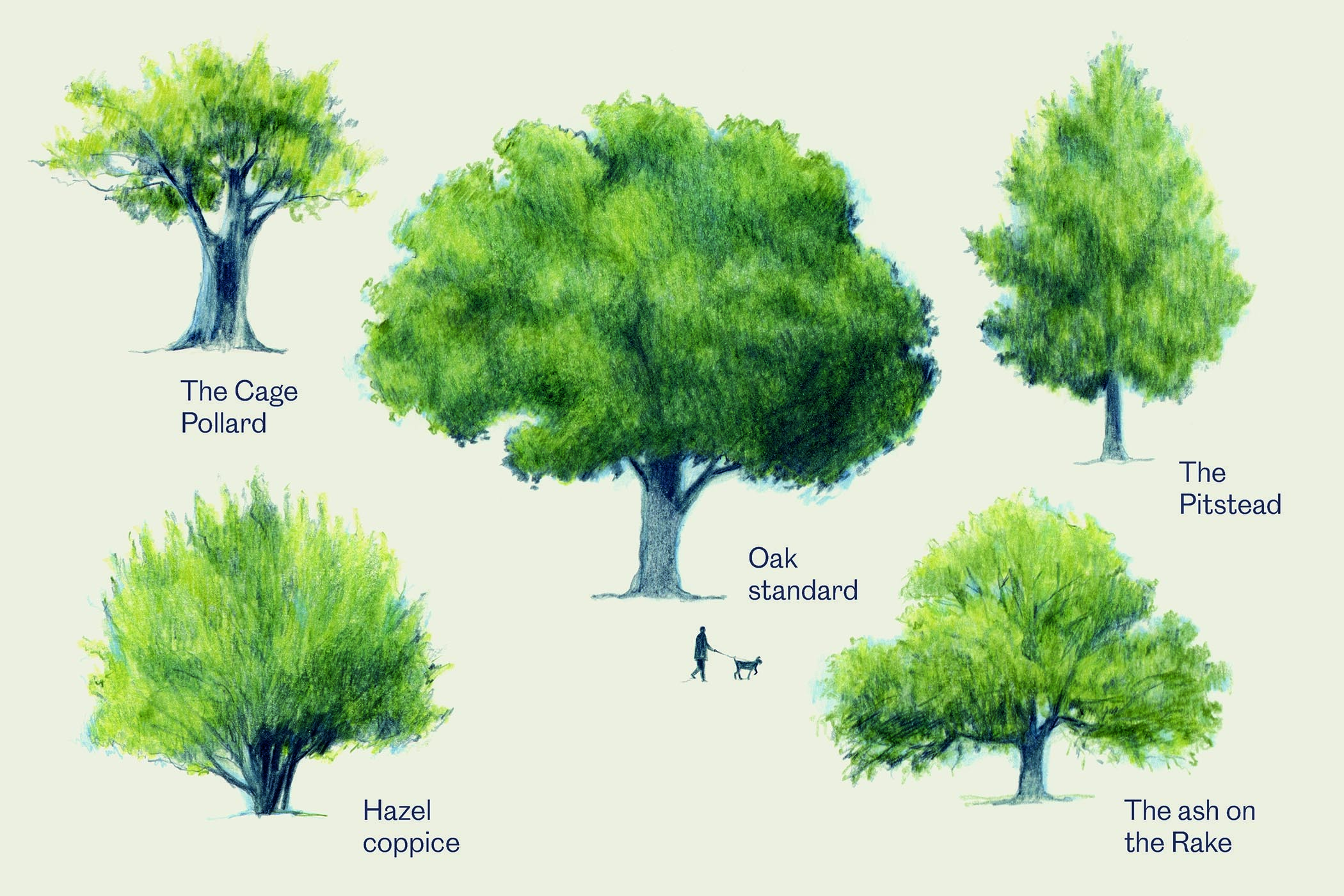
1. The Cage Pollard beech, Burnham Beeches, Buckinghamshire
I credit Robin Hood: Prince of Thieves with getting me into woodland. As kids our little gang was obsessed with the 1991 film; we spent days on end re-enacting its battles in our local wood. The late lamented Sycamore Gap tree was famous for its role in the film, but when I started to work in London I was more excited to meet one of the lesser known – but even more characterful – trees that the outlaws hung around.
The Cage Pollard is an ancient beech at Burnham Beeches, an old wooded common that hosted many of the film’s scenes. For hundreds of years, local people held rights to graze their cattle and pigs here and to take much else they needed from the land. Trees were “pollarded” – cut periodically above head height, where the cattle couldn’t reach the lush regrowth – and the bushy “poles” taken away to be dried as winter fodder and for firewood. The short, lower trunks that were never cut – known as “bollings” – grew increasingly fat over hundreds of years, persisting even as the wood at their centre began to decay and crumble away. The juxtaposition of living and decaying wood makes them an extraordinary ecosystem; ancient trees support more than 2,000 of Britain’s invertebrate species.
Since we no longer use their products, pollards like this are now at risk, along with their special wildlife. The Cage Pollard dramatically illustrates the problem, with knobbly strips of living wood – the “bars’” of the cage – surrounding an entirely hollow centre. Its top-heavy crown is propped on one side. Since the late 1990s the rangers at Burnham have been at the forefront of efforts to extend the life of our oldest trees using a range of innovative techniques – which I ended up being involved with at Ashtead Common, in Surrey, bringing my Robin Hood-inspired story full circle.
2. Hazel coppice, Spring Park, London
One of my favourite times of the woodland year is in late winter when the catkins of hazel emerge; the dangling male flowers draw the eye to this sometimes anonymous understorey tree and, in a wood dense with the species, create a sherbet haze beneath the canopy. It’s easy to overlook the multi-stemmed hazel as we gaze up at towering beeches and gnarly old oaks, but throughout most of human history it was a vital resource as the trees were “coppiced” – their material harvested close to ground level for firewood, livestock hurdles and much else, and the stumps (or “stools”) left to grow back with a new crop.
Here the rangers have restored the historic coppice regime. They mainly produce stakes and binders for use in hedge-laying, another traditional craft, but the real reason for the work is to help restore the wood’s wildlife. While our ancestors coppiced trees to get the things they needed, in doing so they unwittingly recreated the varied conditions of the pre-agricultural “wildwood” in which all species evolved. The end of traditional management triggered a mass decline in woodland wildlife.
3. Oak standard, Spring Park, London
A blue tit zips in beneath a spray of leaves and works its way along a branch, hanging by fish-hook feet as it grazes for caterpillars and tiny spiders; life in the canopy doesn’t stop for a climber in the way a wood can go quiet when you walk in.
Climbing one of Britain’s oak “standards” – the tall trees that rise above the coppice – is a lesson in history as well as ecology. The careful growth of trees like this was a foundational industry until just a few decades ago. It would have taken timber from a couple of hundred moderately sized oaks to make a medieval farmhouse, while there are thousands of giant beams in the roofs of our cathedrals and palaces. More than 6,000 trees went into building HMS Victory.
At the top of the canopy a purple hairstreak butterfly flutters out a few inches from the tree when the air is still and dashes back into shelter with the slightest breeze. Suddenly I realise they’re everywhere, the whole crown exhaling and inhaling with dozens of the tiny creatures, tumbling in and out and keeping time with the gentle currents of the summer air. The irregular rhythm is hypnotic; the visual effect trippy and reinforced by the soft, sympathetic sway of the branch I’m tied on to. We seem to breathe and move together: the tree, the butterflies, and me.
4. The Pitstead Lime, Dodgson Wood, Lake District
This sprawling small-leafed lime is almost a little wood in itself, a complex grove of interconnected life formed by its own collapse and regeneration. One of the swooping branches has embedded itself in the loose earth and set root to spark a younger sister, while fallen stems remain connected at the base and have erupted along their length into rows of new trees, shooting for the light. A ragged stump has produced a dense mass of soft, orange-green twigs.
The tree – or grove, or thicket – has a particular energy: it’s not the solid, stoic presence of an old oak but something more supple and lithe, a victory of adaptation rather than resistance. Lime has been called a “living link to the Neolithic wildwood” and this one could have been clinging on here since soon after the last ice age, roaming slowly around the steep slope with each failure and reiteration.
The biggest and most dramatic section, though, perfectly frames a platform hewn from the hillside, clearly the work of people. This “pitstead”, where wood was once baked into charcoal, is set almost like the stage in a theatre beneath an arch of spreading crown. Time is compressed here, with layers of history not only legible but tangible in the prehistoric trees and the vague humps and mounds of woodland archaeology.
5. The ash on the Rake, Peak District
Turning up the hill and out of the village of Monyash, the road straightens out. But in summer, by habit, I always slowed down. There is a giant, wind-dancing ash tucked behind the drystone wall, its limbs splayed joyfully. Ash dieback had arrived in Derbyshire’s White Peak and every day, on my commute, I inspected the edges of the tree’s loose crown for the telltale signs of the fungal disease: skeletal twigs emerging from the foliage; a thinning of the leaves into sparse clumps. Nearby, we hoped to diversify the area’s woods and increase their resilience by thinning ash to give the few other tree species a better chance to seed, and by planting some of the under-represented species that are native here.
Tree disease isn’t the only threat to our ancient woods. Air pollution, built development, too many deer, invasive plant species and the recent history of abandonment combine to put immense pressure on our woodland. But across Britain there’s a small, growing band of woodlanders breathing life back into our ancient woods, and learning from our historic interdependence with trees to rebuild our ancient wood culture – only recently lost – for the benefit of both the woods and ourselves. Ten years since we saw the first signs of dieback in the White Peak, my tree by the wall and many other open-grown ash trees like it seem untouched. There’s plenty to worry about in the state of our woods, but there is also a glimmer of hope.
Luke Barley is a former ranger and now senior woodland adviser with the National Trust, and author of Ancient: Reviving the Woods That Made Britain, published by Profile
Newsletters
Choose the newsletters you want to receive
View more
For information about how The Observer protects your data, read our Privacy Policy