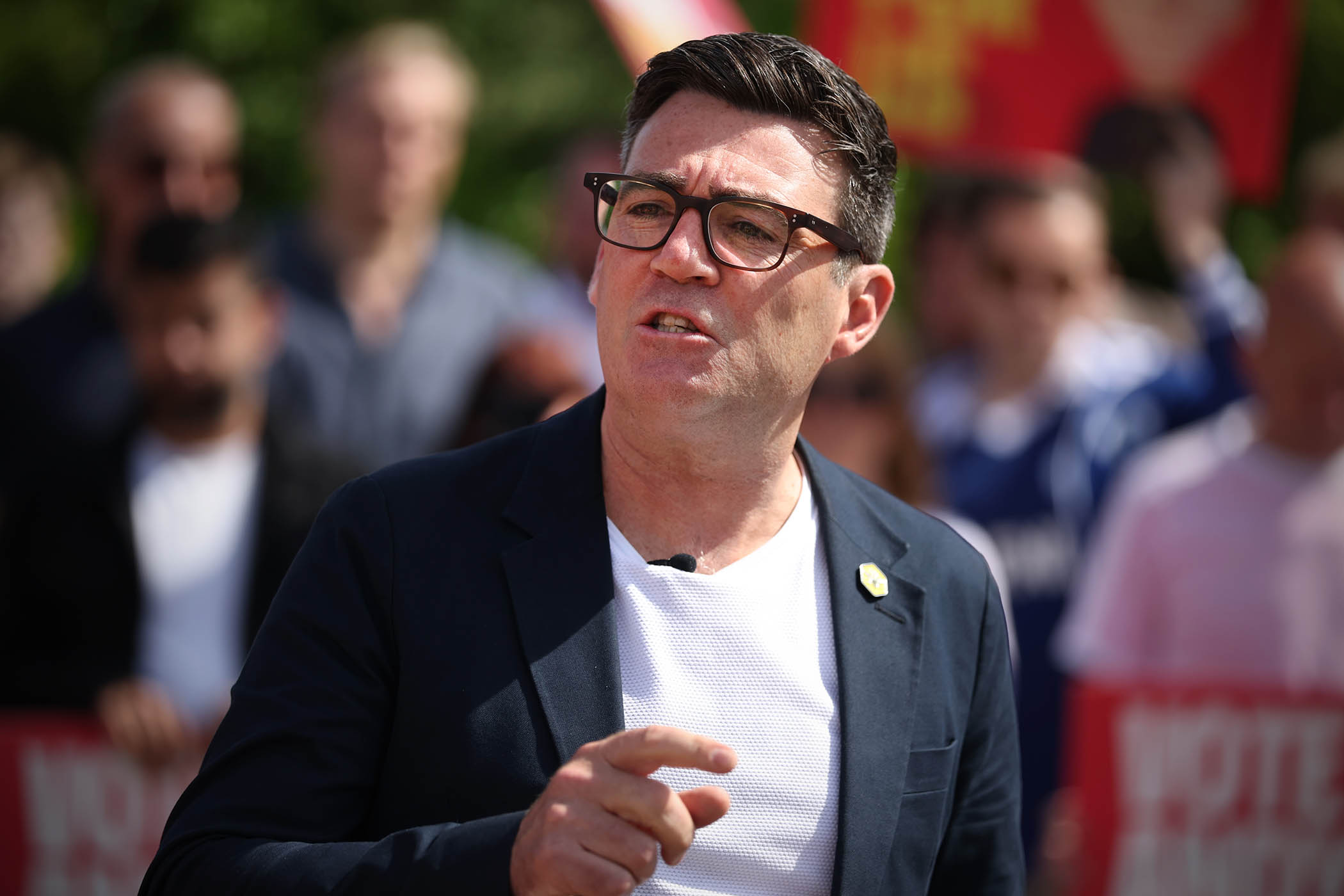
Andy Burnham has criticised Tony Blair for failing to grasp the importance of inequality in politics after the former prime minister warned the Labour party against going to the left.
In an interview with The Observer, the greater Manchester mayor said Blair’s intervention in the Labour leadership battle shows he misunderstands the economic causes of populism. “He doesn’t mention inequality once,” Burnham said. “If you don’t get how that’s driving politics now, if you are not rooting your analysis in the fact that people are unable to live and that things that were taken for granted are no longer affordable, then you are not understanding what’s going on.”
In an essay published by the Tony Blair Institute for Global Change, the former prime minister said Labour suffered from a “perennial delusion – that when we lose seats to the right the country is really signalling it wants Labour to move left”. He called for his party to champion the “radical centre”.
But Burnham hit back, insisting it was the centrists who had failed voters and fuelled the rise of Nigel Farage and Zack Polanski. Blair “criticises my phrase about 40 years of neoliberalism but the last 40 years has given us wide inequality – that’s what’s responsible for the abandonment of the centre,” Burnham said. “People don’t think the centre has delivered for them in terms of their lives, therefore they’ve gone further to the extremes.”
Burnham, who is widely expected to be a contender in a leadership contest if he wins the Makerfield byelection next month, insisted the state should be more active to ensure a level playing field and value for money in public services. “Where you need to intervene you need to do it decisively,” he said. “Tony seems to argue that the private sector has all-encompassing reach into everything, and when it comes to essential services the evidence is pretty clear it isn’t the fix.”
Asked whether he saw himself as leftwing, the mayor replied: “If you want to call it leftwing that’s fine by me. It’s knowing where you need to take a more left solution and where you want to be pro-business. Blairism sometimes saw the market as always the answer. That’s its problem.”
He insisted he had always taken a “very pragmatic” approach in Manchester, adding: “You can be pro-growth as we are but also recognise that if the bus system is unaffordable and not functioning it doesn’t support people into that.”
Burnham, who served in the governments of both Blair and Gordon Brown, also attacked Blair’s “obsession” with universities. The former prime minister set a target of 50% of young people going on to higher education, but the mayor said there should be greater focus on technical education. “The prioritisation of universities is a significant part of the problem that has left out too many people and has impacted on the welfare system.”
In his 5,600-word essay, Blair said Labour was “playing with fire” in the race to succeed Keir Starmer and risked consigning Britain to “relegation from the Premier League of nations” if it changed leader without first deciding on a policy direction. He accused ministers of lacking a coherent economic plan and argued that manifesto commitments on workers’ rights, net zero and taxation should have been abandoned after the 2024 election.
The former prime minister slammed successive generations of politicians for failing to tackle long-term difficult issues such as social care. But Burnham said that on social care, “Tony is part of that”. In 1997, Blair told the Labour party conference: “I don’t want [our children] brought up in a country where the only way pensioners can get long-term care is by selling their home.” He left office without resolving the problem and Burnham’s proposal for a care levy to fund reform was branded a “death tax” by the Conservatives during the 2010 general election campaign.
Newsletters
Choose the newsletters you want to receive
View more
For information about how The Observer protects your data, read our Privacy Policy
Speaking on the campaign trail in Makerfield, Burnham admitted he had a “hard fight” to win the seat, where Reform has been rising in popularity. “My whole pitch is I’m not running a traditional byelection – it’s not ‘Labour’s great and all the others are rubbish’,” he said.
“We need to change Labour locally and nationally and that’s my starting point. I think politics in Britain needs to change hugely. The culture of it is really rotten in many ways and it just isn’t connecting with people.”
For more from The Observer’s interview with Andy Burnham, sign up to receive the first edition of Rachel Sylvester on Politics – a new weekly newsletter in which our political editor shares her exclusive insight into what’s happening in Westminster, Whitehall and beyond.
Photograph by Ryan Jenkinson/Getty Images