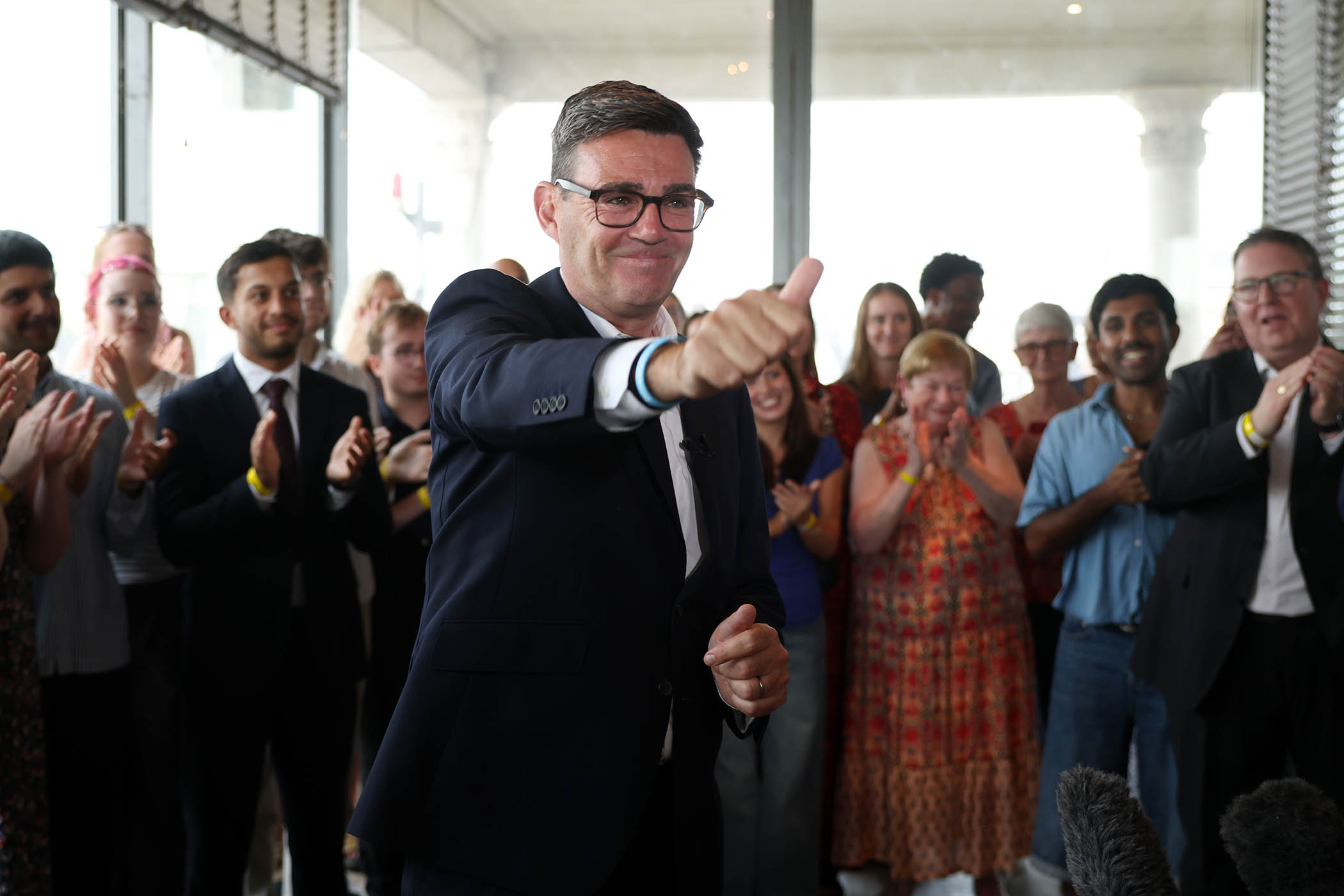



One of Andy Burnham’s closest confidants recalls him saying: “Every day, when I wake up, I ask myself: how can I be more popular today than I was yesterday?” For many people, including this friend, such a remark merely confirms that the next prime minister is a better politician than the man he replaces in Downing Street on Monday.
As one of his keenest supporters says: “It’s not that complicated – we’re going to do some politics again.”
But between winning the Makerfield byelection a month ago and being anointed as the new Labour leader on Friday, Burnham’s skills were more apparent in what he has not – rather than what he has – done. He side-stepped scrutiny from often hostile or grandstanding “lobby” journalists, making just one speech and a solitary contribution in the House of Commons, while doing a couple of soft media interviews including a podcast mostly about football with Gary Lineker last week. This strangely silent and uniquely smooth ascent to power, shorn of the clamour and scrutiny of a general election or a leadership contest, has allowed him to keep preparations for government tightly guarded within a troika comprised of Burnham himself, his chief of staff, James Purnell, and his parliamentary lieutenant, Louise Haigh.
For weeks there was an assumption that Burnham would appoint Ed Miliband as chancellor, but an apparently coordinated briefing operation over recent days from sources claiming to know Burnham’s mind said Miliband had been blocked. It was suggested he was “too London”, too scary for business or too disliked by northern trade union leaders.
For some on the soft left of the party, this is “rinse and repeat” of the past two years, when Downing Street aides or other parts of the Labour machine routinely slagged off ministers without being held to account. Burnham used his acceptance speech on Friday to declare he would eradicate factional in-fighting “and the insidious briefing culture that goes along with it”. But some of Miliband’s friends sigh and mutter under their breath: “That’s what Keir used to say too.” Miliband would probably accept an offer of another big cabinet post, perhaps foreign secretary, even though this may mean having to watch much of his net-zero agenda being unpicked by whoever succeeds him as energy secretary.
Early policy announcements next week are expected to encourage more North Sea oil and gas drilling, possibly by changing the windfall tax for fossil fuel companies, as well as removing legal obstacles to the Jackdaw and Rosebank projects over which Miliband has been accused of stalling. The anger this will cause on the Labour left will only intensify if reports are correct that Shabana Mahmood, the home secretary who aligns with the socially conservative “blue Labour” wing of the party, is made chancellor.
Although Burnham promised on Friday to have a cabinet that represents “all parts of our party, all communities” by building a united and “authentically” Labour government, there are rumbles of discontent about the prospect of a team dominated by what one MP predicts will be a “northern cabal of Andy’s friends”.
Haigh may get the powerful Cabinet Office role, and her co-campaign chief in the Makerfield byelection, Anneliese Midgley, is said to be lined up for chief whip. Lucy Powell and Angela Rayner, both of whom are Manchester area MPs and long-standing allies of Burnham, are expected to be brought back into the cabinet, while two more – Jonathan Reynolds and Lisa Nandy – are set for promotions. Wes Streeting, who resigned as health secretary to bring down Keir Starmer and then abandoned his own leadership bid to fall in line behind Burnham, also expects to play what he calls a “big role” in the new government.
Although Rachel Reeves, the chancellor, could yet be offered a senior post, those who may have to make way include Steve Reed, Richard Hermer, Liz Kendall and Emma Reynolds, as well as possibly Darren Jones and David Lammy, who generally remained loyal to the departing prime minister.
There will be more continuity in the government’s backroom. Jonathan Powell and Varun Chandra will remain as the PM’s national security and business advisers, while most of Starmer’s team are being offered at least short-term contracts to help Burnham develop a more detailed programme that will be unveiled during the party conference at the end of September. But, like the rest of the country, they have only an outline of what Burnham wants to do. He has talked about devolution, public control over privatised utilities, and building more council houses. Immediate cost-of-living measures to make energy and transport more affordable are expected, along with an acceleration of longer-term reforms of social care, welfare, opportunities for young people and even the student loan system.
Newsletters
Choose the newsletters you want to receive
View more
For information about how The Observer protects your data, read our Privacy Policy
Starmer’s aides point out, wearily, these are all such good ideas that the government was already pursuing them. They also know about some of the pitfalls. Devolution is popular until it gets to the stage where national targets, such as those for NHS waiting times, are abandoned and replaced with a “postcode lottery”. Building more council houses than those already planned or taking control of water and energy firms have cost implications that are likely to require raising taxes, spending cuts or increased borrowing.
While many MPs may think Burnham now owes his job to them, he cannot give all of them one in return
While many MPs may think Burnham now owes his job to them, he cannot give all of them one in return
Burnham has already constrained himself by upholding promises on tax, tight fiscal rules, the “triple lock” for pensions – not to mention the “red lines” on Europe – that stopped the last government doing anything more radical to fix what he calls “the big things”. Although he has recently hinted at making the wealthiest pay more, saying such decisions are “for another day”, Treasury sources say he may have to make some of these very soon by ruling out measures such as raising capital gains tax – or introducing an “exit tax” for wealthy people thinking of taking their money out of the country.
A senior member of Starmer’s inner circle says: “I suspect Andy is about to find out why we made some hard, unpopular decisions on everything from tax rises and delaying reform to social care, to releasing offenders from overcrowded prisons. And part of the job of being prime minister is to handle those trade-offs with the kind of determination and resilience that Keir showed.”
Burnham’s team is believed to favour big changes in the government machinery so that the new PM can grip everything that happens across Whitehall and Westminster, as well as extend that reach up to the “Manchester Mar-a-Lago” of No 10 North. Indeed, one reason cited for Burnham’s change of mind over his choice as chancellor is that he wants to avoid having a powerful figure making the Treasury a rival source of authority.
But Mahmood is no ingenue and she, like Miliband, played a significant role in forcing Starmer out. Similar traces of blood can be found across the ranks of Labour ministers and MPs. Lurking behind the warm tributes for the departing prime minister this week was a chilly omertà over what has just happened, which has made controlling ministers and managing the party’s 403 MPs more difficult. As one of Starmer’s aides put it, “they now know their power”.
While many MPs may think Burnham now owes his job to them, he cannot give all of them one in return. In the next week, the new PM – who is a decent person and will not relish this task – will have to sack not only members of the cabinet but perhaps half the government’s 92 ministers. He will also have to tell a similar number of allies that their dreams of getting on to the front bench have been dashed, and then start making other decisions that alienate friends or confirm him as an enemy to others.
This is why the speed with which Starmer’s popularity sunk to unplumbed depths after he entered Downing Street is a cautionary tale. Polls that placed Burnham as the most popular politician in Britain when he was mayor of Greater Manchester already show him dipping into net negative territory as he approaches the slippery seat of power in Westminster.
It is sometimes said of new prime ministers that they are never more powerful than on their first day in Downing Street. This one may also have to recognise that for all his formidable political skills, it will be hard to be more popular once his new dawn has broken.
What are your thoughts on this? Send us a letter to letters@observer.co.uk
Photograph by Dan Kitwood / Getty Images