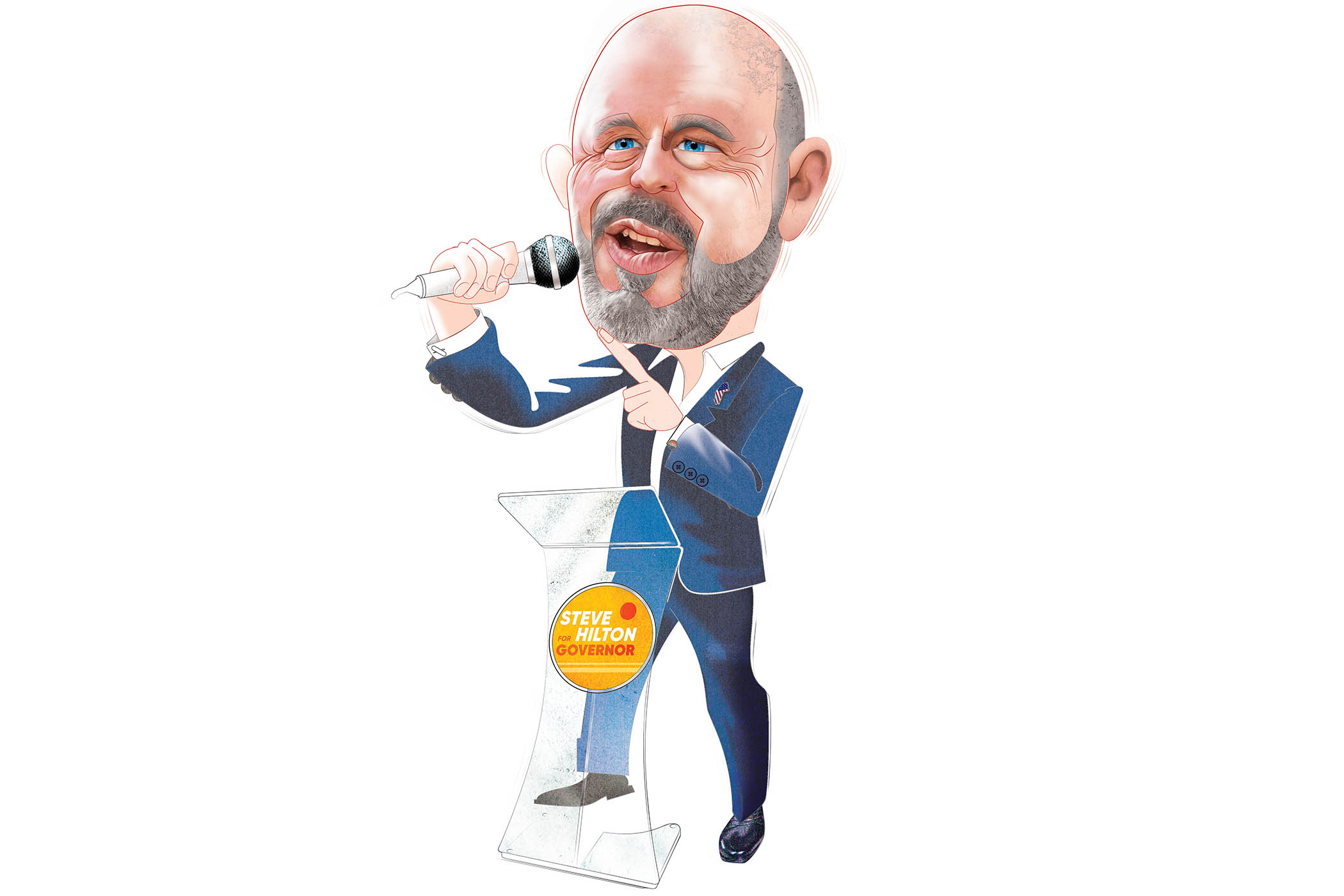

Before his Downing Street days as David Cameron’s director of strategy, Steve Hilton made a couple of unsuccessful attempts to run for the Tory safe seats of Wealden and Surrey Heath. The failure to get past local constituency selection boards obviously didn’t limit the scale of his ambition: he is now the leading candidate to become the next governor of California, the fourth largest economy in the world, in November’s election. He is aiming to succeed Gavin Newsom, the powerful Democrat (will he run for president in 2028?) who was first elected in 2018, replacing the state’s longest-serving governor, Jerry Brown.
The journey from maverick Conservative sidekick, known for wearing shorts to work and wandering around in socks, to an American Republican party politician in a well-cut jacket is only one of the striking transformations that Hilton, now 56 and an American citizen since 2021, has undergone. When he was Cameron’s blue-sky thinker-in-chief, he emphasised environmental concerns – he had once voted Green, and set up the company Good Business to foster corporate social responsibility. Now he wants to maximise California’s gas and oil production.
Credited as being the brains behind Cameron’s “hug a hoodie” campaign that called for empathy for young offenders, he has become a favourite of Donald Trump, known, among other things, for his rather more draconian approach to law and order.
So is he a Maga stalwart or just an unconventional conservative? Does he retain the social idealism of his shoeless days or has his heterodox radicalism hardened into something more sinister and ruthless?
In April Trump surprised many people, including Hilton himself, by backing his candidature. “Steve Hilton has my COMPLETE & TOTAL ENDORSEMENT. He will be a GREAT Governor and, importantly, WILL NEVER LET YOU DOWN!!!,” he wrote on Truth Social.
But it wasn’t an endorsement that necessarily did the chosen candidate any favours. Hilton’s best chance in the state’s open primary is if the two Republican candidates come top in the first round, because he would be favourite to win the all-Republican runoff. Going head-to-head with a Democrat — in a famously Democratic state — would be an altogether more daunting prospect.
While Hilton still leads in the aggregate polls, his fellow Republican, Chad Bianco, is now in fourth place, behind two Democrats (there are five main Democrat candidates). Many of Hilton’s old friends and colleagues in the UK remain baffled by the relationship with Trump, but as one says, it’s real and mutual.
“He genuinely likes Trump and sees him as a kindred spirit,” says one British friend — who was happy to speak but unwilling to be named. “Steve is very funny and he thinks Trump is too. And they both have this anarchic approach to the establishment.” Jokes aside, though, it would be a daunting challenge, even for someone of Hilton’s imaginative intellect, to reconcile hoodie-hugging with ICE raids and protestor shootings.
“Steve would be tough on immigration,” says another old friend, “but I can’t for a moment believe he would support ICE agents storming houses. He’s the child of immigrants.” This is perhaps naive, as there are many among Trump’s entourage who have immigrant heritage. Hilton’s parents fled Hungary during the revolution of 1956, changing the family name from Hircsák to Hilton. His father, István, had played ice hockey for the Hungarian national side and worked as a builder in the UK. The parents split when Hilton was five, leaving his mother to depend on state benefits. He eventually went to Christ’s Hospital school in West Sussex before going on to Oxford.
Those who know him say his parents’ experience of communism endowed Hilton with a powerful belief in personal liberty and an abiding sympathy for the poor and powerless. Giles Gibbons, with whom he co-founded Good Business, believes there is a continuum between Hilton’s early more altruistic outlook and the Trump-supporting populism of today, if only in analytical approach. “The way he has run his campaign from day one was to use his policy background to understand what the problems were and try to find ways to fix them,” says Gibbons.
Newsletters
Choose the newsletters you want to receive
View more
For information about how The Observer protects your data, read our Privacy Policy
Hilton has concluded the biggest issue facing Californians is the cost of living. As he repeatedly points out, despite the state’s apparent wealth, California ranks alongside Louisiana as the state with the highest poverty rate. To that end he has coined a new word “Califordable”. It sounds like something that might have emerged from a brainstorming session between Alan Partridge and David Brent, but Hilton is getting plenty of mileage out of it.
He has been helped by several factors, chief of which has been the disappointing performance of the Democrats in power in California – that leading Democrat, Eric Swalwell, had to quit the race amid allegations of sexual misconduct hasn’t helped matters. Aside from glaring issues of homelessness and street crime, California also ranks near the top of the unemployment rankings.
Exactly how his promise to remove restrictions on buying guns (currently limited to three a month) will help reduce violent crime is not clear. But his overall argument is that good liberal intentions have led to bad unintended consequences, stifling entrepreneurship and creating cycles of poverty. Tightened regulations on housebuilding, he argues, have added to the cost and demand for homes. He aims to freeze regulations for five years.
His key policy, however, is to eliminate state income tax for everyone earning below $100,000. Critics have pointed out that schools, roads and Medi-Cal (the state public health insurance programme) will all suffer.
The interface of innovative ideas and political reality has always been a volatile area in Hilton’s working life. When he was in Downing Street he gained a reputation for presenting dramatically new solutions to longstanding problems, only to be curtailed, in his view, by risk-averse civil servants. Almost invariably the thwarting of his plans would trigger one of Hilton’s renowned temper tantrums.
“There were quite a lot of stormy moments,” recalls one insider, who wasn’t sure if Hilton was thinking outside of the box or was simply out of his box. “He drove George [Osborne] a bit bananas.”
Writing during the Brexit campaign, Andy Coulson, Cameron’s director of communications, recalled how “Hilton Airways set a course for La-La-Land with policies that promised, in an instant, to make us happier, more powerful and altogether cooler citizens… against the backdrop of historic budget cuts”. Coulson complained that Hilton had no idea how these policies would be implemented. These revelations were prompted by Hilton’s pro-Brexit stance. He left Downing Street in 2012, having called for further welfare cuts, and moved that same year to California, where his wife, Rachel Whetstone, had been promoted to lead Google’s public relations team. Hilton co-founded Crowdpac, a tech startup, from which he resigned in 2018.
From 2017 to 2023 he hosted The Next Revolution, a Fox News current affairs show. His friends believe that his political ambition sharpened during the Brexit debate, when he returned to the UK to campaign against his former boss Cameron’s remain position, igniting a lasting enmity.
“There was a massive falling out that revealed these deep-seated class dynamics,” says one friend. “The poshos all expected Steve and Michael Gove to toe the line. That was the moment that increased his sense of outsiderness and his determination to be a disruptive force. It was also when he went front of house. And it turned out he was rather good at it.”
In this more public endeavour he is supported behind the scenes by Whetstone. A former adviser to Michael Howard, she is rated by one former Downing Street insider as “a very significant political figure”. Another who has seen her in action says she is “the best corporate communicator I’ve ever come across”. She and Hilton have two teenaged sons and live in Atherton, an upmarket suburb in the Bay Area.
Whether the power-couple combination, and Trump’s double-edged support, will prove enough to get Hilton over the line is an open question. California may face obvious problems but the Democratic party machine is still a formidable operation, with registered members outnumbering their Republican counterparts by almost two to one.
F Scott Fitzgerald claimed that there are no second acts in American lives. Hilton, who betrays some of the bold self-invention of a fictional character, seems eager to join the long list of comeback kings who have proven that observation so very wrong.
Illustration Andy Bunday