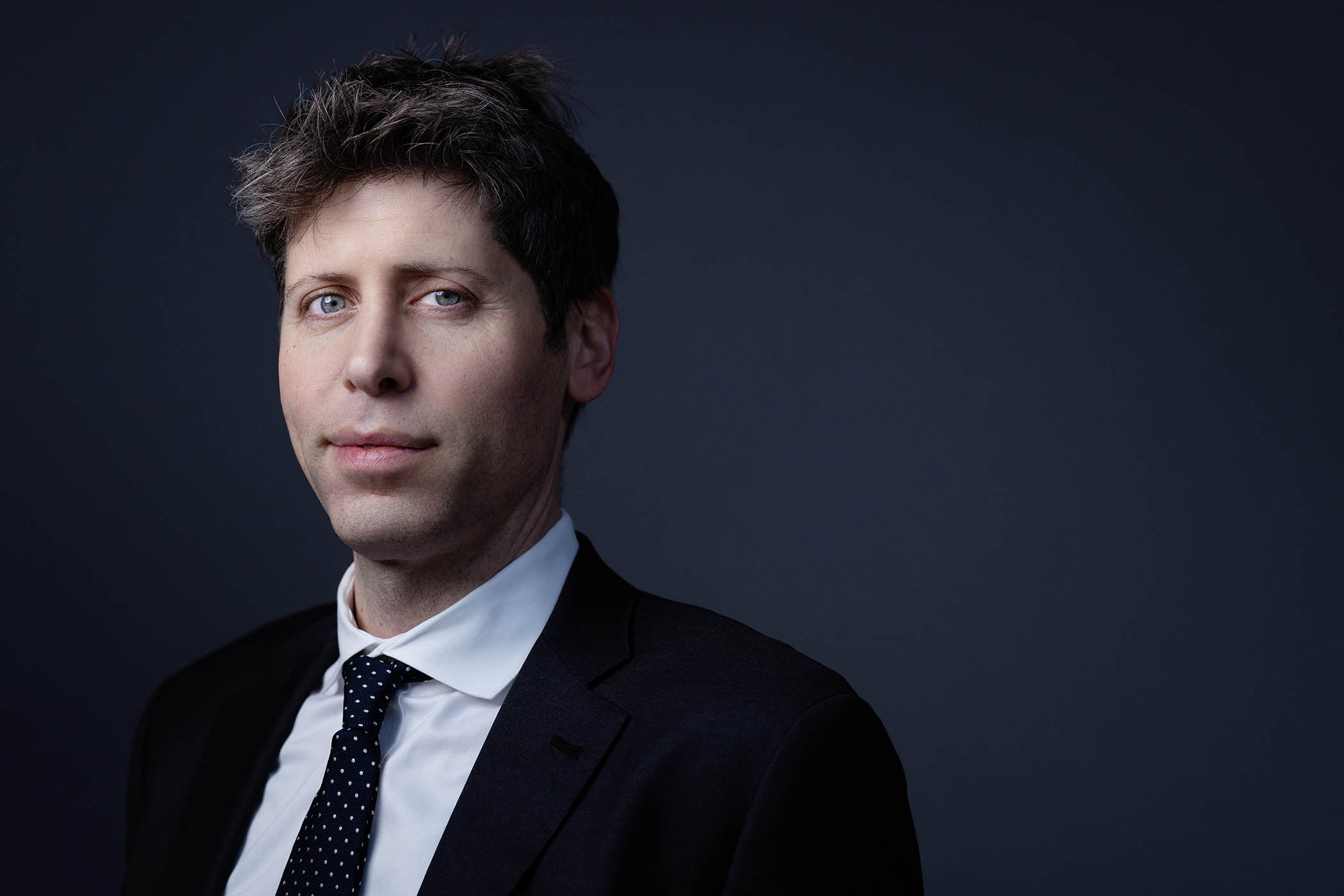
Last autumn, I sat in a community arts building in a pocket of north London, among young creatives sipping negronis, and watched Sam Altman get fired. Or rather, a version of him did. In Doomers, Matthew Gasda’s brisk, funny play about the days surrounding Altman’s ousting from OpenAI in 2023, the CEO becomes “Seth”: a man pacing a war room, evangelising late-stage capitalism, ordering bubble tea to stage, sparring with ethicists and radiating the jittery charisma of both a prophet and a fraud. The play was written almost as quickly as the news cycle itself: Gasda interviewed AI workers and even credited chatbots as his fellow dramaturgs. ChatGPT was his source material and collaborator.
I thought about Doomers again this week while reading a sprawling new investigation into Altman by Ronan Farrow and Andrew Marantz in the New Yorker, which reconstructs the same strange interregnum. Its more novelistic details read like the play. The real Altman also paused each evening to distribute negronis in his “war room”, telling colleagues: “You need to chill.” The coincidence feels too perfect – as though the play had somehow leaked back into life.
Altman’s brief firing and rapid reinstatement has, in the months since, generated many creative responses. Luca Guadagnino is directing Artificial, a film about the episode, starring Andrew Garfield as Altman. The documentary Deepfaking Sam Altman goes further, conjuring an AIsimulacrum of him to interrogate. Each of these works claims, in its own way, to explain Altman. But collectively, they reveal something more interesting: the speed and eagerness with which he is being turned into a character.
In these retellings, Altman is both a manager of a large and complicated company and a romantic figure from literary history: he is Faust, bargaining for forbidden knowledge; Victor Frankenstein, animating a creation he cannot control; or J. Robert Oppenheimer, the haunted father of nuclear weapons. Gasda himself has been explicit about this lineage, describing Altman and the AI field as a story that Goethe or Isaac Newton would recognise. They share the uneasy feeling that enlightenment carries within it the seeds of catastrophe.
There is something irresistible about this framing. Artificial intelligence is both abstract and technical, which makes it often incomprehensible to many normal people. To render it dramatically legible, we reach for archetypes and personalities. The story becomes about a dystopia and a dictator, one man’s hubris and our possible downfall. It is a way of shrinking a terrifying and incomprehensible system. But what do we learn about Altman from this impulse to dramatise him? Perhaps more about ourselves than we might like.
The cultural mythologisation of Altman is about our anxiety. AI seems like a threshold technology, the kind that reorganises society in ways that are hard to predict and harder to govern. In such moments, we have to look for protagonists. We want the story to have a face and a centre of gravity. It is easier to fear, or admire, a person than a system.
There is a long tradition of doing exactly this. The Industrial Revolution produced its own gallery of titans and monsters, the atomic age gave us Oppenheimer, retrospectively cast as both Prometheus and penitent. In each case, the individual stands in for a sprawling network of institutions, incentives, systems and accidents. The story sharpens our understanding of the scary thing but it also distorts it.
The Farrow and Marantz investigation lays bare Altman’s emerging mythology even as it feeds it. He emerges as a singular evil-genius-engineer but also as something closer to a virtuoso persuader: “the greatest pitchman of his generation”, a figure capable of bending reality through sheer conviction. Former colleagues describe a “reality-distortion field”, a phrase borrowed from Steve Jobs, in which ambition and accomplishment blur. He is a liar, they show us, but a very good one.
It’s worth asking how much of his mythos Altman is actively shaping. Founders, particularly in Silicon Valley, have long understood the value of narrative. Elizabeth Holmes of Theranos consciously modelled herself on Jobs, down to the black turtlenecks and the rhetoric of world-changing innovation. The result was a kind of immersive theatre, in which investors, employees, and complimentary journalists all played their parts in corporate fraud. Altman’s case is obviously different in scale and substance, but the underlying dynamic, this blurring between aspiration and reality, is familiar.
What’s striking about the Altman moment is how quickly this process is unfolding. Myth is being manufactured in real time, alongside the events it seeks to explain. This simultaneity produces a strange feedback loop. The more Altman is depicted as a dramatic figure, the more his real-world actions are interpreted through that lens. The dramatisations are examples of this loop – they are engines of his myth-making as much as reflections of it.
The urge to cast Altman as Faust or Frankenstein risks obscuring the less glamorous, more structural realities of AI development. Our governments who fund it, the investors who shape it, the technical uncertainties, the effect on the climate. We need to hold it all to account, and resist replacing a messy, collective process with a singular, legible dramatic person. So many people and systems have given Altman the keys to our future. It’s harder to turn them into characters and harder still to hold them responsible too.
Photograph by Joel Saget/ AFP via Getty Images
Newsletters
Choose the newsletters you want to receive
View more
For information about how The Observer protects your data, read our Privacy Policy