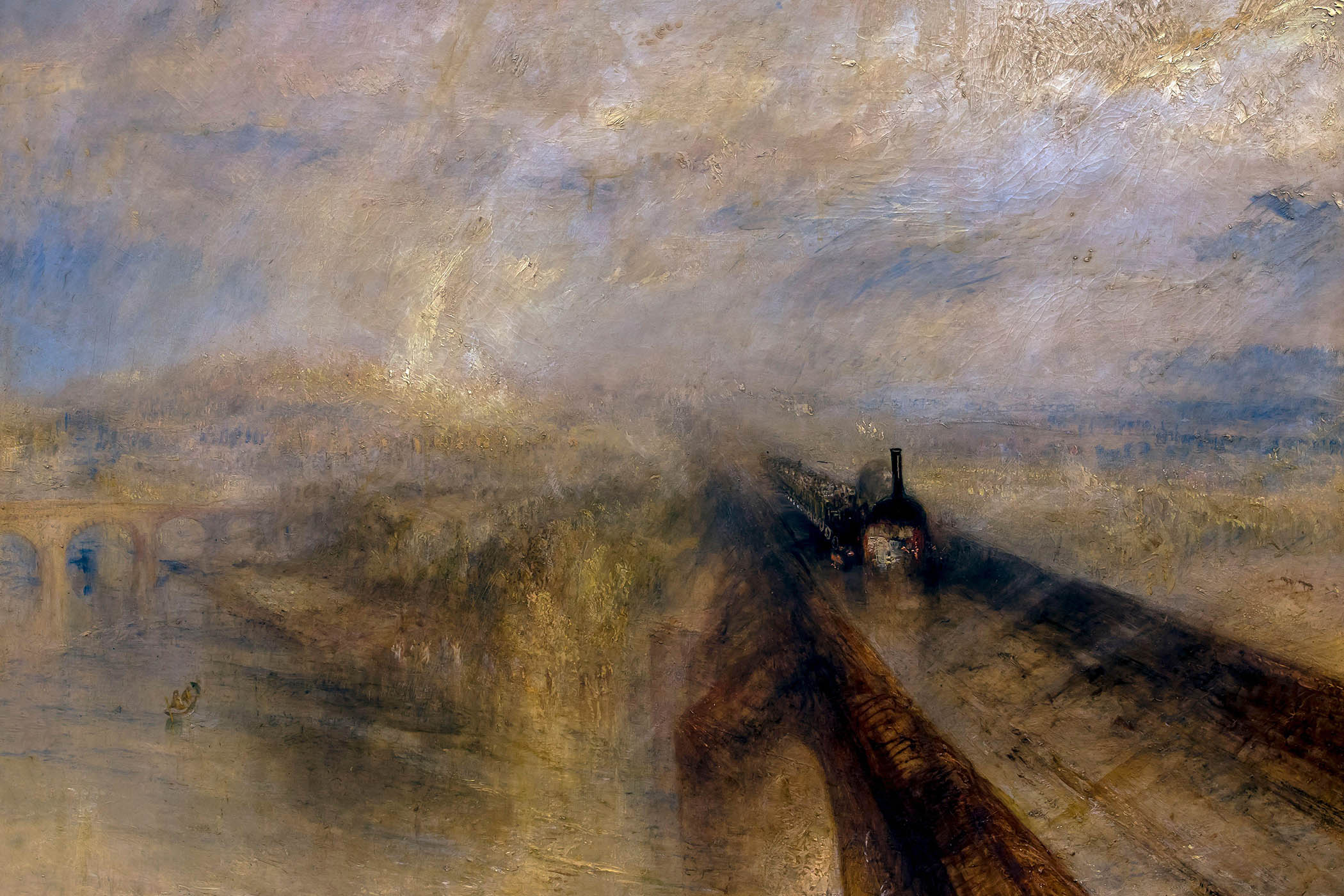



I’m staring at JMW Turner’s Rain, Steam, and Speed – The Great Western Railway, a painting he did in 1844 of a section of the line at the Maidenhead railway bridge. It’s a classic Turner landscape obscured by swirling clouds, wisps of steam and rain. Nothing is clear except the funnel of an oncoming steam train and the walls of the viaduct, built by Isambard Kingdom Brunel, which Turner has exaggeratedly foreshortened, leading our eyes to follow it back to the fuzzy horizon. Everything else in the picture is a misty haze.
Pondering the picture, I began to wonder if what I was looking at was a visual metaphor for our current plight. We’re in the middle of a traumatic phase transition – from a disintegrating socioeconomic order into a future that is unknowable and could conceivably be dystopian. Lots of things that we once regarded as unthinkable are happening on a daily basis. Assumptions that we used to regard as solid bases on which to plan for the future are evaporating like melting snow.
Take, for example, the belief that children would have better lives than their parents had. Or that a university degree was a ticket to employment. Or that young people who worked hard would be able to own a place of their own. Or that democratic politicians who took bribes and kickbacks would be shamed into resignation once their transgressions were exposed.
In the middle of this chaos, however, one certainty seems to have gripped our ruling elites: that AI is the future. It’s the modern counterpart for the steam locomotive in Turner’s picture. And – according to the dominant narrative everywhere – it’s coming for us all.
The National Gallery commentary on the painting reveals that Turner had lightly brushed in a running hare roughly midway along the rail track to represent the speed of the natural world in contrast to the mechanised speed of the engine. (The animal is now invisible, as the paint has become transparent with age, but the gallery explains that it can be seen in an 1859 engraving of the painting.)
So, metaphorically speaking, that frightened hare is us humans.
Likewise, the misty haze is also doing heavy symbolic lifting. Turner wasn’t painting imprecisely; he was making a claim about how modernity feels from inside it. The traditional landscape (the Thames Valley, the old bridge visible to the left, the hare running in the foreground) isn’t simply replaced; it’s made visually uncertain by the new technological force cutting remorselessly through it.
Then there’s the fact that we don’t see where the train is going, just that it’s coming towards us – which means we’re on the track. The painting puts the viewer in the position of someone who cannot get out of the way and cannot see around the engine. That’s a very different visual argument from, say, a train seen from the side or the rear.
The viaduct is also doing some interesting work. At the time it was built, in 1838, the Maidenhead viaduct had the widest, flattest brick arches in the world – an engineering marvel that many thought would collapse. So even that part of the painting carries the sense of untested infrastructure being relied upon by the new technology. For me, the really delightful aspect of that lies in the analogy to current AI deployment; in which the “track” (datacentres stuffed with Nvidia chips and other infrastructure) is being laid while the train is already running!
Metaphors are cognitive shortcuts that act as mental “bridges” that allow us to carry the understanding we have of a familiar domain and use it to navigate an unfamiliar, abstract one (such as AI). They have their uses and abuses, as I’ve written here before. But I’ve found this particular one helpful in thinking about the technology that is the feedstuff for this column.
Newsletters
Choose the newsletters you want to receive
View more
For information about how The Observer protects your data, read our Privacy Policy
For example, the locomotive in the painting is already there, visible and tangible; its form is legible even if the surroundings aren’t. The interesting thing is that AI is much, much less legible than that. In fact, it’s intrinsically invisible and opaque. All AIs are, in their nature, black boxes. So while Turner shows the oncoming thing clearly, our situation is much more worrying because we can’t quite make out what’s in the engine at all.
And that opacity points to something the Victorians didn’t have to reckon with. When Brunel’s locomotive bore down on Turner that day, the threat – and the promise – was at least visible. You could see the engine, appreciate its mass and power, calculate whether to get off the track. The hare could see what was coming, even if it couldn’t outrun it.
Would that we were that fortunate. What’s bearing down on us now is genuinely “unseeable” – not because of Turner’s atmospheric haze, but because opacity is baked into its architecture. We live, in other words, inside a version of the painting where the locomotive itself has dissolved into the mist. The viaduct is rumbling. Something is coming. We just can’t make out what.
What I’ve been reading
Sovereign states
The Moonshot: Real Sovereign AI Has Never Been Tried is a sobering Substack read from Anton Leicht on what Europe would need to do to achieve AI sovereignty.
Look and learn
Eminent lawyer Lawrence Lessig reveals how to teach Meta a lesson in Let’s Create the “Wynn-Williams Effect”.
Writing class
Three Lessons on Writing from Joan Didion’s Notes is an interesting Substack piece by Jillian Hess, who’s been in the late author’s archives.
Painting Rain, Steam, Speed, Great, Western, Railway, by JMW, Turner, 1844 via Alamy