
The plan as far as Liverpool are concerned has never changed. That should not be a surprise. For a decade and a half, the club’s modern identity has been built around the rational and the logical, favouring facts over feelings. Their powerbrokers – on Merseyside and in Massachusetts – regard themselves as men of science. Emotion is best left to children.
Even as this season has lurched from one bitter disappointment to another, the message from inside Liverpool has been consistent. Arne Slot has not become a bad manager overnight. He remains the unheralded coach who walked into the Premier League and, after a summer in which he signed just one player, won it at the first attempt.
They have not wavered in that belief, even as Liverpool’s title defence crumbled before Christmas, even as the prospect of missing out on qualification for next year’s Champions League grew ever larger, even as the rumblings of discontent started to roll around Anfield.
Slot, they know, has not been flawless, but there have been mitigating circumstances, too: an unbalanced squad, a disrupted pre-season, a suite of injuries. These are short-term issues. They are big-picture guys. Under the aegis of Fenway Sports Group, Liverpool have become a process-driven club, and that process remains in place.
And so as things stand, Liverpool’s intention is to start next season with Slot standing in the dugout, boasting a suite of new players – the second phase of the retooling of the squad that began at considerable expense last summer – and a point to prove. These intentions, in their own way, are quite admirable. This kind of loyalty, this kind of conviction is vanishingly rare in football.
The problem, of course, is the one that was best encapsulated by Mike Tyson in his treatise on the interrelation of theory and reality. Liverpool’s plan is all well and good. Their track record over the past decade might warrant no small degree of trust and respect. But that is how everyone thinks until they are, in Tyson’s words, punched in the mouth.
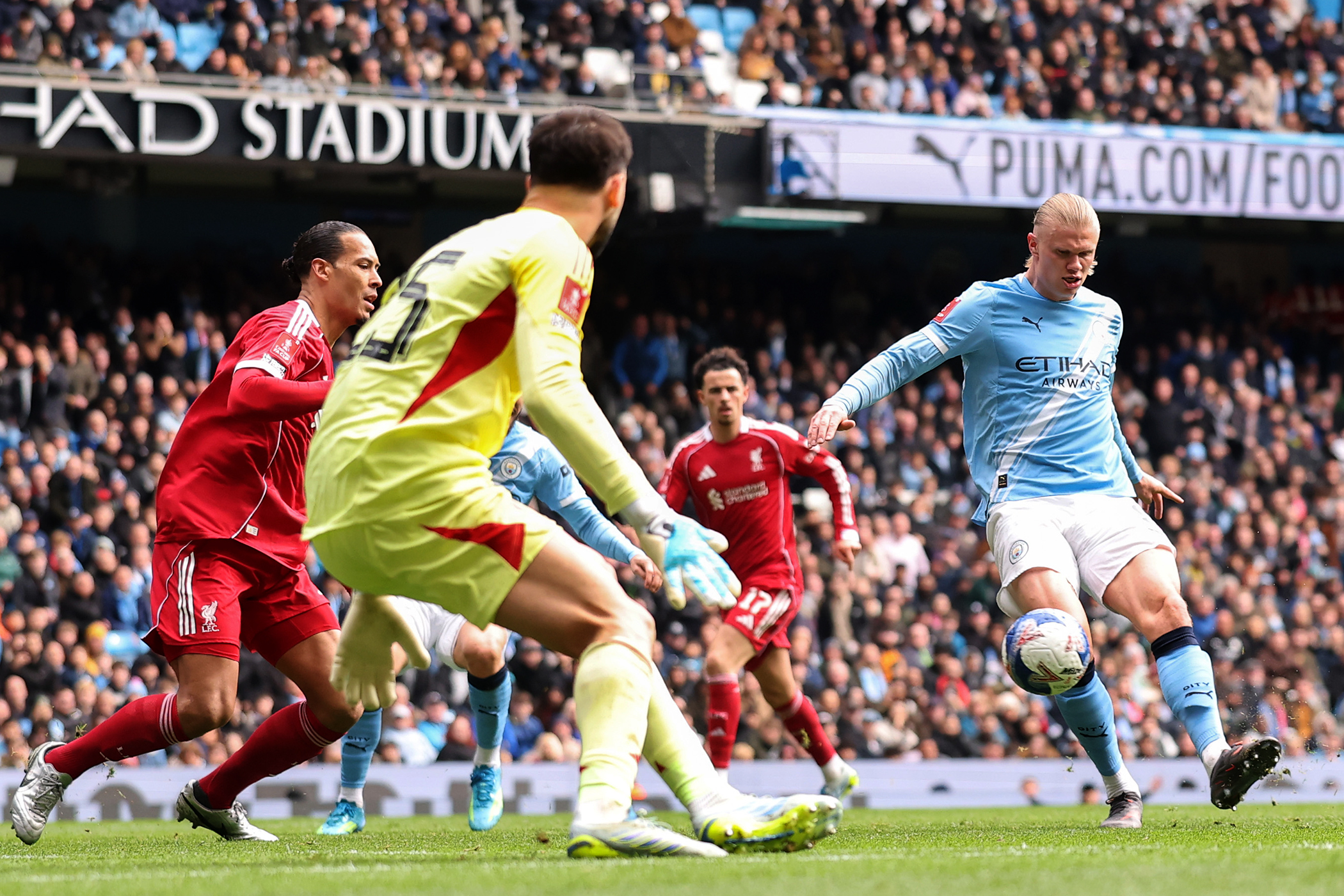
That, of course, is precisely what happened at the Etihad Stadium yesterday. A victory against Manchester City in their FA Cup quarter-final would have been a considerable fillip for Slot, for Liverpool: a chance to hold on to the prospect of silverware this season for a little while longer, a green shoot of recovery after a long, hard winter.
Even a narrow defeat – the sort that comes with handshakes and pats on the back and no small degree of credit – might not have wrought any particular damage. City, after all, have just won the Carabao Cup; Pep Guardiola’s team are starting to bristle with the sort of menace that might even unnerve Arsenal, nine points ahead of them in the Premier League table, though City have a game in hand.
Instead, Liverpool were humiliated. More pernicious still, they were humiliated in a painfully familiar way: Slot’s team played perfectly well for 38 minutes, creating a handful of chances and, perhaps, carrying just a little more menace than their hosts. Then Virgil van Dijk conceded a needless penalty, and Liverpool fell apart. Within 25 more minutes on the pitch – excluding half-time – City led by four goals, and the game was over. The last half an hour, Slot admitted, was played out by two teams who had “accepted it was 4-0”.
That admission in and of itself is pretty damning, but even that was not the greatest indignity of the afternoon. Michael Oliver, the referee, called time on the game after 90 minutes and four seconds, a gesture that might be thought of as the Pity Whistle; he did not want Liverpool to have to suffer any more than was strictly necessary. Worse still, when Slot and his players glanced up at the away section, next to the scoreboard outlining the scale of their defeat, they would have seen rows of empty seats. Liverpool’s 8,000 travelling fans had started dispersing after less than an hour.
There is a decent chance that, within 10 days, Liverpool’s hopes of silverware will have evaporated
There is a decent chance that, within 10 days, Liverpool’s hopes of silverware will have evaporated
Liverpool’s powerbrokers might regard it as beneath them, but football cannot entirely be stripped of emotion. It is a game that rests on spirit and sentimentality as much as science. How something feels is important: the fact that Liverpool are out of the FA Cup does not matter nearly as much as the manner in which they were eliminated.
The risk now is that the blows will keep coming. Slot has four days to prepare his team, drained of confidence and form and self-belief, for a Champions League quarter-final with Paris Saint-Germain. A week after that, the European champions come to Anfield. There is a decent chance that, in 10 days’ time, Liverpool’s hopes of silverware this season will have evaporated. Their remaining games in the Premier League are unappealing enough that it may be their last Champions League experience for some time.
Should that prove to be the case, it would be pure, uncut obstinacy not to change the equation around Slot’s future. The underlying data might still be the same; the mitigating factors would still apply. But the feeling would be completely different, the goodwill generated by that Premier League title victory burned through comprehensively.
And the feeling, even at a club as cool and rational as Liverpool, matters. It can have shape and form and weight. Liverpool’s intentions, without doubt, are good. More clubs should want to stand by their managers, as much as they can. But it is worth remembering at times exactly where a road paved with such things tends to lead.
Photograph by Carl Recine/Getty Images
Newsletters
Choose the newsletters you want to receive
View more
For information about how The Observer protects your data, read our Privacy Policy