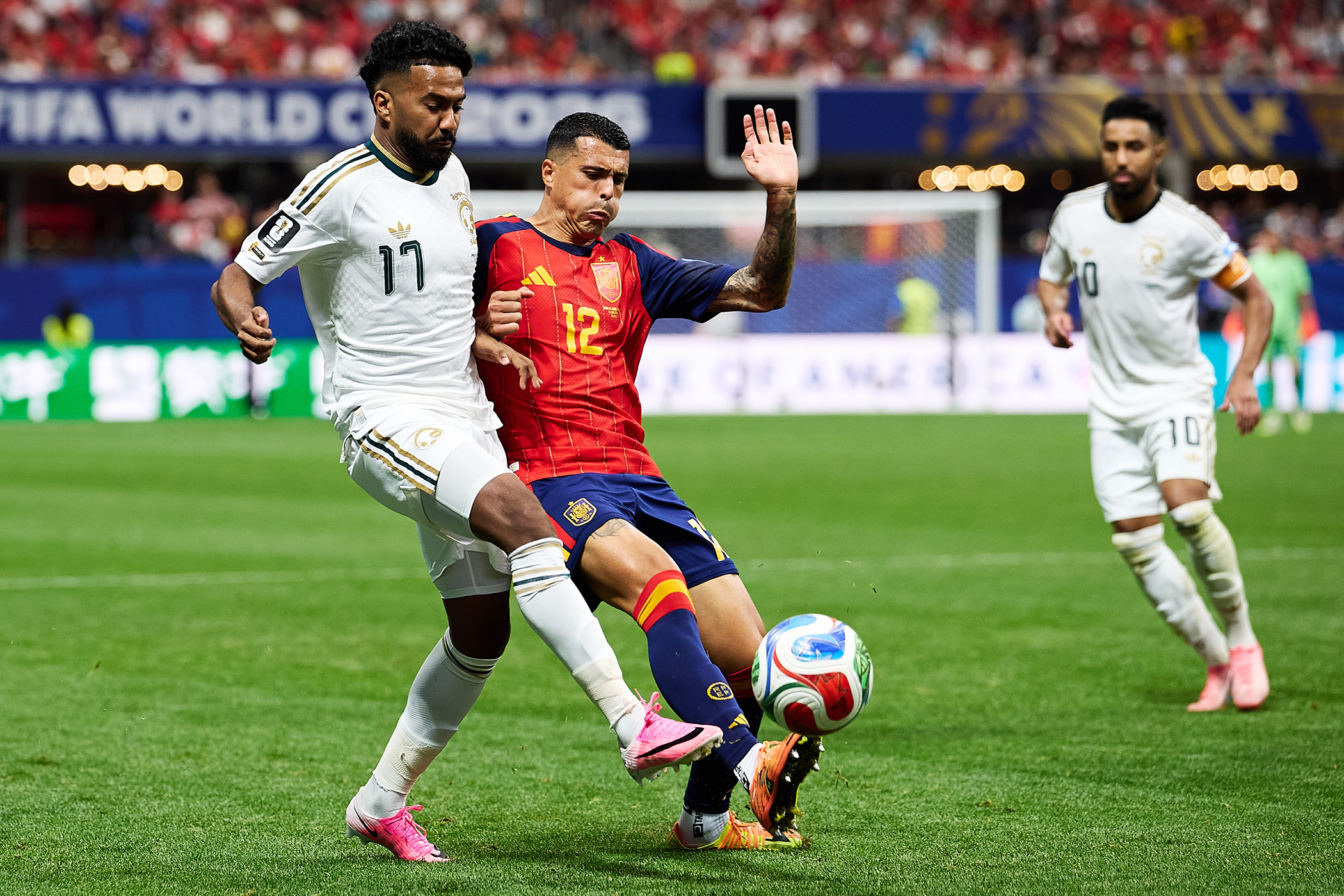
Won’t somebody think of the oil-soaked autocracies, the dictators doing it for themselves? For all the novel joy of Curaçao selecting a squad featuring 25 players born in the Netherlands, what about the footballing nations with no ability to pan for European football’s excess gold? Of Saudi Arabia and Qatar’s 26-man World Cup squads, both comprise 25 players based in their domestic leagues – the most at the tournament (England are third with 21) – with only Lens’s Saud Abdulhamid and Cultural Leonesa’s Homam Ahmed the respective exceptions. But while the Qatari corps is propped up by various naturalised South American and African-born players, every Saudi player was born in Saudi Arabia, a last bastion of footballing isolationism in a globalised game.
This might not be romantic, might not involve any ignored LinkedIn messages, but it is interesting. Saudi Arabia are the clearest example of how difficult it is to manufacture an elite domestic footballing structure from a standing start, to construct the requisite culture of professionalism and skill. It is now three years since Saudi Arabia’s Public Investment Fund (PIF) bought majority stakes in the Saudi Pro League’s four biggest clubs, ossifying a financial and reputational revolution launched by Cristiano Ronaldo’s signing less than six months earlier.
In April, the PIF sold its share in Al-Hilal to a firm run by a billionaire Saudi royal, valuing the club at £275m, about the same as Wolves. After a 4-0 slapping by Spain, the Saudi national team head coach Georgios Donis – he of 21 Premier League games alongside Tim Sherwood for Blackburn – said “the more competitive the [Saudi Pro League], the better our players will be”. Yet this doesn’t hold up. Their starting goalkeeper Mohammed Al-Owais had to join second division side Al-Ula ahead of the 2024-25 season in pursuit of minutes, forced out by Al-Hilal signing Yassine Bounou, a Moroccan. Hamed Al-Shanqiti, the most promising Saudi keeper at 21, has played five senior matches ever. Talal Haji, a forward who became the youngest player ever to play in the Asian Cup two years ago, is now 18 and played 187 minutes for top-flight strugglers Al-Riyadh last season. Of the 32 top scorers in last season’s Saudi Pro League, only two are Saudi, Al-Ettifaq’s Khalid Al-Ghannam and national team captain Salem Al-Dawsari. There is little short-term sign that artificially elevating the level of their domestic structure is correlating to a similar rise in the quality of Saudi players.
This is because the fundamental tenet of creating an elite national team is not better clubs but better academies - the latter often follows the former, but not necessarily. This is how this has become the diaspora World Cup, via the volume of players now pumped through European academies – it’s not just 98 players were born in France, or 67 in the Netherlands, but that those players were raised and forged through their footballing systems.
This brings us to Uzbekistan, bottom of Group K and unlikely to change that, but also the first Central Asian team to qualify for a World Cup. They have roughly the same population as Saudi Arabia and sit one place above them in the Fifa world rankings. Their own little-autocrat-who-could has invested massively in grassroots football over the past decade – renovating 15,000 school sporting facilities, massively inflating the number of available pitches and academies, and building a new national football centre and stadium. They developed a national playing style and taught it everywhere. This is how they won the 2025 U17 Asian Cup and how they developed their first genuinely elite talent in Abdukodir Khusanov, who stayed in Uzbekistan until he was 17 with Bunyodkor (Rivaldo’s former club). While their league recently came under government control, its strength is irrelevant when the academies are effective.
And so European powers have recently established academies in Saudi Arabia, an attempt to speedrun importing standards and expertise. Liverpool set one up in Riyadh, Inter and AC Milan’s are based in Jeddah, while Paris Saint-Germain and Juventus have several each across major cities. The state-run academy system was launched in July 2020, with a board including José Mourinho, while their Future Falcons academy in Catalonia, run by Michel Salgado, is a development school for under-16 players. It does appear to be working – they lost that 2025 U17 Asian Cup final to Uzbekistan, losing the U20 Asian Cup to Australia the same year.
Most of this is in service of hosting the 2034 World Cup, having pronounced their aim to reach the top 20 of the world rankings by then, a goal which still feels somewhere between unrealistic and fantastical. But in the short term, Saudi Arabia meet Cape Verde in Houston on Saturday morning UK time knowing that victory for either will qualify them for the last 32, two vastly different tales at opposing ends of the cuddly scale, the brutal might of oil money meeting a team essentially developed by accident. And yet both teach us something about how to build a national team and structure in 2026: football as industry versus football as colonial legacy. One bathing in the dregs of the European waterfall, the other learning how to survive in a desert of their design.
Juan Luis Diaz/Quality Sport Images/Getty Images
Newsletters
Choose the newsletters you want to receive
View more
For information about how The Observer protects your data, read our Privacy Policy